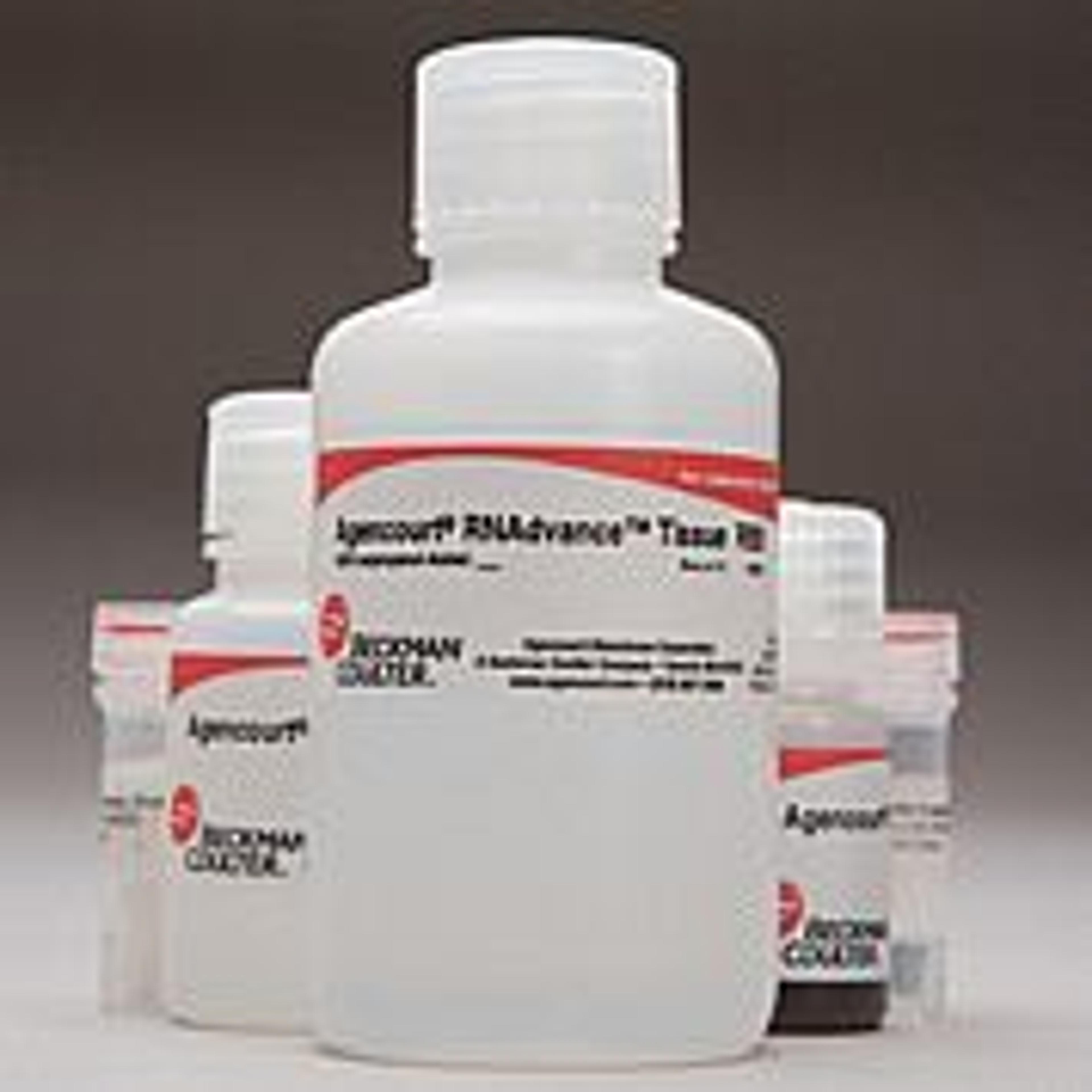
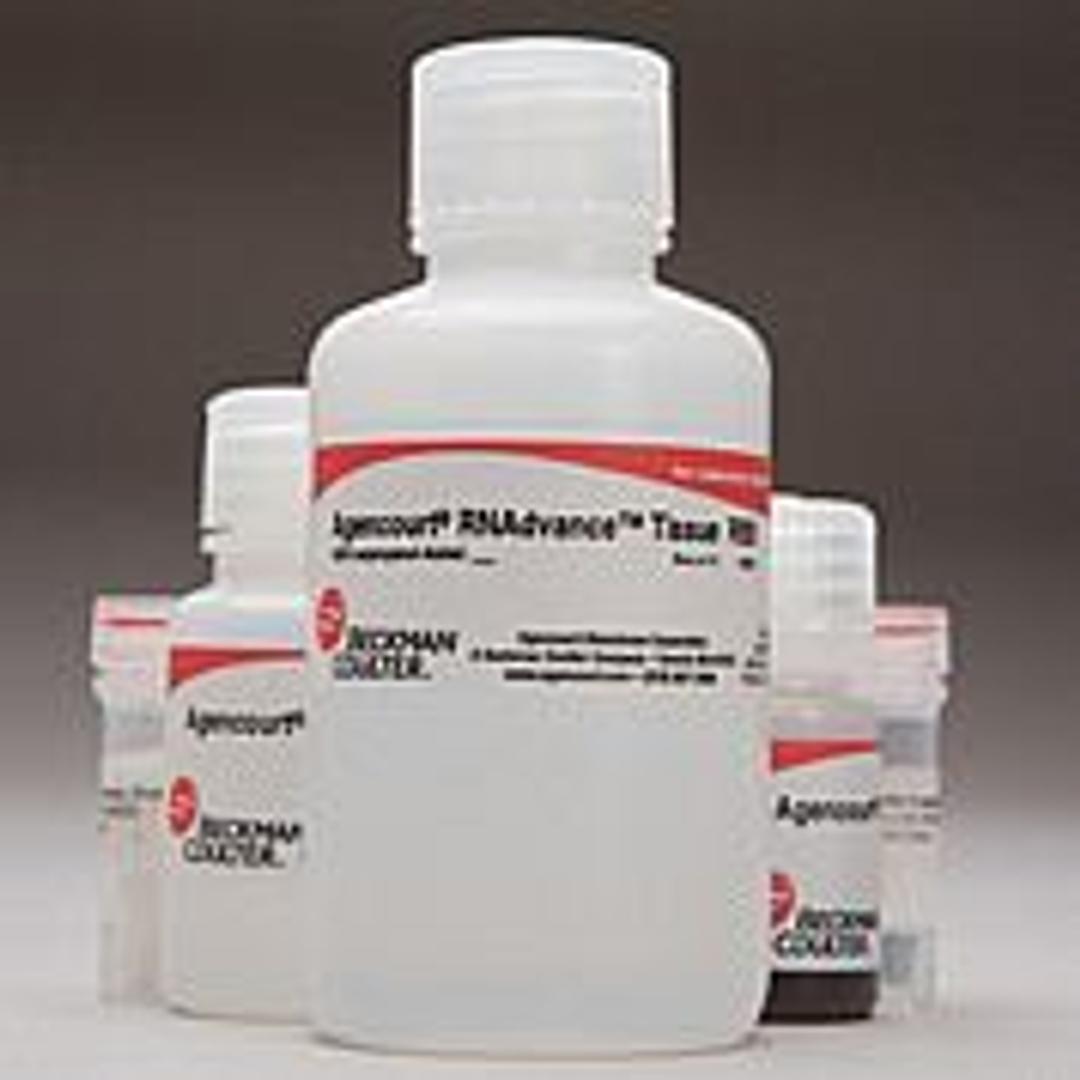
RNAdvance Tissue
The Agencourt RNAdvance Tissue total RNA extraction technology in combination with Beckman Coulter automation offers researchers a true walk away solution for consistent recovery of high quality total RNA in a multi-well format.

The supplier does not provide quotations for this product through SelectScience. You can search for similar products in our Product Directory.
The Agencourt RNAdvance Tissue total RNA extraction technology in combination with Beckman Coulter automation offers researchers a true walk away solution for consistent recovery of high quality total RNA in a multi-well format. Utilizing Solid Phase Reversible Immobilization (SPRI) paramagnetic bead-based technology, the Agencourt RNAdvance Tissue system can extract total RNA from a wide variety of tissues without the hazards and waste removal issues of organic solvents. The Agencourt RNAdvance Tissue system produces high recovery of total RNA from soft, fibrous, and lipid-rich tissues. Isolating total RNA using the Agencourt RNAdvance Tissue protocol results in high yields without the necessity of centrifugation, vacuum filtration or organic solvents.
Features:
- Extraction and purification of high quality total RNA from many tissue types
- Efficient removal of genomic DNA and other contaminants
- No centrifugation or vacuum filtration required
- No organic extraction steps
- Supports automated as well as manual processing
- Ability to process from eight to 96 samples on a Biomek NX Workstation with a Span-8 configuration

High Throughput miRNA Purification from FFPE, Cell and Tissue Samples Using Solid Phase Reverse Immobilization (SPRI) Technology and Biomek FXp Liquid Handler
This poster describes an efficient and robust miRNA extraction method using the Agencourt SPRI (Solid Phase Reverse Immobilization) technology and Biomek automation. Three extraction methodologies described are (1) miRNA extracted and purified from FFPE samples using the Agencourt FormaPure Kit, (2) miRNA extracted and purified from cell culture using the Agencourt RNAdvance Cell v2 kit and (3) miRNA extracted and purified from tissue using the Agencourt RNAdvance Tissue kit.

From Genes to Discovery: How Next-Generation Sequencing Reshapes Cancer Research
Cancer is a leading cause of death worldwide, accounting for nearly 10 million deaths in 2020.1 Prostate cancer ranks as the second-leading cause of cancer-related deaths among American men, surpassed only by lung cancer.2
Join our upcoming webinar featuring Dr. Nallasivam Palanisamy, Henry Ford Health and Zachary Herbert, Dana-Farber Cancer Institute, as they delve into the rapidly escalating role of next-generation sequencing (NGS) in revolutionizing cancer research.
The speakers will examine the pivotal significance of NGS technology in unraveling intricate cancer mysteries. With a focus on prostate cancer, the webinar will highlight transcriptomic signature – a ground-breaking approach to illuminate the genetic nuances underlying cancer disparities, particularly in African American men. The transformative power of transcriptomic analysis will be demonstrated along with insights into the latest advancements and their implication for cancer treatment.
Furthermore, how the automation revolution is reshaping the landscape of cancer research will also be explored. Through pioneering automation techniques, researchers can now manage testing volumes and reduce turnaround times, accelerating the pace of discovery. This innovative approach will be showcased through pilot data displaying the successful application of RNAse1/hybrid capture in a current project.
Dr. Nallasivam Palanisamy is an associate Scientist in the Department of Urology at Henry Ford Health. Palanisamy specializes in prostate cancer, cancer genomics, and molecular cytogenetics/molecular pathology. His research interests are on discovering and characterizing gene fusions in cancer and understanding their role in carcinogenesis from a translational research perspective.
Zachary Herbert is the Director of the Molecular Biology Core Facilities, Lead Scientist at Dana-Farber Cancer Institute, and an Associate Director of the Harvard University Center for AIDS Research Advanced Laboratory Technologies Core. His laboratory primarily focuses on developing and implementing NGS sample preparation, sequencing, and bioinformatics services to advance basic and translational research. He has a BA in Molecular Biology and Biochemistry, a Master’s in Biotechnology, and 20 years of experience running a high-throughput genomics facility.
Ferlay J, Ervik M, Lam F, Colombet M, Mery L, Piñeros M, et al. Global Cancer Observatory: Cancer Today. Lyon: International Agency for Research on Cancer; 2020. Available from URL: https://gco.iarc.fr/today?
American Cancer Society.?Facts & Figures 2023. American Cancer Society. Atlanta, Ga. 2023. Available from URL: https://www.cancer.org/cancer/types/prostate-cancer/about/key-statistics.html??
Key learning objectives
- Explore effective FFPE RNA utilization in NGS for cancer research
- Learn more about the identification of key genes driving aggressive prostate cancer in African Americans, aiding racial disparity workflow understanding
- Discover NGS workflow automation’s role in accelerating tumor biology insights
Who should attend?
- Academia
- Government research
- Contract research organic
- Hospitals
- Clinical
- Pharma
- Biotechnology
- Medical centers
Certificate of attendance
All webinar participants can request a certificate of attendance, including a learning outcomes summary, for continuing education purposes.
miRNA Enrichment and RNA Size Selection Using SPRI Paramagnetic Bead Technology
This presentation describes a flexible method for miRNA enrichment and RNA size selection using solid phase reversible immunobilization (SPRI) paramagnetic bead technology.