Amino Acids
Free and Protected Amino Acids

The supplier does not provide quotations for this product through SelectScience. You can search for similar products in our Product Directory.
CIL offers a broad and diverse array of unlabeled and stable isotope-labeled amino acids. These include free and protected amino acids (for both canonical and noncanonical) as well as mixes and methyl labeling kits. The amino acids are available for different grade material (e.g., research, microbiological and pyrogen tested), with the labeling accessible for different isotopic enrichments and patterns. Applications are directed to proteomic (e.g., free amino acids for metabolic or chemical incorporation, protected amino acids or preloaded resins for solid phase peptide synthesis), metabolomic (e.g., free amino acids for quantitation), metabolism (e.g., free amino acids for isotopic flux analysis) or structural biology studies.
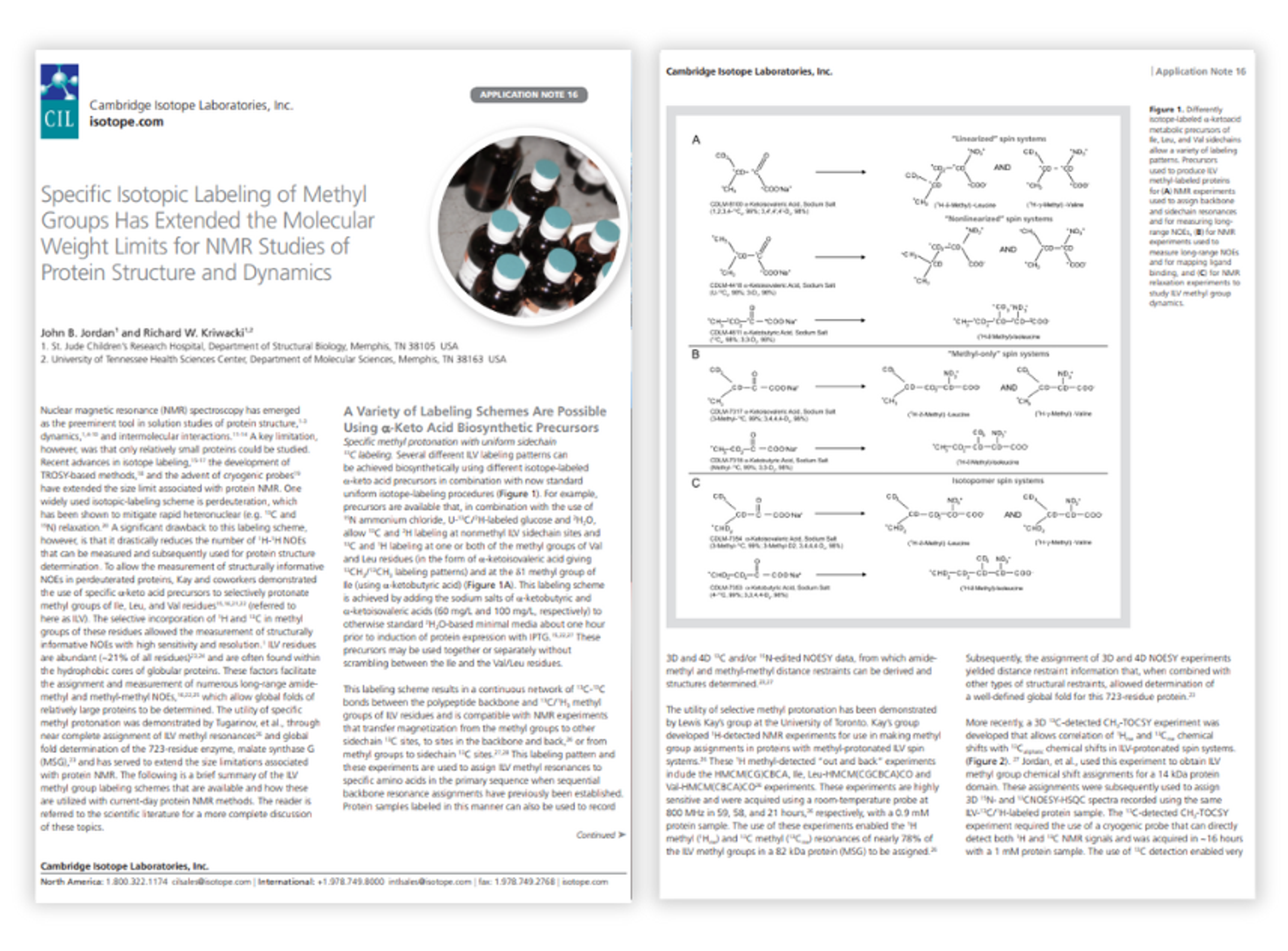
Specific isotopic labeling of methyl groups has extended the molecular weight limits for NMR studies of protein structure and dynamics
Nuclear magnetic resonance (NMR) spectroscopy has emerged as the preeminent tool in solution studies of protein structure, dynamics, and intermolecular interactions. A key limitation, however, was that only relatively small proteins could be studied. In this application note, Cambridge Isotope Laboratories shares a brief summary of the ILV methyl group labeling schemes that are available and how these are utilized with current-day protein NMR methods.
Resource details:
- Resource type: Application note
- Page count: 4
- Read time: 6 mins
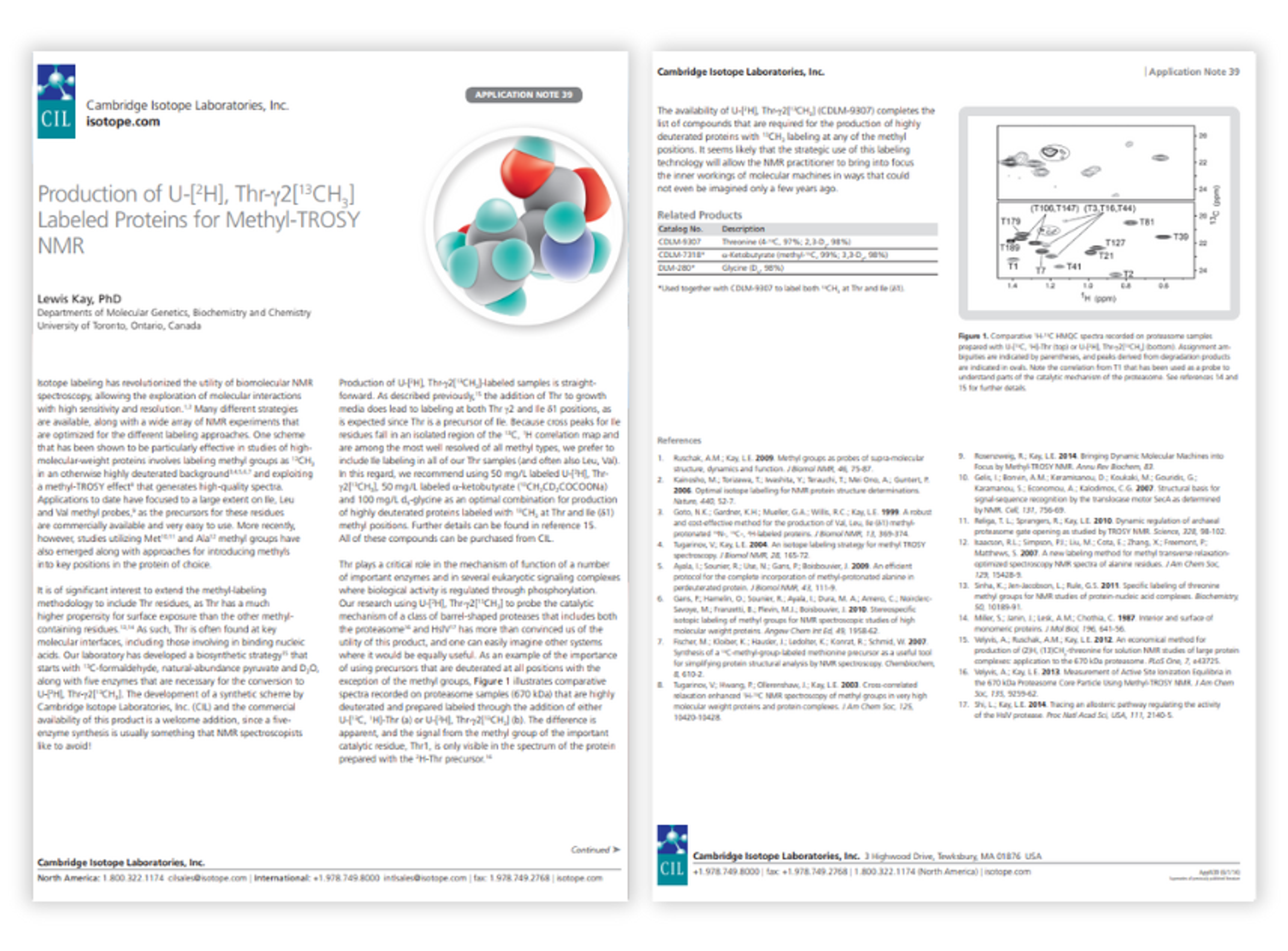
Production of U-[2H], Thyr-γ2[13CH3] labeled proteins for methyl-TROSY NMR
Isotope labelling has revolutionized the use of biomolecular NMR spectroscopy, allowing the exploration of molecular interactions with high sensitivity and resolution. Introducing labelled Thr, a protein often found at molecular interfaces and involved in binding nucleic acids, would allow a deeper understanding of the interactions at these surfaces. In this application note, Cambridge Isotope Laboratories describes a simple biosynthetic strategy that labels these proteins for use in NMR spectroscopy.
Resource details:
- Resource type: Application note
- Page count: 2
- Read time: 3 mins
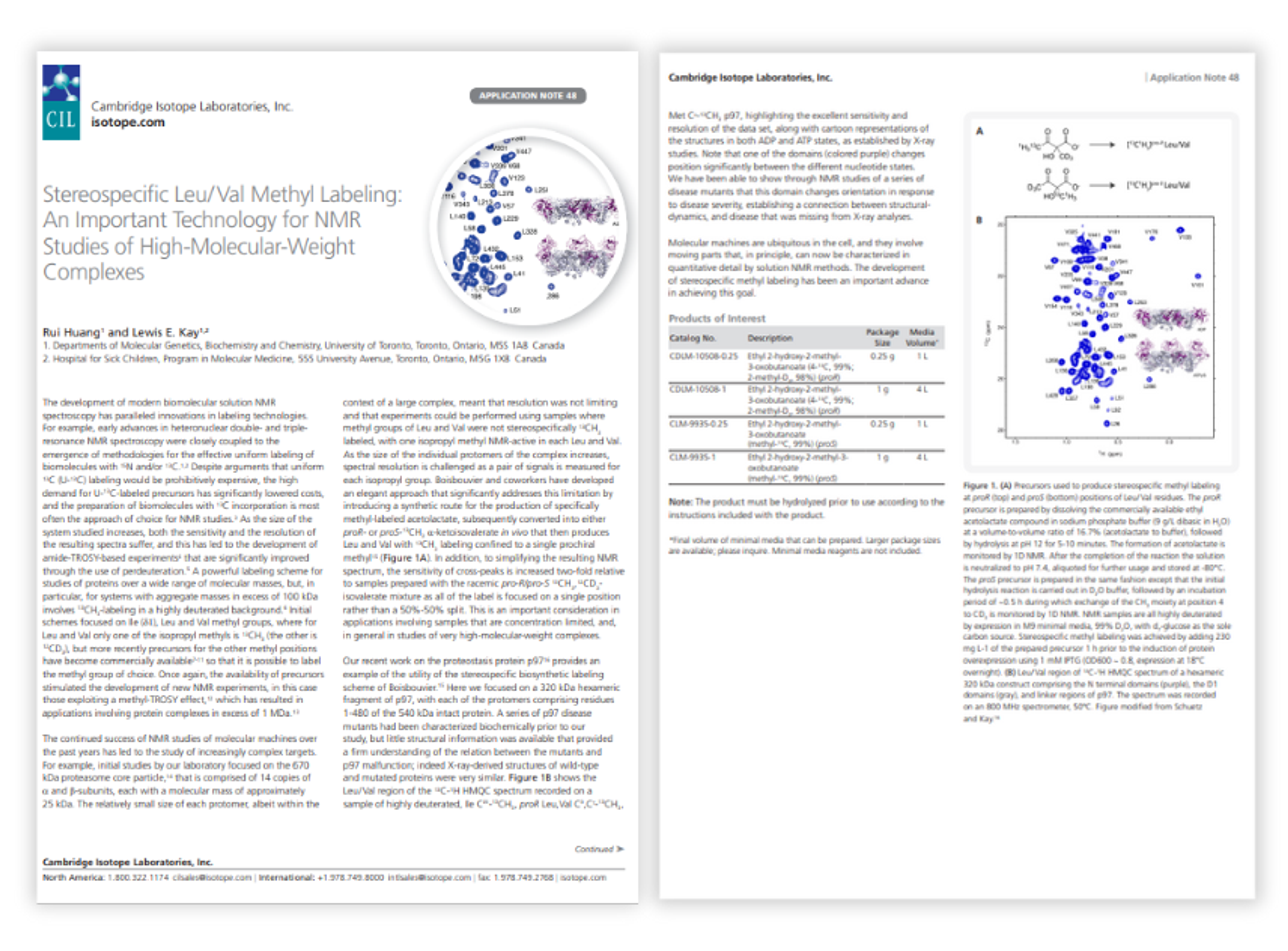
Stereospecific Leu/Val methyl labeling: An important technology for NMR studies of high-molecular-weight complexes
The development of modern biomolecular solution NMR spectroscopy has paralleled innovations in labeling technologies. For example, early advances in heteronuclear double- and triple-resonance NMR spectroscopy were closely coupled to the emergence of methodologies for the effective uniform labeling of biomolecules with 15N and/or 13C. Despite arguments that uniform 13C (U-13C) labeling would be prohibitively expensive, the high demand for U-13C-labeled precursors has significantly lowered costs, and the preparation of biomolecules with 13C incorporation is most often the approach of choice for NMR studies. As the size of the system studied increases, both the sensitivity and the resolution of the resulting spectra suffer, and this has led to the development of amide-TROSY-based experiments that are significantly improved through the use of perdeuteration.
Resource details:
- Resource type: Application note
- Page count: 4
- Read time: 6 mins
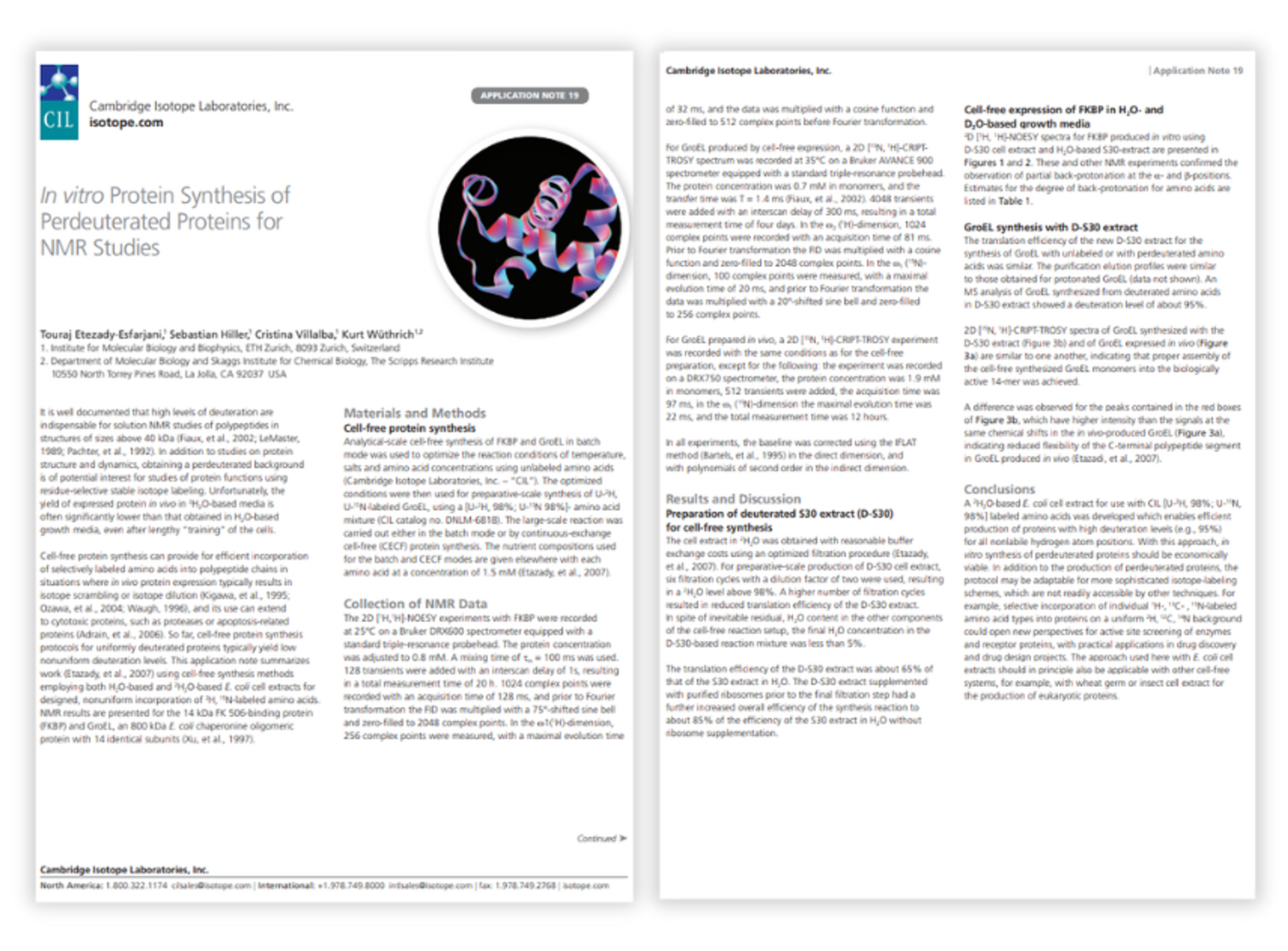
In vitro protein synthesis of perdeuterated proteins for NMR studies
Perdeuteration of polypeptides is a useful technique for studying large polypeptides in solution, however this can be difficult to do in vivo. In this application note, Cambridge Isotope Laboratories summarizes work using cell-free synthesis methods employing both H2O-based and 2H2O-based E. coli cell-extracts for the non-uniform incorporation of 2H, 15N-labeled amino acids in vitro.
Resource details:
- Resource type: Application note
- Page count: 4
- Read time: 6 mins
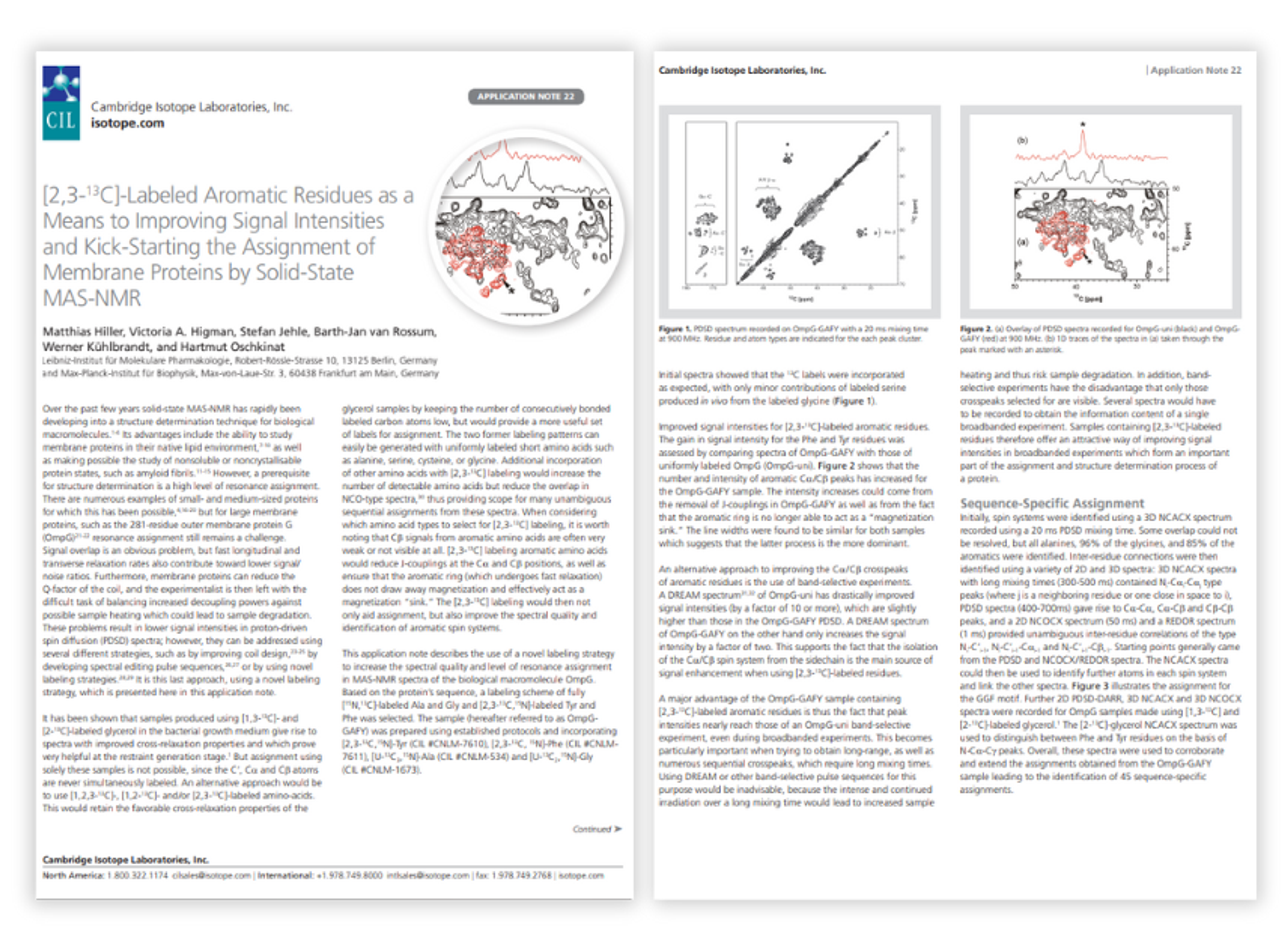
Improving signal intensities and assignment of membrane proteins by solid-state MAS-NMR using labeled aromatic residues
Solid-state magic-angle spinning (MAS)-NMR has rapidly been developing into a structure determination technique for biological macromolecules, as it enables the study of membrane proteins in their native lipid environment, as well as the study of non-soluble or non-crystallizable protein states, such as amyloid fibrils. However, a prerequisite for structure determination is a high level of resonance assignment, which is difficult for many large membrane proteins. This application note from Cambridge Isotope Laboratories discusses the labeling of specific residues of proteins so as to make assignment easier.
Resource details:
- Resource type: Application note
- Page count: 4
- Read time: 6 mins
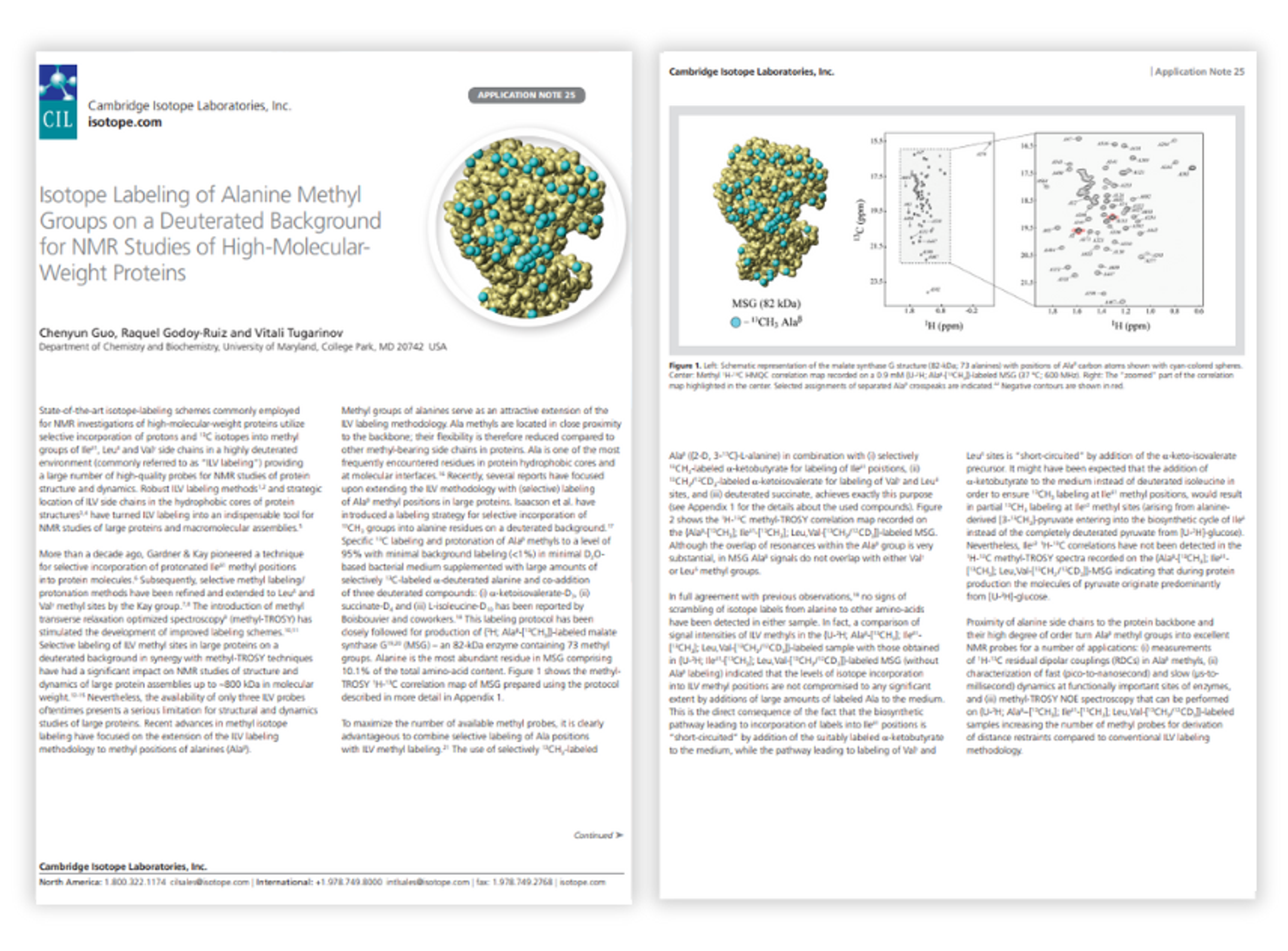
Isotope labeling of alanine methyl groups for NMR studies of high-molecular-weight proteins
Labeling schemes commonly employed for NMR investigations of high-molecular-weight proteins utilize selective incorporation of protons and 13C isotopes into methyl groups of Ileδ1, Leuδ and Valγ side-chains in a highly deuterated environment (commonly referred to as “ILV labeling”), providing a large number of high-quality probes for NMR studies of protein structure and dynamics. In this application note, Cambridge Isotope Laboratories describes the labeling of the methyl groups of alanine as an attractive extension of the ILV labeling methodology.
Resource details:
- Resource type: Application note
- Page count: 4
- Read time: 6 mins