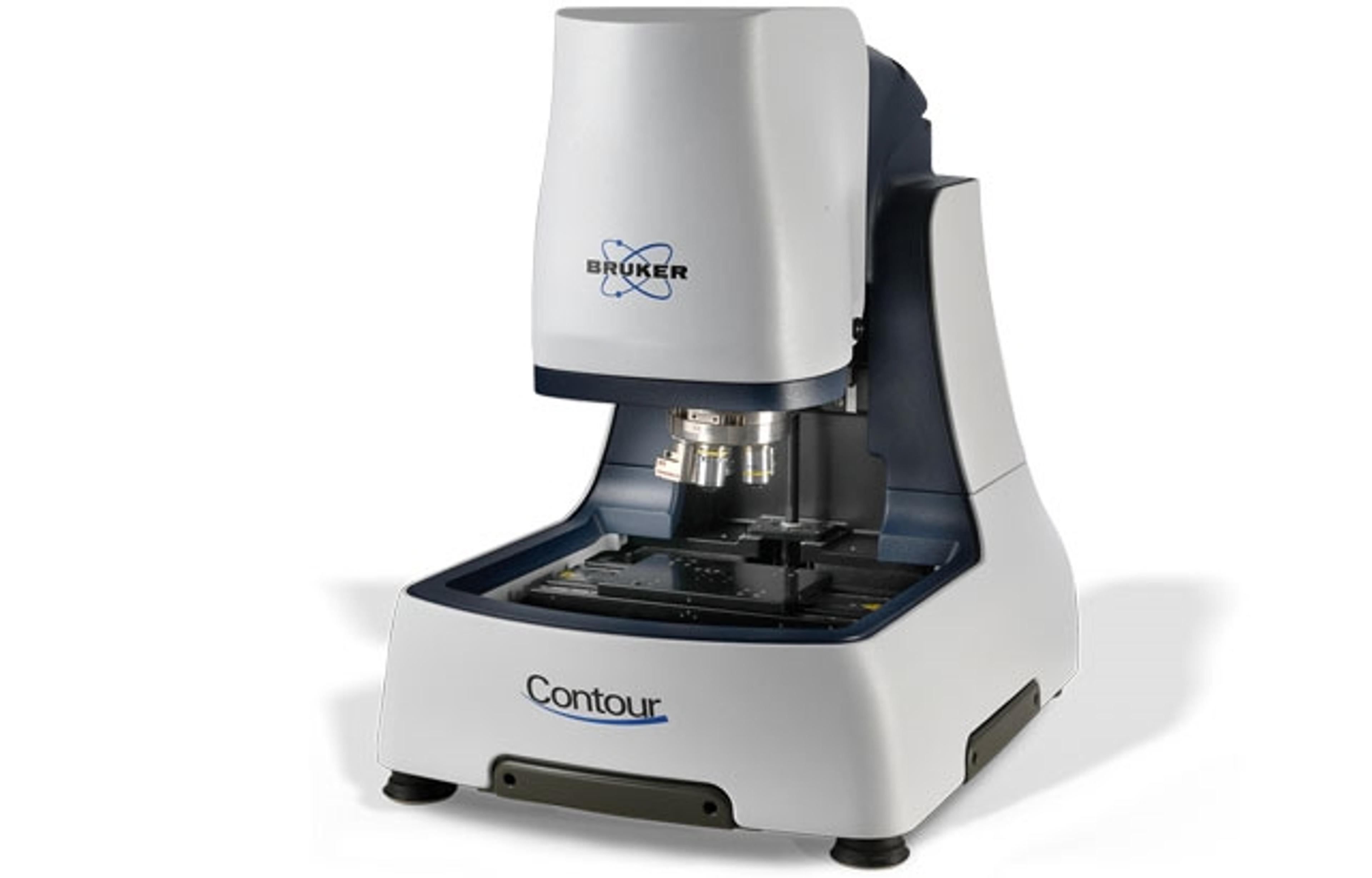
ContourX-500
The ContourX-500 Optical Profilometer is the world’s most comprehensive automated benchtop system for fast, non-contact 3D surface metrology. The gage-capable ContourX-500 boasts unmatched Z-axis resolution and accuracy, and is easily customized for the widest range of complex applications, from QA/QC metrology of precision machined surfaces and semiconductor processes to R&D characterization for ophthalmics and MEMS devices.…
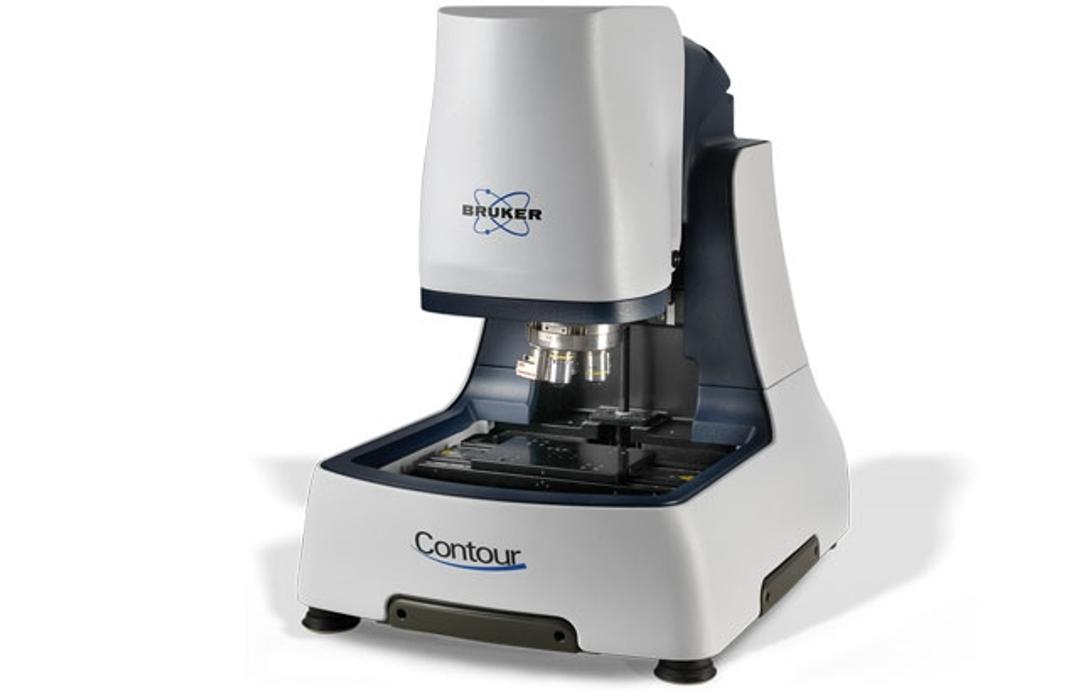
ContourX-500 optical profilometer
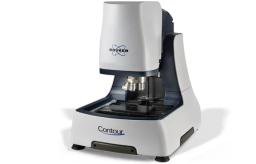

The supplier does not provide quotations for this product through SelectScience. You can search for similar products in our Product Directory.
Full-featured optical profiler with advanced automation and tip/tilt head.
ContourX benchtop profilometers combine four decades of Wyko and Bruker technological advances to achieve industry-leading capability and utmost customer satisfaction with:
- Most optimized WLI technology for surface metrology
- Unmatched vertical resolution over large field of view
- Fastest time to results with uncompromised precision and accuracy
- Best-in-class reliability and repeatability

Improving additive manufacturing with accurate surface metrology
In the past few years, manufacturing has undergone a series of major evolutions. Standard formative techniques (molding, injecting, casting, stamping, forging) and subtractive processes (CNC milling and turning, drilling, cutting) have been challenged by new, rapidly growing disruptive technologies, such as additive manufacturing, 3D printing, and laser surface texturing, among others. This application note positions some of these new technologies versus legacy approaches to understand the underlying parameters and challenges. Bruker Nano also discusses how Bruker 3D optical profiling technologies fit into new and evolving manufacturing approaches. Finally, several case studies illustrate how optical profiling can contribute to the optimization of new manufacturing processes.
Advantages of measuring surface roughness with white light interferometry
The concept of measuring surface roughness originated nearly a century ago as a means to prevent uncertainty and disputes between manufacturers and buyers. Now, it has become a common identifier used throughout industry for validating manufacturing processes, confirming adherence to both internal and regulatory specifications, and guaranteeing quality and performance of end products. In this application note, Bruker Nano discusses the advantages of using mean roughness measurements with white light interferometry (WLI) optical profilers.
Achieving gage-capable process control for high-speed, precision manufacturing
In this application note, Bruker Nano discusses gage studies and its latest metrology advancements that help manufacturers and engineers meet the increasingly stringent demands for high-end applications. Solid, gage-proven metrology is an essential tool for process control across all industrial settings. A good measurement system enables manufacturers – ranging from factories that operate 24/7 and incorporate high-volume, high-end processes to medical instrument production performing critical FDA inspections – to keep parts within tight specification limits. However, if the measurement system is unsuitable and the amount of measurement error exceeds the allowable tolerance, it may incorrectly overlook and accept bad parts and/or reject good parts. Consequently, a company’s ability to comply with evolving standards, participate in product and process innovation, and remain competitive in modern markets are all contingent upon highly accurate measurement system performance.
ContourX 3D optical profilometers
In this application note, Bruker Nano provides a detailed overview of its range of benchtop profilometers. The ContourX suite of benchtop profilometers features the latest measurement hardware and analysis advances to provide gage-capable, quantitative 3D surface characterization for an extremely wide range of surfaces, from rough to smooth, bright to dark, transparent to opaque, or otherwise difficult to measure. With the available choice of configurations, analytical options, objectives, and measurement modes, ContourX has been designed to meet the needs of virtually any challenging surface metrology application.
Comparing 3D optical microscopy techniques for metrology applications
In this application note, Bruker Nano discusses the metrology advantages of Bruker’s ContourGT® 3D optical microscopes over confocal microscopes for certain applications. Key to these advantages is the ability to maintain subnanometer vertical resolution and 0.1 nanometer RMS repeatability, regardless of magnification or field of view.
3D optical microscopy is a mainstay metrology technology across a wide range of industries. There are a few techniques that provide a 3D surface representation from a microscope image, including the two key techniques of white light interferometry (WLI) and confocal microscopy, also known as laser scanning confocal microscopy (LSCM). These two methods are ubiquitous for measuring nanometers-to-millimeters surface heights. The principle of operation for each method provides different advantages and disadvantages.
3D optical microscopy for orthopedic implants
This application note discusses Bruker’s 3D optical microscopy technique in both the research and development and quality control stages of orthopedic implants manufacturing. The benefits of this technique include non-contact and non-destructive characterization, an insensitivity to material type, a large dynamic range to measure very rough and very smooth surfaces, quick, accurate and repeatable areal measurements, and the capability for complete automation to measure a batch of parts and perform pass-fail summaries based on user-specified parameters.
3D optical microscopes provide key metrology for ophthalmic industrial applications
In this application note, Bruker Nano discusses the manufacture and production of various contact lenses and intraocular implantable lenses (IOLs) and how properly deployed metrology, using advanced 3D optical microscopes provide a high return on investment to manufacturers in this space.
Correlating advanced 3D optical profiling surface measurements to traceable standards
In this application note, Bruker Nano describes the advantages of the non-contact inspection method employed by 3D optical profilers, and discusses the best practices and measurement results for some specialized physikalish-technische bundesanstalt (PTB) traceable roughness standards and other low-cost fingernail roughness gages. The correlation results are based on measurement factors that should be understood and considered when imaging and analyzing surface textures that range in roughness from a few nanometers to micrometers in scale.