
AI, automation, and partnerships rewrite the diagnostics playbook
11 Sept 2026
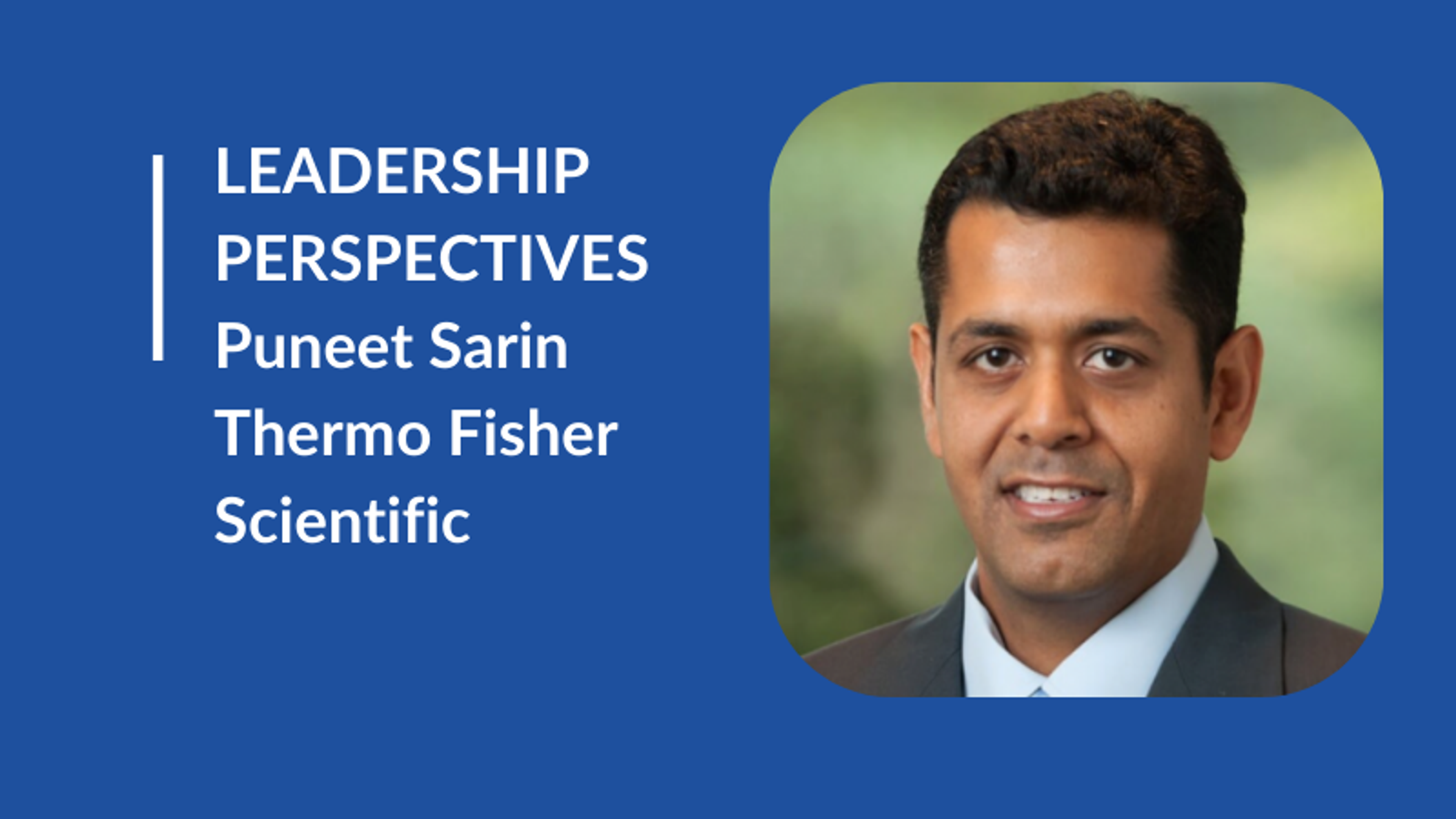
From precision medicine and companion diagnostics to the growing importance of strategic partnerships across the healthcare ecosystem, Puneet Sarin, Senior Vice President and President of Specialty Diagnostics at Thermo Fisher Scientific, discusses the trends already shaping the future of diagnostics.
Hear how advances in automation, artificial intelligence, and less invasive monitoring approaches are helping to create smarter clinical laboratories, deliver deeper clinical insights, and improve patient outcomes. Plus, discover Sarin's vision for the clinical lab of the future, powered by AI, automation, and new models of care.
This interview was recorded at ADLM 2026, Anaheim, California.
About the company

Thermo Fisher Scientific
Thermo Fisher Scientific Inc. (NYSE: TMO) is the world leader in serving science, with annual revenue over $40 billion. Our Mission is to enable our customers to make the world healthier, cleaner and safer. Whether our customers are accelerating life sciences research, solving complex analytical challenges, increasing productivity in their laboratories, improving patient health through diagnostics or the development and manufacture of life-changing therapies, we are here to support them. Our global team delivers an unrivaled combination of innovative technologies, purchasing convenience and pharmaceutical services through our industry-leading brands, including Thermo Scientific, Applied Biosystems, Invitrogen, Fisher Scientific, Unity Lab Services, Patheon and PPD. For more information, please visit www.thermofisher.com.
Video transcript
Show transcript
I'm Puneet Sarin, Senior Vice President and President of Specialty Diagnostics at Thermo Fisher Scientific.
Really excited to be here at ADLM. Great energy on the floor and really great conversations with our customers and business partners as well.
As I reflect on our discussions, a few themes stand out.
First, what's really promising is that the global demand for advanced specialty diagnostics continues to be strong. We're seeing that in North America and Europe, in more established markets, but also from Latin America, Asia Pacific, the Middle East, and India. So, all in all, very encouraged as we see the near future in every possible way.
The other big theme that's coming in, given all the external volatility, is that customers are starting to rethink how they view partners.
To put it in context, we're seeing geopolitical factors, we're seeing inflation, and reimbursements impact coming into play. So, the notion of partnership is not just about instruments and reagents. It's scaling more into companies that can provide a real demonstration of clinical and operational value creation for customers, and companies that can operate at scale to benefit their customers.
And then the last piece that has come up in our conversations with customers is that innovation, in and of itself, is not good enough anymore. Today, customers are looking at partners who can impact that entire ecosystem. So, what I mean by that is the payers, the policymakers, and the providers. Ultimately, driving that complete impact to patient care is what matters most and what drives innovation.
When I think about the role of innovation in diagnostics, I look across the entire patient care continuum, from screening and risk assessment to diagnostics, to therapy selection, and ultimately monitoring.
I think that while there has been a lot of progress in every step of the patient care continuum, there is so much more we can do, especially for high-acuity diseases.
We, as a company, are evolving our stance to move from a single assay to more of a panel-based approach that provides early and accurate diagnosis.
In the case of therapy selection, the work our company is doing, working with many pharmaceutical providers in companion diagnostics, helps make sure we have the right drug for the right patient at the right time.
And in the role of monitoring, our newly launched EXENT solution in multiple myeloma is a great example of how we can use less invasive procedures or practices that help us with recurrence or relapse of cancer in such situations.
Partnerships are not new to diagnostics. Historically, many times, companies have relied on other third-party assay providers to bring the menu onto their integrated platforms, which eventually drives adoption.
But the whole concept of partnerships is evolving from what was more of a product- or menu-based partnership and is now evolving into more clinical decision support and really elevating patient care.
No one company today can have the entire breadth of capabilities, from biomarker discovery to evidence generation, to lab instrumentation, market access, and healthcare. So, we need the entire ecosystem to come together.
So, when I think about the clinical lab of the future, it is going to be really a convergence of automation, artificial intelligence, and new business models coming into practice.
We know labs are having to do more with less, with shortages of skilled workforce, and those trends are being acted upon. But where artificial intelligence has a huge role to play is in reducing clinical complexity in the labs, whether it is clinical decision support, whether it is interpretation of data and analysis, or even driving reproducible results from care provider to care provider.
So, when I think about the clinical lab of the future, it's the labs that are using robotics and artificial intelligence, driving smarter care and deeper clinical insights. And I think we at Thermo Fisher Scientific have a huge role to play in enabling our customers' transition into those new settings and being the trusted partner of choice.
What does this video cover?

Topics covered in this video
- How is Thermo Fisher Scientific shaping the future of specialty diagnostics?
- What role does precision medicine play in next-generation clinical diagnostics?
- How are AI and automation transforming smarter clinical laboratories and workflows?
- Why are strategic partnerships vital across the healthcare diagnostics ecosystem?
- How will less invasive monitoring improve patient outcomes in companion diagnostics?
Other videos from Thermo Fisher Scientific

Links
Tags
Frequently asked questions
Show frequently asked questions
How is Thermo Fisher Scientific shaping the future of clinical diagnostics through precision medicine and companion diagnostics?
Puneet Sarin, Senior Vice President and President of Specialty Diagnostics at Thermo Fisher Scientific, explains that precision medicine and companion diagnostics are key trends shaping the future of diagnostics. These approaches enable more targeted testing and treatment decisions, helping clinical laboratories deliver deeper clinical insights and ultimately improve patient outcomes across the healthcare ecosystem.
What role do automation and artificial intelligence play in creating smarter clinical laboratories at Thermo Fisher Scientific?
In the SelectScience interview, Puneet Sarin highlights how advances in automation and artificial intelligence are central to building smarter clinical laboratories. These technologies streamline workflows, enhance data analysis, and support more efficient, accurate diagnostics. By leveraging AI and automation, Thermo Fisher Scientific aims to power the clinical lab of the future and enable new models of care that benefit patients.
Why are strategic partnerships across the healthcare ecosystem important for Thermo Fisher Scientific’s Specialty Diagnostics business?
Puneet Sarin emphasizes the growing importance of strategic partnerships across the healthcare ecosystem for Thermo Fisher Scientific’s Specialty Diagnostics. Collaborations with healthcare providers, technology partners, and other stakeholders help integrate companion diagnostics, less invasive monitoring, and AI-driven tools. These partnerships support the delivery of deeper clinical insights and improved patient outcomes while advancing the overall future of diagnostics.