
Making Alzheimer’s testing more accessible with blood-based biomarkers
AAIC 2026 interview with Beckman Coulter Diagnostics
18 Sept 2026
In this video, Dr. Chris Bird, Chief Medical Officer at Beckman Coulter Diagnostics, discusses the evolution of Alzheimer’s disease testing from PET imaging and cerebrospinal fluid analysis to the growing role of blood-based biomarkers. Bird explains how advances in analytical sensitivity, including the DxI 9000 Immunoassay Analyzer, could help detect highly diluted biomarker signals in blood and support more scalable approaches to assessing Alzheimer’s-related pathology.
Bird also highlights Beckman Coulter’s recent CE-marked Access p-Tau217 assay and the broader need for a portfolio of biomarkers to address the complexity of Alzheimer’s disease diagnosis and monitoring. With the potential to bring standardized, automated testing into routine laboratory workflows, blood-based biomarker testing could help improve access, consistency, and clinical confidence across diverse healthcare settings.
Interview filmed at the 2026 Alzheimer's Association International Conference® (AAIC 2026).
Video transcript
Show transcript
I'm Dr. Chris Bird. I'm the chief medical officer of Beckman Coulter Diagnostics. Some of the challenges with Alzheimer's diagnosis and management, if you look from a diagnostic standpoint, historically, as we look back a few years, is mostly with PET imaging.
And PET is a great tool, but you're only able to diagnose based on limitations. You're limited based on where the technology is available, and the technology is expensive. It has to be delivered by those that are qualified to deliver that care, which means that you have specialists that are trained on how to deliver, score, and interpret the result from a PET, so it is a bit limiting.
Then you transition a little bit later into cerebrospinal fluid, or CSF-based testing. Another great test, but again this is something that is highly invasive, so it requires a lumbar puncture, or a spinal tap, as it is also known. This is not a great method for patients because of its invasive nature or procedure. Great results, though.
So then we fast forward to blood-based biomarkers, and this is particularly interesting because for the longest time we couldn't detect it, and that's largely because of the nature of the molecules. As the molecules pass the blood-brain barrier, they're diluted about 50-fold, so the technology to detect it just wasn't there. It was so diluted and it was so small of a signal that we couldn't pick it up.
In comes, in our case, the DxI 9000. It's an analyzer from Beckman Coulter Diagnostics, which has massive improvements in sensitivity and then enables that ability to detect because of its sensitivity. So you see there's an evolution of PET, cerebrospinal fluid-based testing, and then blood-based biomarkers.
We're not the only ones. So there are other technologies that also have blood-based biomarker testing, but they're largely manual. The manual technologies, and some of them have got CE approvals or CE marks.
So with our recent announcement at Beckman Coulter last week, with its CE mark approval, this now gives us the ability to have standardization and democratization of the way that we go about testing. So whether you're here in the UK or whether you're in Kenya or Uganda or Brazil, you're going to get the same result. Sample in, result out with that same precision, accuracy, and standardization, regardless of where you are, regardless of your postcode, you're going to get the same level of quality.
So some of the challenges of blood-based biomarkers are that there's not one silver bullet. There's not one biomarker that addresses all of the challenges.
What you hear at conferences like AAIC, or the Alzheimer's Association International Conference, is cutting edge. This is where all of the thought leaders come. So what the early adopters, and I think in large part your routine neurologists, they are familiar with p-Tau217. But there are a lot of cutting-edge biomarkers, too, that you hear at this conference and other conferences.
Similar to neurology, if you look at drawing a parallel in the industry to oncology, there are a number of biomarkers. There's no one biomarker that is going to get the job done. So we recognize that and we've invested, yes, in p-Tau217, but we've invested in a portfolio of biomarkers.
This was the first domino to fall in the regulatory domino world, so we've got one that has come with the CE mark here and all of the countries that accept CE marks, and then soon with the FDA approval in the United States. But we have a massive portfolio of markers, and we've announced this. We made it clear that this is an area where we're investing heavily because we recognize that it's important to address the unmet medical needs, not just of today, but of the future.
What does this video cover?
Topics covered in this video
- The evolution of Alzheimer’s disease testing from PET imaging and CSF analysis to blood-based biomarkers
- How improved assay sensitivity is helping detect highly diluted biomarker signals in blood
- The role of the DxI 9000 Immunoassay Analyzer in automated blood-based biomarker testing
- Why standardization and accessibility are important for routine Alzheimer’s testing
- The significance of p-Tau217 and the need for a broader biomarker portfolio
Related products
Request Quote for All Products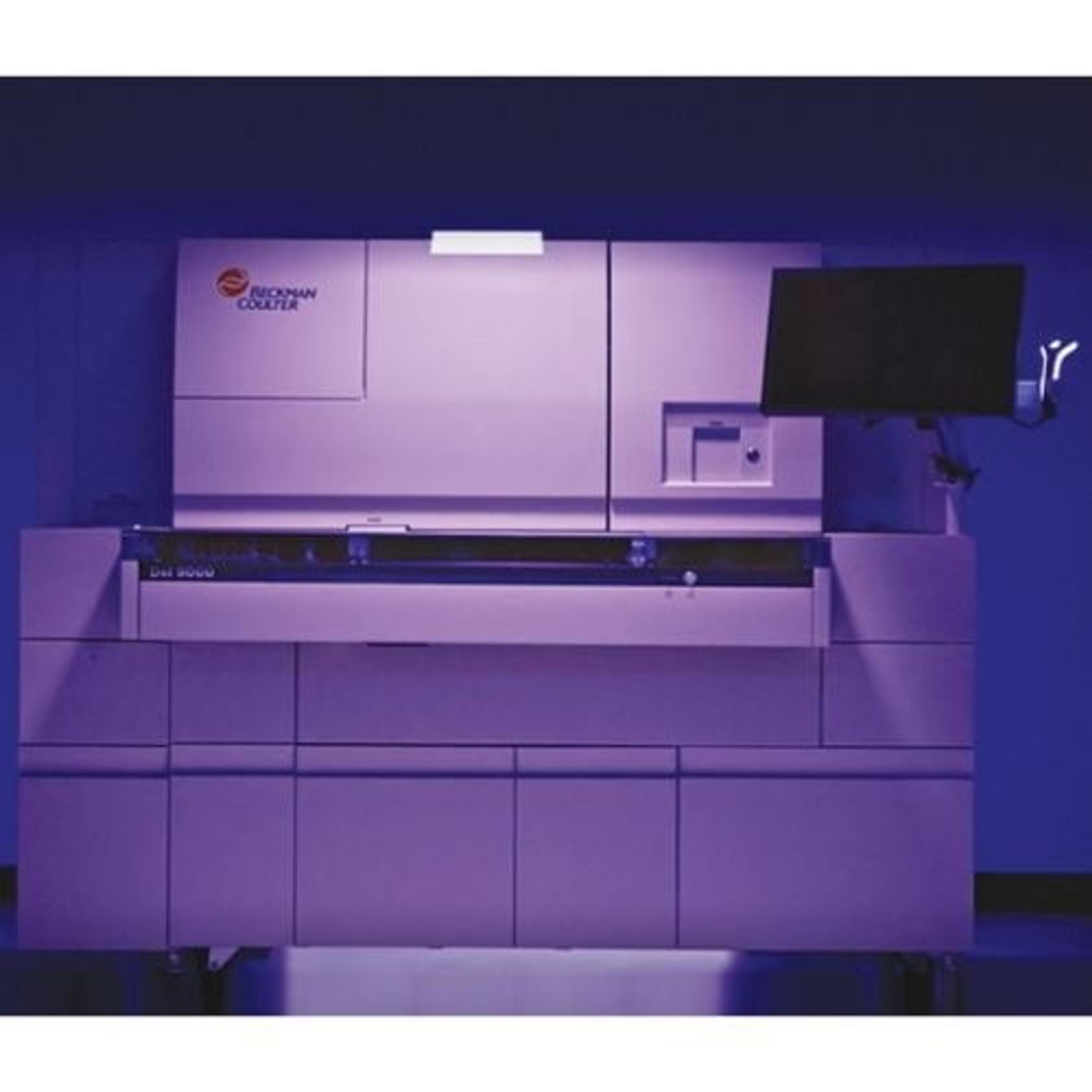
DxI 9000 Immunoassay Analyzer
Beckman Coulter DiagnosticsThe award-winning DxI 9000 Analyzer sets a new standard for today’s busy labs. With meaningful innovations that amplify your impact, liberate you from the laborious, and power your performance across your health system, this high-throughput immunoassay analyzer takes diagnostics to the next level.
Tags
Frequently asked questions
Show frequently asked questions
What are blood-based biomarkers for Alzheimer’s disease?
Blood-based biomarkers are measurable biological signals found in blood that can provide information about Alzheimer’s-related pathology. In the video, Dr. Chris Bird explains that advances in analytical sensitivity are making it possible to detect these highly diluted biomarker signals after they pass the blood-brain barrier.
How has Alzheimer’s disease testing traditionally been carried out?
Dr. Bird describes how Alzheimer’s disease testing has historically relied on PET imaging and cerebrospinal fluid testing. While both approaches can provide valuable results, PET imaging may be limited by availability, cost, and specialist interpretation, while cerebrospinal fluid testing requires an invasive lumbar puncture.
Why is blood-based biomarker testing important?
Blood-based biomarker testing could help make Alzheimer’s disease testing more scalable and accessible by enabling sample-in, result-out testing in routine laboratory workflows. According to Dr. Bird, automated and standardized testing could support greater consistency across different healthcare settings.
What role does p-Tau217 play in Alzheimer’s disease testing?
p-Tau217 is one of the biomarkers discussed in the video and is described as an important focus for early adopters and neurologists. Dr. Bird notes that while p-Tau217 is significant, no single biomarker is likely to address all diagnostic and monitoring needs, making a broader biomarker portfolio important.
What is the DxI 9000 Immunoassay Analyzer?
The DxI 9000 is an analyzer from Beckman Coulter Diagnostics. Dr. Bird explains that improvements in sensitivity on this platform help enable the detection of Alzheimer’s-related blood-based biomarker signals that were previously too diluted to detect reliably.