CellTiter-Glo® Luminescent Cell Viability Assay
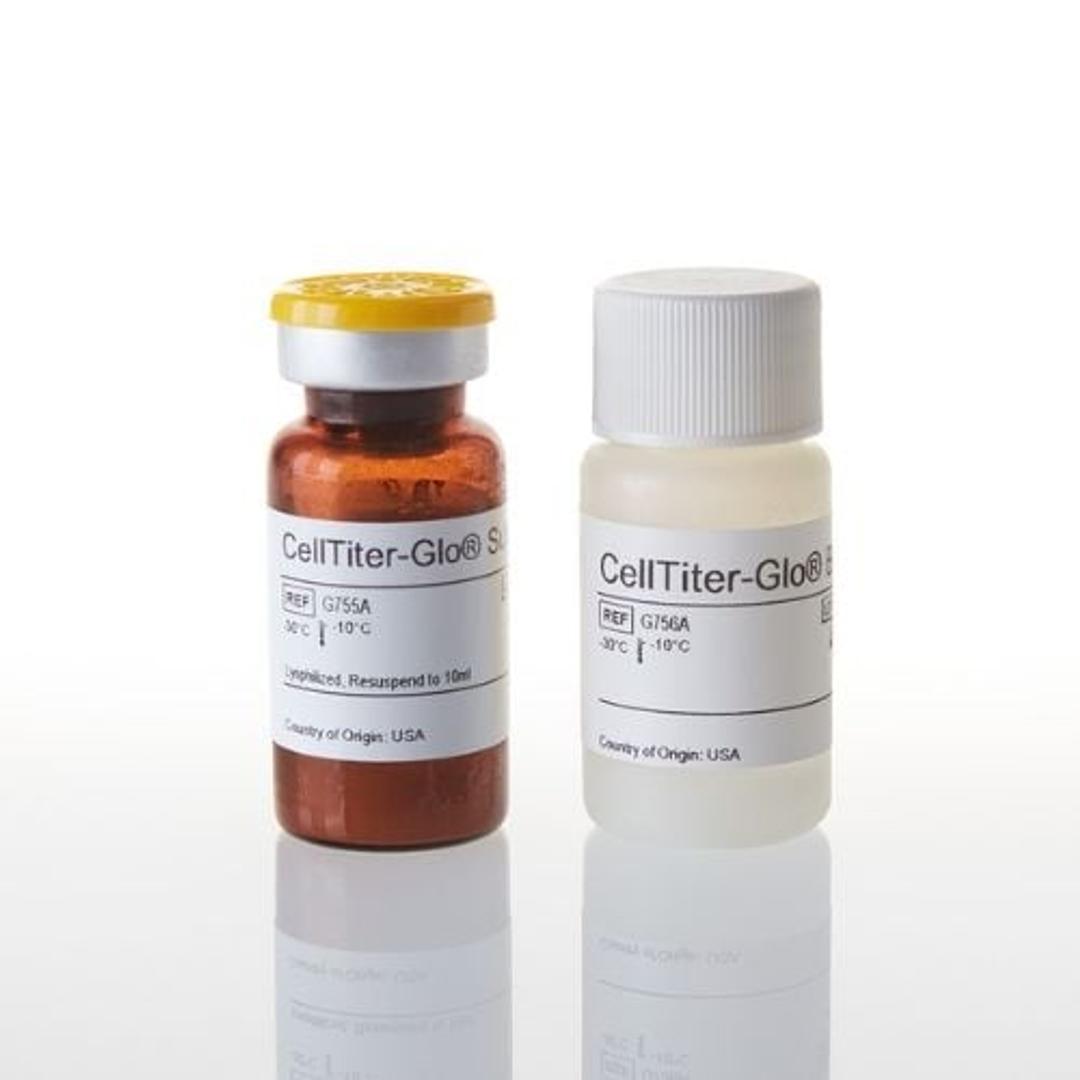
The CellTiter-Glo® Luminescent Cell Viability Assay(a,b) is a homogeneous method of determining the number of viable cells in culture based on quantitation of the ATP present, an indicator of metabolically active cells. The CellTiter-Glo® Assay is designed for use with multiwell formats, making it ideal for automated high-throughput screening (HTS), cell proliferation and cytotoxicity assays. The homogeneous assay procedure in…

Receive your quote directly from the manufacturer.
Highly recommended product
Cells viability evaluation through ATP detection
The kit for cell viability evaluation is very easy to use. Results are reproducible with high accuracy. Although this kit is intended to be used for monolayer cell cultures I found that could be applied to small 3D cell culture systems (eg. spheroids)
Review Date: 5 Sept 2023 | Promega Corp.
Quality result, it was good and easy to use and good productivity and reproducibility
Biochemical assay
Cell titer glo assay is a proximity assay, used to find the activity of cells and also find the viability of the cell especially used in drug discovery field to find the screening of compound and cell death identification
Review Date: 24 May 2022 | Promega Corp.
Cannot think of using anything else for cell viability determination/quantitation!
Cell viability determination of primary tumor samples after dose ranging drug treatment
This product is the absolute best in its class and keeps getting better. I've been using this since 2009 and have moved from the original reagent to the new improved version 2.0 with greater temperature stability. Incredible dynamic range from 50-100 cells per well all the way out to 50,000 cells within a 384well TC plate. Fantastic!
Review Date: 16 Nov 2021 | Promega Corp.
A simple and robust endpoint assay for cell proliferation.
Plate based proliferation and cell health studies
The CellTiter-Glo kit gives an easy and robust assay for measuring endpoint cell proliferation in 96-384 well format. This allows fast data generation to understand cell health following the addition of compounds.
Review Date: 18 May 2021 | Promega Corp.
Great product for great research.
Analysis of ATP levels of cells cultured in 2D or 3D
The CellTiter-Glo Luminescent Cell Viability Assay from Promega Corp. is easy to use and very efficient to determine the viability of cells based on the ATP levels. Extra- and intracellular ATP is used to produce the luminescent signal and hence, qualitative and quantitative analysis can be performed in less than 30 minutes.
Review Date: 14 May 2021 | Promega Corp.
Highly recommended!
Analysis of cell viability upon drug exposure
A sensitive viability assay subject to fewest possible chemical interferences from drug carrier/matrices.
Review Date: 27 Oct 2019 | Promega Corp.
Consitently good results.
Cell viability
Products works reliably every time with little batch to batch variation.
Review Date: 26 Oct 2019 | Promega Corp.
Excellent product, excellent results.
Test cell viability after treatment with compounds
Our laboratory regularly uses CellTitier-Glo and achieves very consistent, reproducible results which are essential to our workflow. It is the industry standard for good reason, and will continue to function as a major assay within our lab.
Review Date: 26 Oct 2019 | Promega Corp.
Great product, consistent results on batch by batch.
Investigate cell survival by compound dosing
Easy to use. Consistent and reliable results. High throughput is possible.
Review Date: 25 Oct 2019 | Promega Corp.
Very good product.
Screening of anti-tumor small molecules by proliferation assay.
Very consistent result and less variation in experimental replicates.
Review Date: 25 Oct 2019 | Promega Corp.
The CellTiter-Glo® Luminescent Cell Viability Assay(a,b) is a homogeneous method of determining the number of viable cells in culture based on quantitation of the ATP present, an indicator of metabolically active cells. The CellTiter-Glo® Assay is designed for use with multiwell formats, making it ideal for automated high-throughput screening (HTS), cell proliferation and cytotoxicity assays. The homogeneous assay procedure involves adding the single reagent (CellTiter-Glo® Reagent) directly to cells cultured in serum-supplemented medium. Cell washing, removal of medium and multiple pipetting steps are not required. The system detects as few as 15 cells/well in a 384-well format in 10 minutes after adding reagent and mixing.
The homogeneous "add-mix-measure" format results in cell lysis and generation of a luminescent signal proportional to the amount of ATP present. The amount of ATP is directly proportional to the number of cells present in culture. The CellTiter-Glo® Assay generates a "glow-type" luminescent signal, which has a half-life generally greater than five hours, depending on cell type and medium used. The extended half-life eliminates the need to use reagent injectors and provides flexibility for continuous or batch mode processing of multiple plates. The unique homogeneous format avoids errors that may be introduced by other ATP measurement methods that require multiple steps.