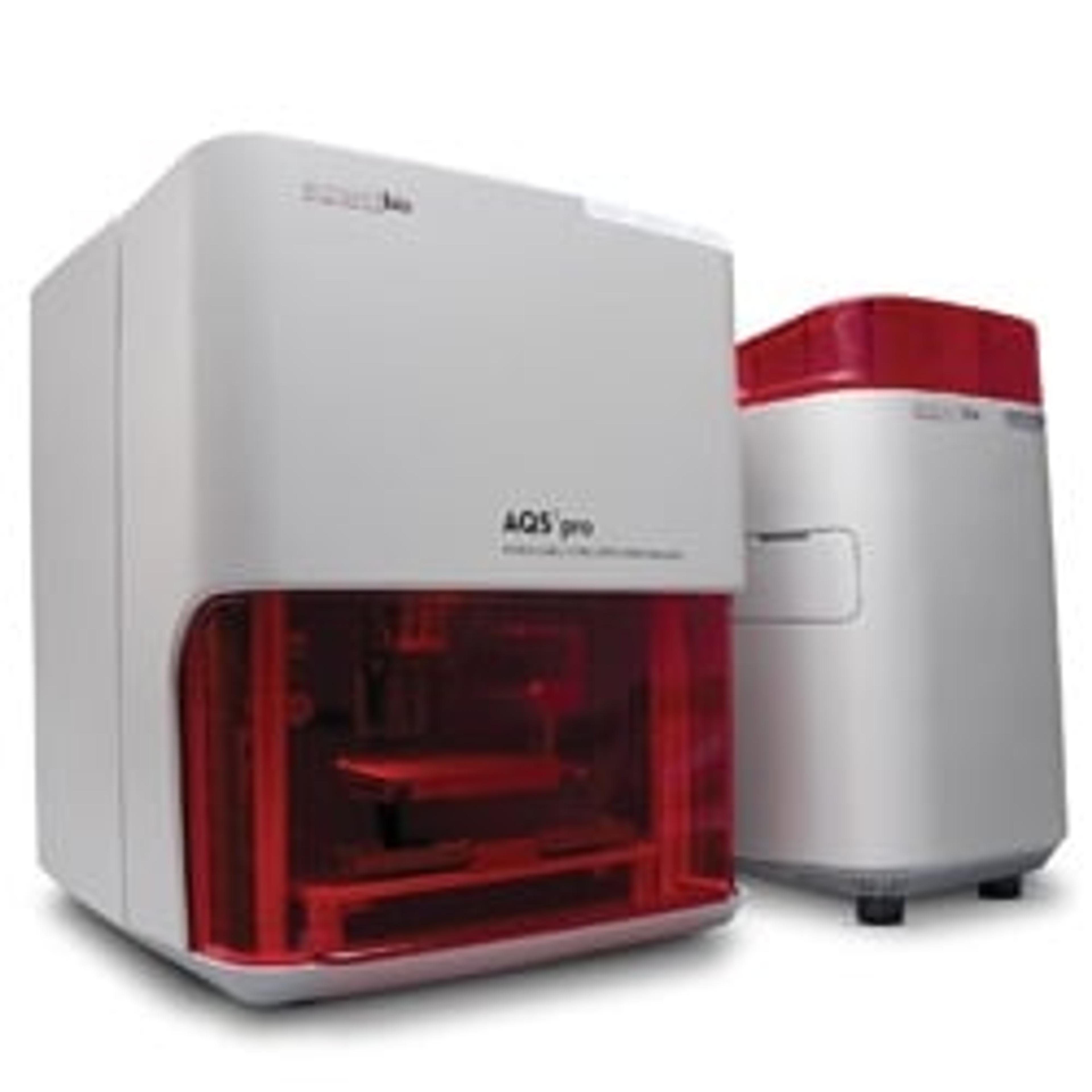
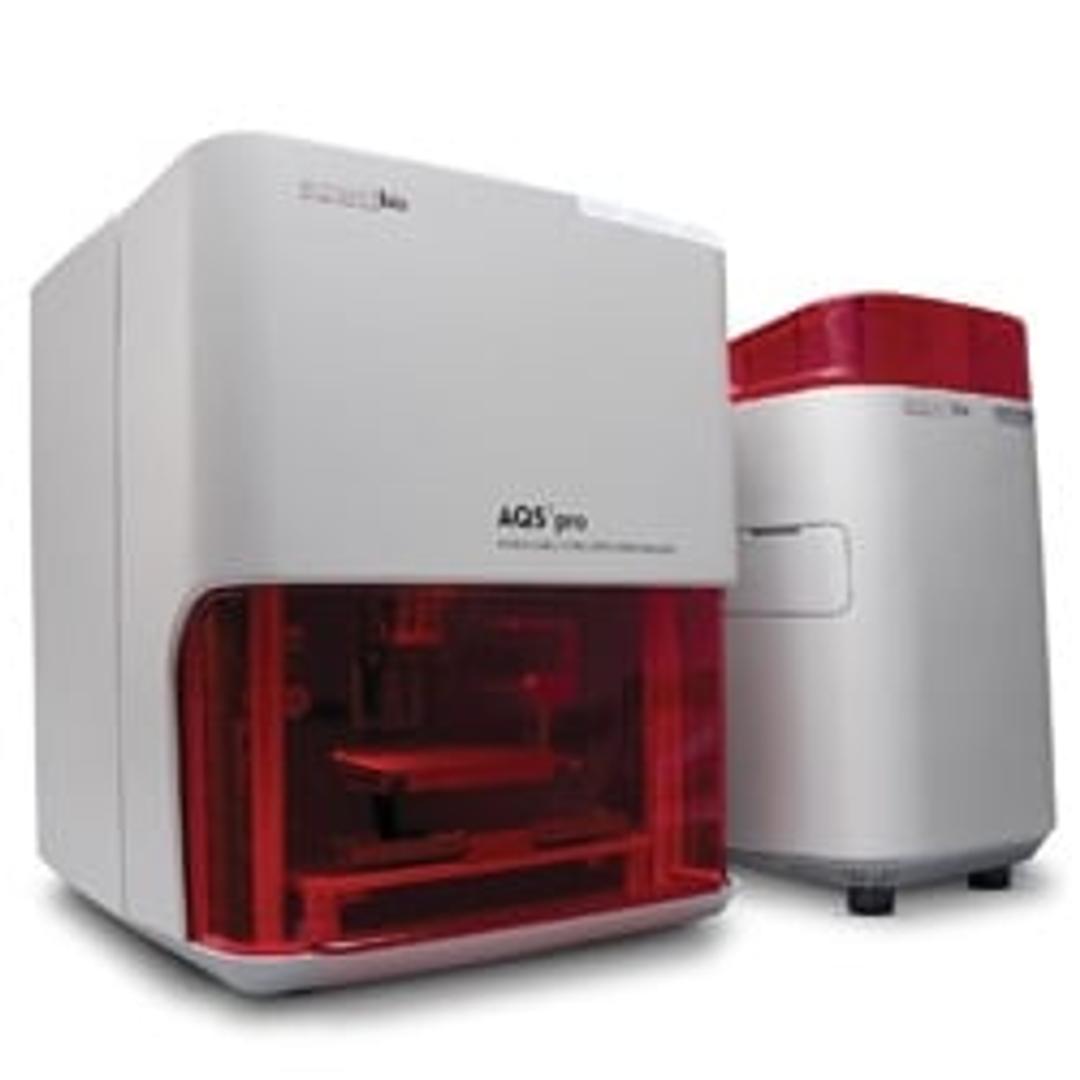
AQS3™Pro System featuring AQS3delta software
The AQS3pro has been designed for the biophysical characterization of proteins.

The supplier does not provide quotations for this product through SelectScience. You can search for similar products in our Product Directory.
Anyone needs to analyse structure at concentration- Awesomeness
Protein structure
High throughput. Incredible sensitivity
Review Date: 30 Mar 2022 | RedShiftBio
Infrared spectroscopy has been recognized for 50+ years as a powerful technique for a range of applications. Fourier transform infrared spectroscopy (FTIR) instruments are the best performing implementation of IR spectroscopy today. However, FTIR is mature, and has seen only incremental improvements in performance over the past decade. RedShiftBio developed and commercialized Microfluidic Modulation Spectroscopy (MMS) to perform IR spectroscopy in an important application – liquid spectroscopy – where FTIR is inherently disadvantaged due to its weak optical source, lack of dynamic range, and performance limiting referencing techniques. MMS has been shown by independent third parties, to achieve more than 20 times better sensitivity, 20 times greater dynamic range, and less than 1/10th the test labor cost of FTIR instruments. As such, MMS represents the single most significant advancement in IR spectroscopy for liquids, and in particular for therapeutic protein characterization, since the advent of FTIR technology.
RedShiftBio introduced the AQS3pro MMS-based instrument in 2018. With its greater sensitivity, the AQS3pro now makes it possible to characterize proteins from 0.1 mg/mL to over 200 mg/mL, the concentration range found across the full spectrum of drug development. No other similarly capable technique, including FTIR, circular dichroism and differential scanning calorimetry, is capable of this range of analysis, providing the ability to see changes that scientist could currently miss. As a flow technology with built-in real time referencing, MMS instruments can also be automated. The AQS3pro is a true walkaway instrument, capable of running through well plates automatically to provide characterization of aggregation, quantitation, similarity, stability and biophysical structure in one instrument.
Features:
- Load samples and walk away.
- The widest concentration range to characterize biotherapeutics.
- Generate precise, high sensitivity data.
- Analyze and understand protein behavior.
Applications:
- Aggregation
- Quantitation of protein concentration
- Protein Structure
- Protein Stability
- Biosimilarity

Introduction to the AQS<sup>3</sup>™ pro and Microfluidic Modulation Spectroscopy
The ability to measure and characterize changes in the secondary structure of proteins is critical to many research applications, especially the formulation and development of biotherapeutics. In this application note, RedShiftBio will introduce you to the novel IR technique called MMS (Microfluidic Modulation Spectroscopy) which is designed to see change in secondary structure. Data is presented from measurements of commercially available proteins which demonstrate significant increases in sensitivity, dynamic range, and utility for the characterization of protein secondary structure.
Thermal Denaturation Analysis of Bovine Serum Albumin by Microfluidic Modulation Spectroscopy
RedShift BioAnalytics has developed a powerful new infrared spectroscopy tool for protein structural analysis based on Microfluidic Modulation Spectroscopy (MMS). This technology achieves significant increases in sensitivity, dynamic range, and accuracy for determination of protein secondary structure relative to conventional mid-IR and far-UV CD techniques. The analyzer utilizes a tunable mid-IR quantum cascade laser to generate an optical signal 1000X brighter than the conventional sources used in FTIR spectroscopy.
Analysis of an IgG1 Sample by Microfluidic Modulation Spectroscopy (MMS)
Microfluidic Modulation Spectrometry (MMS) is a novel protein characterization technique that combines a microfluidic cell and a tunable mid-IR quantum cascade laser source to assess the comparability, similarity, quantitation linearity, aggregation, and denaturation of proteins by analyzing the absorbance spectra and the high order structure (HOS). To evaluate the data quality and performance of MMS, an IgG1 sample was analyzed at different concentrations ranging from 0.1 mg/mL to 12.3 mg/mL using a RedShiftBio AQS3pro pre-production instrument.
Enhanced Protein Structural Characterization using Microfluidic Modulation Spectroscopy
RedShiftBio has developed a powerful new tool for protein structural analysis based on Microfluidic Modulation Spectroscopy (MMS). This technology shows significant increases in sensitivity, dynamic range, accuracy and utility for determination of protein secondary structure, quantitation, similarity, stability and aggregation. The analyzer utilizes a tunable mid-infrared quantum cascade laser to generate an optical signal 1000X brighter than conventional sources used in FTIR spectroscopy.
Early Events in Amyloid Formation by Lysozyme Detected by Microfluidic Modulation Spectroscopy
The self-assembly of lysozyme to form amyloid fibrils is associated with systemic amyloidosis, a disease characterized by the presence of amyloid deposits in various organs of the body. The early events associated in the self-assembly of lysozyme are not well understood. In this work, we used Microfluidic Modulation Spectroscopy (MMS) to characterize the early events in the self-assembly of human lysozyme. Through MMS, we were able to probe the mid-IR absorption band of the protein which is sensitive to both α-helix and β-structure. With heating at 60 ˚C, the β-turn content of the protein increases while its α-helical content decreases. This result suggests that the first structural transition in the self-assembly of human lysozyme is an α-helix to β-structure conformational rearrangement.
HOS Study for IgG Samples Spiked with Different Amount of BSA by Microfluidic Modulation Spectroscopy
RedShift BioAnalytics has developed a powerful new infrared spectroscopy tool for protein structural analysis based on Microfluidic Modulation Spectroscopy (MMS). This technology achieves significant increases in sensitivity, dynamic range, and accuracy for determination of protein secondary structure relative to conventional mid-IR and farUV CD techniques. The analyzer utilizes a tunable mid-IR quantum cascade laser to generate an optical signal 1000X brighter than the conventional sources used in FTIR spectroscopy. Brighter sources also allow the use of simpler detectors without the need for liquid nitrogen cooling.

RedShift BioAnalytics announces launch of next generation Apollo for ultra-sensitive biophysical characterization of biomolecules
Apollo incorporates major advances over first-generation instrument to support rapidly growing market demand

Protein Biology: SelectScience Special Feature
From optimized sample prep, imaging, and analysis to mapping the entire human proteome, discover the latest technologies, top tips, and best practices for protein biology research

5 Essential Methods to Help Improve Protein-Based Experiments
In this SelectScience special feature dedicated to protein biology, discover methods to improve your experiments