Proteomics
Stable Isotope-labeled Peptide and Protein Reagents / Kits


The supplier does not provide quotations for this product through SelectScience. You can search for similar products in our Product Directory.
CIL offers a variety of stable isotope-labeled materials for labeling or tagging a proteome for qualitative/quantitative MS-based analyses. These can be employed in such applications as biomarker screening and disease model analysis to help define systems biology, improve treatment, and better understand disease. Each section below outlines a specific application along with the stable isotope-labeled (and unlabeled) materials available therein for use.
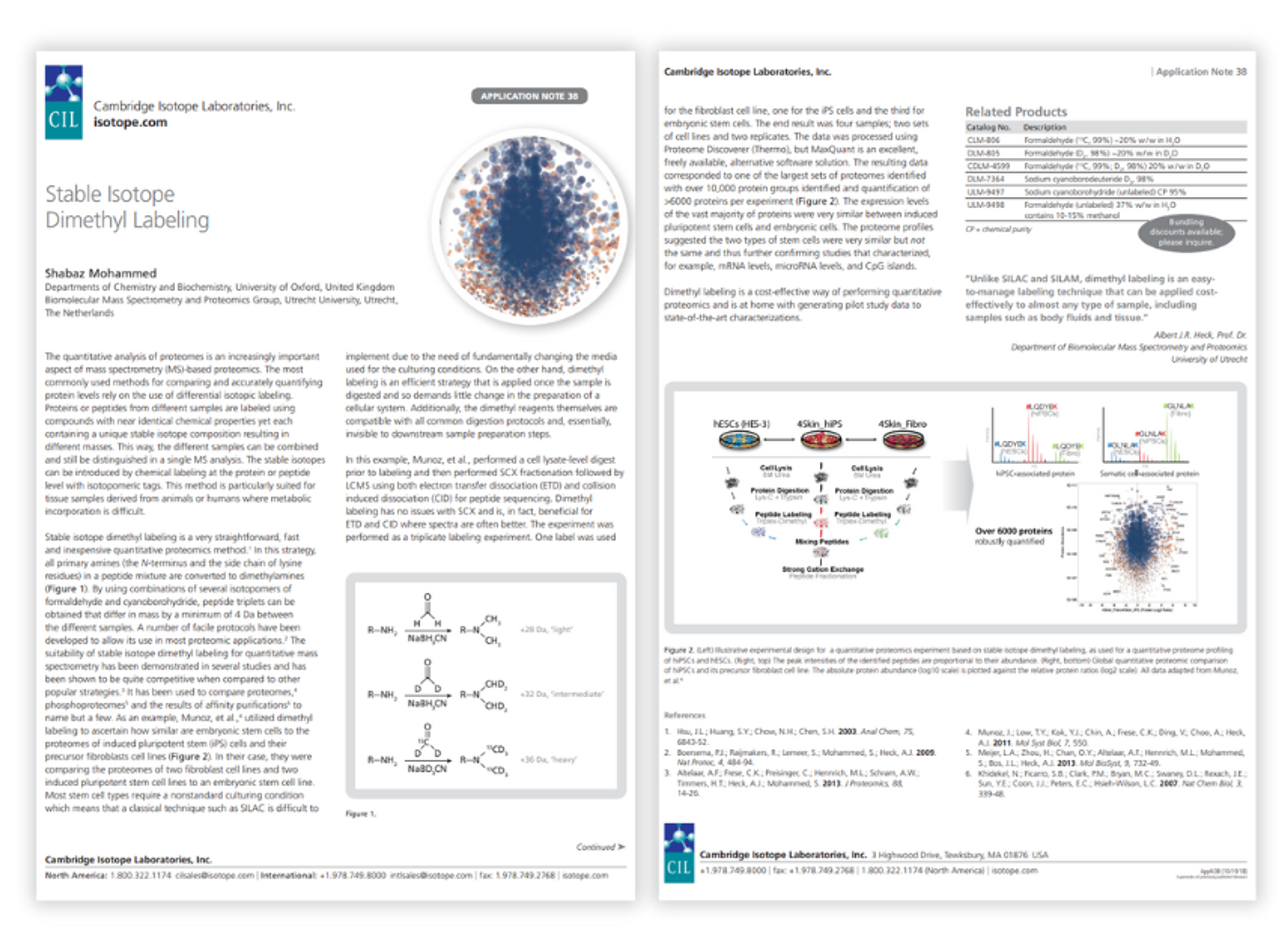
Stable isotope dimethyl labeling
The quantitative analysis of proteomes is an increasingly important aspect of mass spectrometry (MS)-based proteomics. The most commonly used methods for comparing and accurately quantifying protein levels rely on the use of differential isotopic labeling. Proteins or peptides from different samples are labeled using compounds with near identical chemical properties yet each containing a unique stable isotope composition resulting in different masses. This way, the different samples can be combined and still be distinguished in a single MS analysis. The stable isotopes can be introduced by chemical labeling at the protein or peptide level with isotopomeric tags. This method is particularly suited for tissue samples derived from animals or humans where metabolic incorporation is difficult.
In this example, cell lysate-level digest prior to labeling was performed, and then SCX fractionation followed by LCMS using both electron transfer dissociation (ETD) and collision induced dissociation (CID) for peptide sequencing was carried out.
Resource details:
- Resource type: Application note
- Page count: 2
- Read time: 3 mins

Selection and synthesis to analysis: Stable isotope-labeled peptides for proteomic applications
Proteomics is among the core ‘omics technologies commonly implemented in the scientific field to study the molecular processes that drive cellular function and disease pathogenesis. While this enabling technology can be employed independently, it is being increasingly combined today with other ‘omics technologies, such as metabolomics, to capture a more comprehensive view of systems biology. Regardless of the ‘omics technology deployed, mass spectrometry (MS) is the ideal tool for analyte detection (peptides being the focus here) due to its wide-spanning array of analytical benefits. At the sample analysis stage, a mass spectrometer can be operated in a variety of modes (e.g., multiple reaction monitoring, MRM; parallel reaction monitoring, PRM) and is commonly fronted by a separation technique (e.g., liquid chromatography or LC) for enhanced specificity and sensitivity of measurement.
Resource details:
- Resource type: Application note
- Page count: 8
- Read time: 12 mins
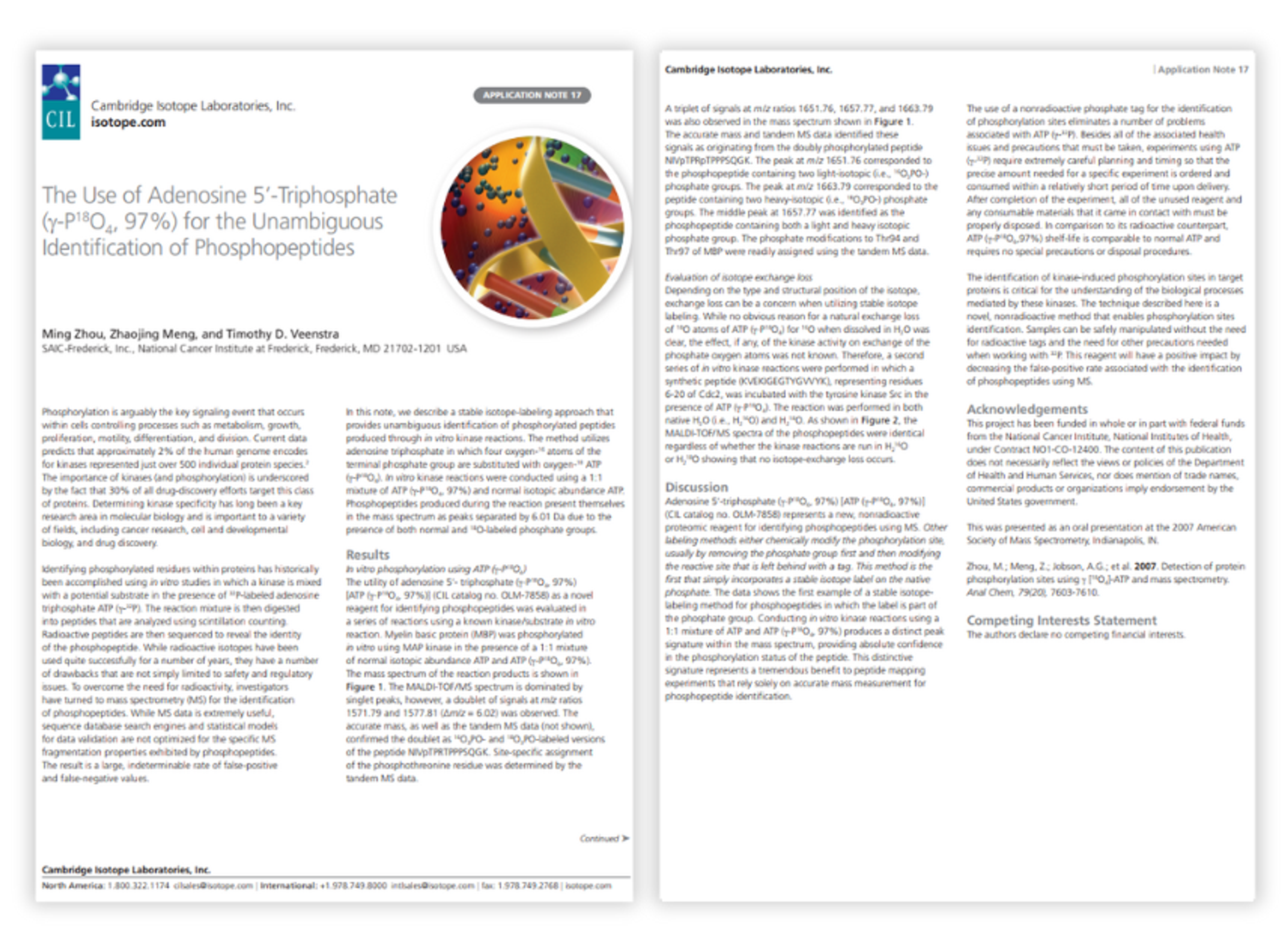
The use of adenosine 5’-triphosphate (γ-P18O4, 97%) for the unambiguous identification of phosphopeptides
Phosphorylation is arguably the key signaling event that occurs within cells controlling processes such as metabolism, growth, proliferation, motility, differentiation, and division. Determining kinase specificity has long been a key research area in molecular biology and is important to a variety of fields, including cancer research, cell and developmental biology, and drug discovery.
In this application note, Cambridge Isotope Laboratories describes a stable isotope-labeling approach that provides unambiguous identification of phosphorylated peptides produced through in vitro kinase reactions.
Resource details:
- Resource type: Application note
- Page count: 4
- Read time: 6 mins