Particle Size and Shape Analyzer SYNC
The best of both worlds - laser diffraction and image analysis combined


Receive your quote directly from the manufacturer.
Great results, can't meet customers requirements without the unit.
Particle size analysis of boron nitride ceramic powders
I have used Microtrac instruments for over 35 years and the dependability has been excellent. If you have a problem (and it did happen once) the service department is excellent and will work with you to help solve the problem. The instruments are easy to use and they present repeatable results. In my opinion, the name Microtrac is so widely used that it is often used in place of the term Particle Size Analysis.
Review Date: 7 Dec 2022 | Microtrac
Fundamental piece of equipment to have in the lab!
Powder Metallurgy
There was a little bit of a learning curve in terms of making sure that the powder was correctly suspended in the wet system to mitigate the possibility of air bubbles but the application team swiftly addressed the issues we were having. It runs beautifully.
Review Date: 7 Dec 2022 | Microtrac
Easy to use and very reproduceable results
Fumed Silica
Easy to use and very reproduceable results
Review Date: 6 Dec 2022 | Microtrac
High CP value
Evaluate the stability of Coating dispersion
It is easily to use and high sensitivity.
Review Date: 6 Dec 2022 | Microtrac
This instrument has been critical for the understanding of many of our materials.
powder characterization
The Microtrac Sync instrument is a very reliable means of generating size and shape data for a variety of particles that we study. I have been impressed with the ease of use and the support that is provided by Microtrac.
Review Date: 6 Dec 2022 | Microtrac
Very easy to analyse
Rock samples
Very easy to apply and the results are accurate
Review Date: 17 Aug 2022 | Microtrac
Impressive results and analysis options. Short measurement runtime.
dry powder morphological measurements, shape parameters analysis
Overall a very effective instrument for dry powders (we use a dry sample module). A hybrid analyzer (laser diffraction and dynamic imaging analysis) gives great morphological results at low particle accelerators (at high accelerations image cameras lack of speed to capture particles). Very powerful software-wide options - correlation options among morphological parameters, impressive scatter diagrams. Reproducible results can be achieved. Moderate easy of use - some knowledge, training should be. After-sales care / remote service may take longer than expected. Many configurations of instruments are available (for fine or coarse samples - different camera lenses and lasers (up to three); dry and wet sampling also available). The value of money is acceptable, but the camera should be faster to capture accelerated particles, also software "Size and Shape Data" at results - reports should be more easily changeable (add/remove data without any rerun).
Review Date: 9 Dec 2021 | Microtrac
Fast, accurate and easy to use analyzer
Ceramics and refractories materials
Really easy to use. Fast and accurate results on many different samples liquid or solid. Some problems with the system in the beginning but the service team got us cover real quick. We like the possibility it offers us for multiple developments projects.
Review Date: 9 Dec 2021 | Microtrac
Great result
Soil samples
It was easy and good.
Review Date: 9 Dec 2021 | Microtrac
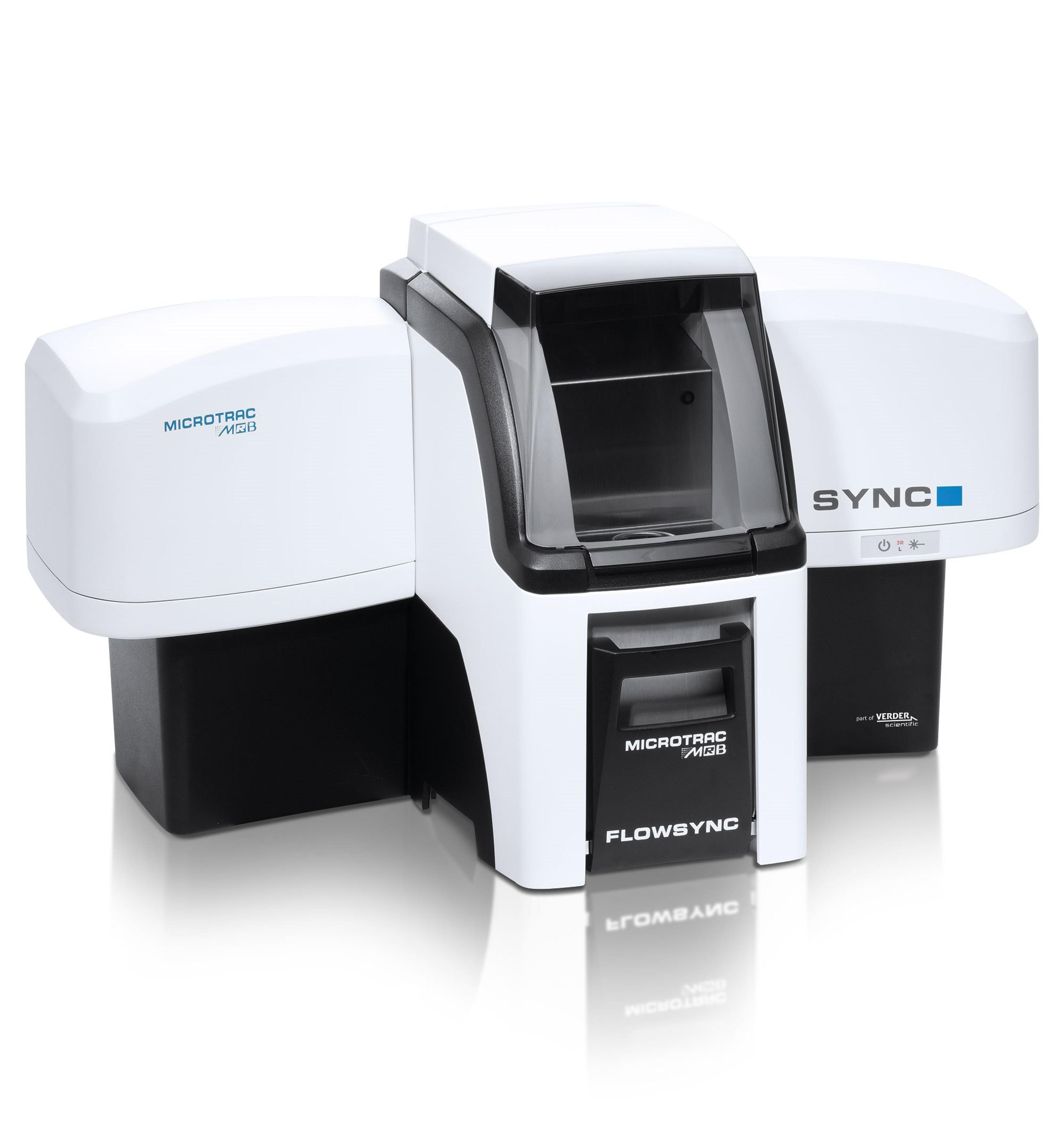
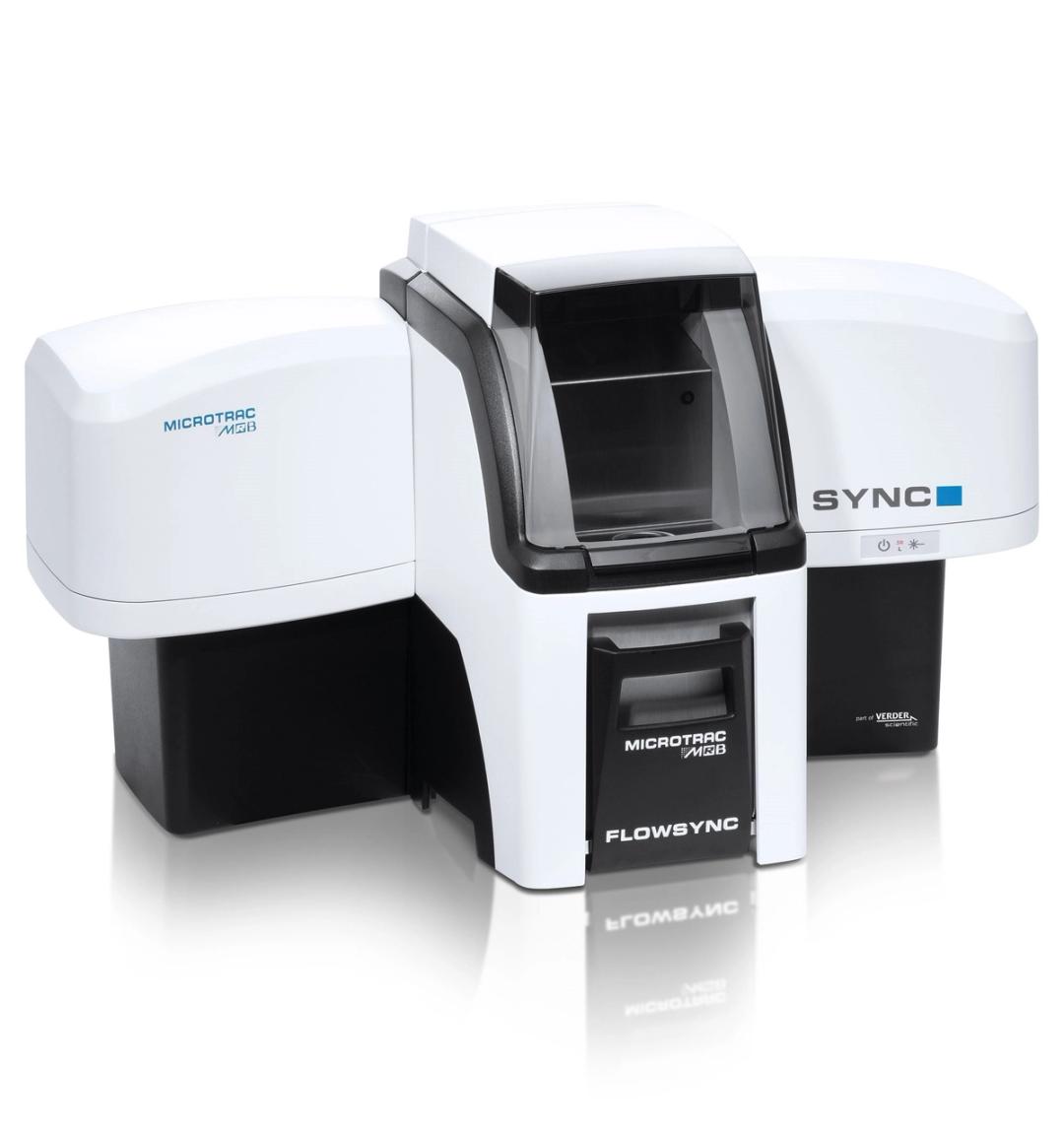
The Microtrac MRB SYNC Analyzer provides traditional users of laser diffraction technology with exciting new capabilities to characterize their materials. The proven tri-laser technology provides accurate and repeatable laser diffraction information from light detected over 163 degrees of angular scatter. When combined with state-of-the-art camera technology capturing images of the particle stream at the same time, the SYNC offers not only size data but also additional information about the shape of the materials and the quality of the dispersion.
The patented synchronous measurement technology of the SYNC allows users to make both a laser diffraction measurement and image analysis on a single sample, in the same sample cell at the same time: One sample, one optical bench, one flow path, one sample cell, one integrated GUI, one analysis.
This makes the SYNC ideally suited for both routine QC and research applications; it provides valuable information to researchers as they develop new materials and processes. The powerful software interface offers both particle size distribution information as well as a multitude of morphological parameters. The patented BLEND routine allows users to examine materials over a wide size range from 0.01 microns to 4000 microns
Brochures

Applications for battery technology
Battery technology has emerged as a critical component in the energy transition, transforming electric transportation, renewable energy integration, and grid resilience. Microtrac highlights how its instrument range can be used for battery technology applications. Discover how the CAMSIZER 3D provides relevant size and shape parameters within a short space of time and can withstand harsh production environments, making it ideal for process-related particle measurement. Plus, learn how Microtrac technologies may be used to make measurements of density, gas adsorption and porosity, central factors in the analysis of battery active materials.
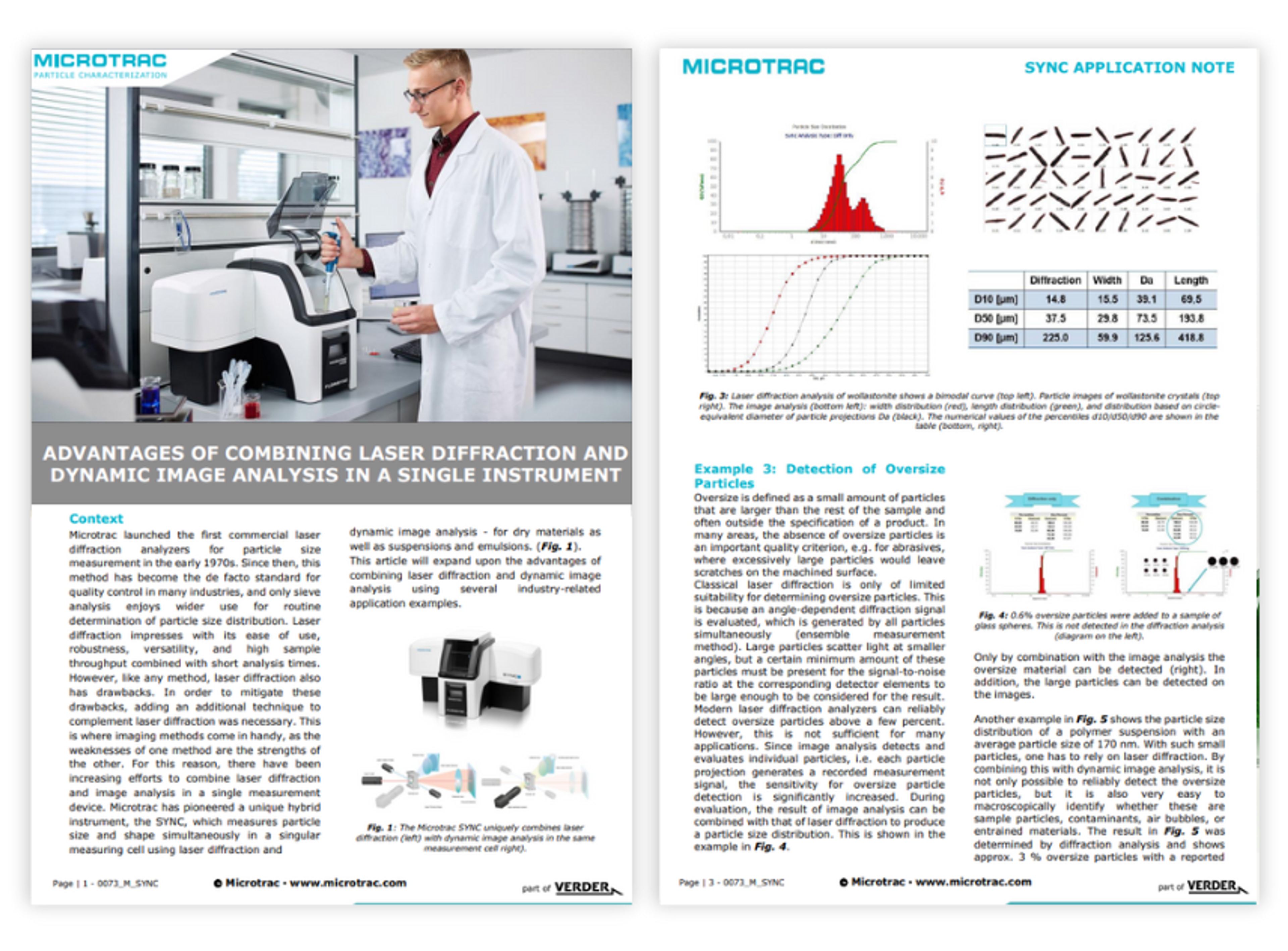
Advantages of combining laser diffraction and dynamic image analysis in a single instrument
Laser diffraction analyzers have been the standard instrument for quality control to measure particle size in many industries. With its ease of use, robustness and versatility, laser diffraction can provide high sample throughput and reduced analysis time. However, like any method, laser diffraction also has its own drawbacks. In order to mitigate these drawbacks, Microtrac has pioneered the SYNC, a unique hybrid instrument to combine laser diffraction with image analysis.
Explore how the SYNC can measure particle size and shape simultaneously in a singular measuring cell using laser diffraction and dynamic image analysis – for dry materials as well as suspensions and emulsions. Plus, discover the advantages of combining laser diffraction and dynamic image analysis using several industry-related application examples.
Measurement of battery materials with laser diffraction - an overview
In this application note, Microtrac MRB provides an overview with examples of battery material measurements using laser diffraction. The optimization and safety of lithium-ion batteries in the reduction of cell aging is very important. One of the most critical factors is the particle size of the active materials like cathode, anode, and separator material. The particle size of the anode, cathode, and separator material affects the electrochemical performance of batteries. Smaller particle size will lead to shorter pathways in solid materials and decreased overall potential leading to improvements in the charge/discharge rate (C rate). Smaller particle size results in larger surface area which leads to a larger proportion of passivation at the solid electrolyte interphase which can reduce battery capacity.
Metallic effect pigments
In this application note, Microtrac MRB presents experimental data on the particle size distribution of two aluminum effect pigments investigated using laser diffraction. Effect pigments are pigments that impart additional properties to the system in which they are embedded, such as angle-dependent changes in hue or gloss, or texture. Effect pigments are divided into metal effect pigments and special effect pigments. Metal effect pigments are luster pigments made of metal that have a parallel orientation in the application and exhibit a metal-like effect produced by the reflection of light from the metal platelets. Important metal effect pigments are aluminum, brass and copper flakes. Non-metallic effect pigments are, for example, mica (sheet silicates), graphite, iron oxides, or molybdenum sulfide. What most effect pigments have in common is the flaky structure of the particles. In contrast to classic pigments, their effect is not primarily based on the absorption of certain wavelengths, but on reflection and interference. While classical pigments such as titanium dioxide often have particle sizes of a few 100 nanometers, the platelet-shaped effect pigments usually have a diameter of 5 - 100 µm, but much smaller layer thicknesses.
Examination of a time release OTC drug by laser diffraction particle size measurement and image analysis
In this application note, Microtrac MRB presents experiments that describe information obtained on a timed-release OTC anti-heartburn medication utilizing laser diffraction particle size measurement and image analysis.
Particle Size and Shape Analyzer SYNC
In this video, Microtrac MRB presents the SYNC analyzer, which combines laser diffraction with dynamic image analysis. The Microtrac MRB SYNC Analyzer provides traditional users of laser diffraction technology with exciting new capabilities to characterize their materials. The proven tri-laser technology provides accurate and repeatable laser diffraction information from light detected over 163 degrees of angular scatter. When combined with state-of-the-art camera technology capturing images of the particle stream at the same time, the SYNC offers not only size data but also additional information about the shape of the materials and the quality of the dispersion.

Advances in materials characterization, from graphene production and correlative imaging to transmission Raman spectroscopy
Explore cutting-edge technologies and the latest resources to support your materials characterization