ChromSpace
GCxGC software



The supplier does not provide quotations for this product through SelectScience. You can search for similar products in our Product Directory.
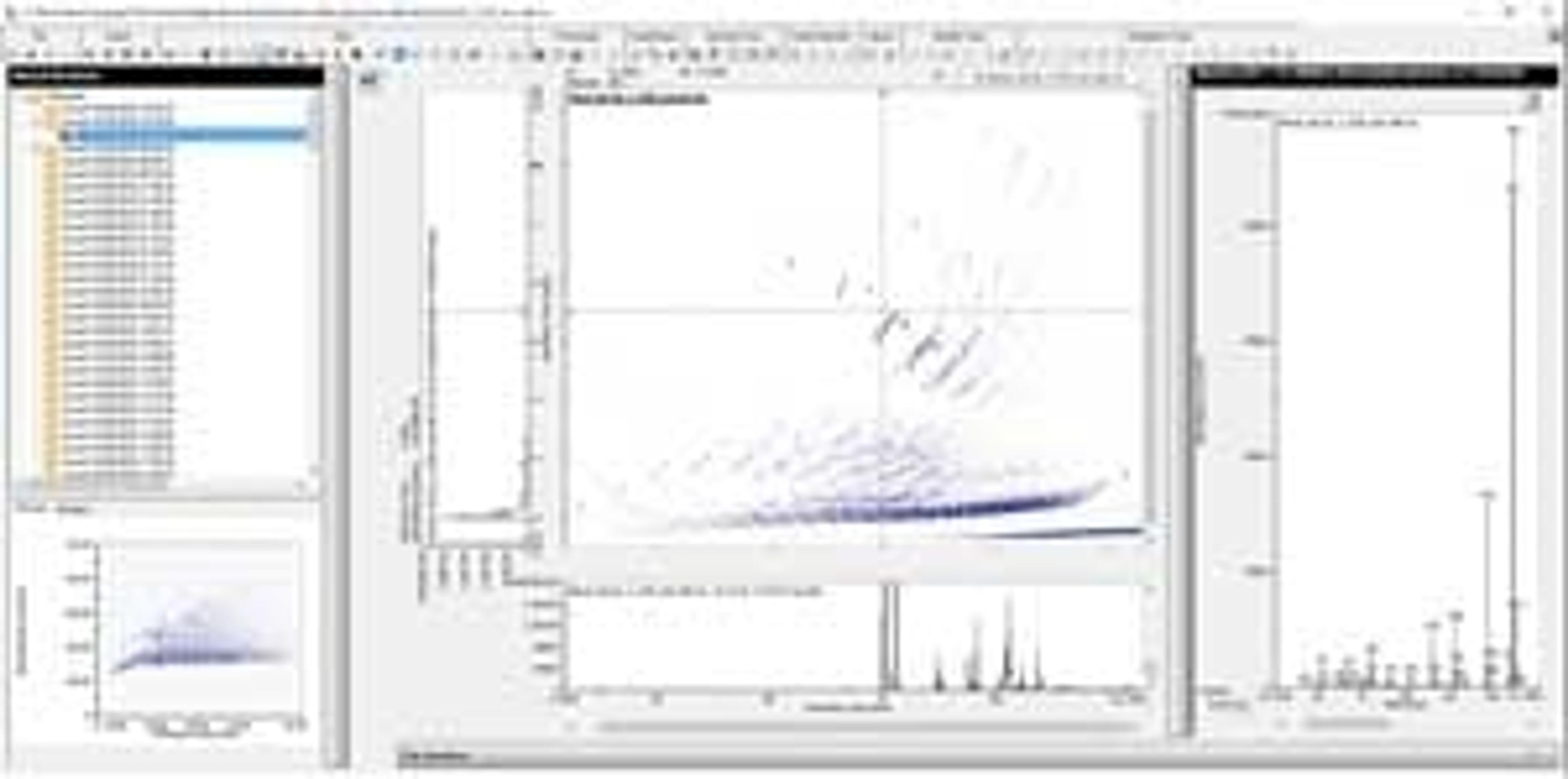
GC×GC data is acquired by a detector in a linear (1D) format, so specialist software is required to ‘fold’ the data in order to view colour and surface plots.
ChromSpace allows GC×GC to be a productive contributor in any high-throughput laboratory, by enabling sophisticated peak merging, flexible data navigation and streamlined workflows.
Time-saving features, such as instant display of library matches and dynamically-linked panes, make GC×GC data exploration effortless, while a unique combination of peak perception algorithms ensures that even trace-level, masked peaks are not overlooked or incorrectly merged.
Product benefits:
- Customisable layout to suit all users.
- Global deconvolution to expose hidden peaks.
- Simplified, user-friendly quantitative workflow.
- Simultaneous acquisition and processing of MS (.lsc and .cdf) and single-channel data, e.g. FID.

Untargeted comparison of soft drink brands using immersive sorptive extraction, GC×GC–TOF MS, and chemometrics
In this application note, SepSolve uses an immersive sorptive extraction coupled with comprehensive two-dimensional gas chromatography and BenchTOF2™ time-of-flight mass spectrometry (GC×GC—TOF MS) to compare flavor profiles from popular brand soft drinks with those of imitation products.
Reverse engineering the aroma of plant-based meat substitutes
This study describes the use of headspace sorptive extraction with GCxGC-TOF MS to compare the volatile profiles of ground meat and plant-based substitutes.
Discovery of biomarkers in breath and other biological samples
The accurate identification and measurement of biomarkers in biological samples - such as breath and biofluids - has the potential to provide rapid, minimally-evasive diagnosis of a range of physiological and pathological conditions. In this application guide, SepSolve Analytical describes how flexible sampling coupled with high-performance GC-MS or GCxGC-MS enables the maximum possible number of compounds to be identified in a realistic run time.
Discovery of biomarkers in breath: Enhancing separation and identification using GCxGC-TOF MS
In this study, SepSolve Analytical describes the comprehensive, high-sensitivity screening of disease biomarkers, through use of sampling onto TD tubes, automated preconcentration, and GCxGC-TOF MS.
Discovery of biomarkers in breath: Development and optimization of a TD-GCxGC-TOF MS analytical platform
This study by SepSolve Analytical describes the development of an analytical platform based upon TD-GCxGC-TOF MS and shows its application to the collection and analysis of breath samples.
Fast and efficient group-type (PiPNA) classification of jet fuels
This study demonstrates the performance of flow-modulated GC×GC for robust group-type characterisation of jet fuels, with quantitative analysis by flame ionisation detection (FID) and confident identification of trace-level contaminants by mass spectrometry.
Routine monitoring of airborne VOCs using TD-GCxGC-TOF MS/FID
This study demonstrates the suitability of a TD–GC×GC system with dual TOF MS/FID detection for the routine, automated analysis of volatile organic compounds (VOCs) in complex air samples. Analysis of a TO-15 standard demonstrates excellent peak shape and repeatability, with integrated control and simple data processing on a single platform.
Aroma profiling of hops and beer using high-capacity sorptive extraction with GC×GC–FID/TOF MS/SCD
This study demonstrates the use of a multi-hyphenated analytical system to provide flexible yet comprehensive aroma profiling of hops and beer, as well as detection of trace odour taints, on a single, fully-automated platform.
Automated aroma profiling of wine using sorptive extraction with GC×GC-TOF MS/SCD
This study demonstrates the use of headspace sorptive extraction coupled with GC×GC–TOF MS/SCD to provide comprehensive information on wine aroma and odour taints on a single, fully automated, cryogen-free platform. The added value of Tandem Ionisation® for confident identification of aroma-active species that can be challenging to identify by conventional 70 eV electron ionisation alone is also shown.
GC×GC Applications Guide
GC×GC first attracted attention in the late 1970s, but for many years advances in conventional GC–MS meant that its superior separation capacity was not seen as being worth the additional technical complexity.
Thanks to greatly improved hardware and software, this has changed, and as a result GC×GC is now being routinely used in a variety of fields. This guide demonstrates just some of the most important applications.