Phytocannabinoid Mixture 10 (CRM)
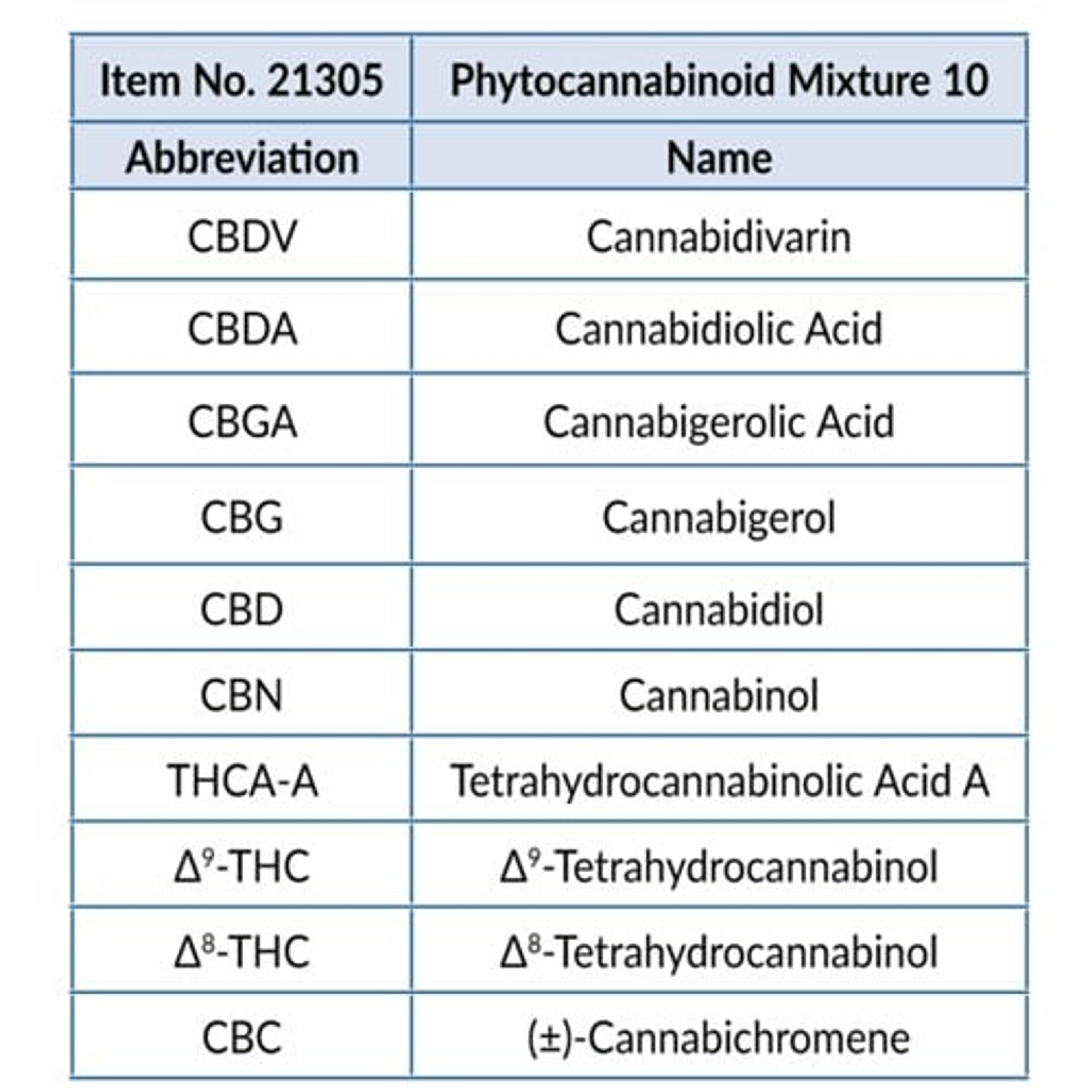
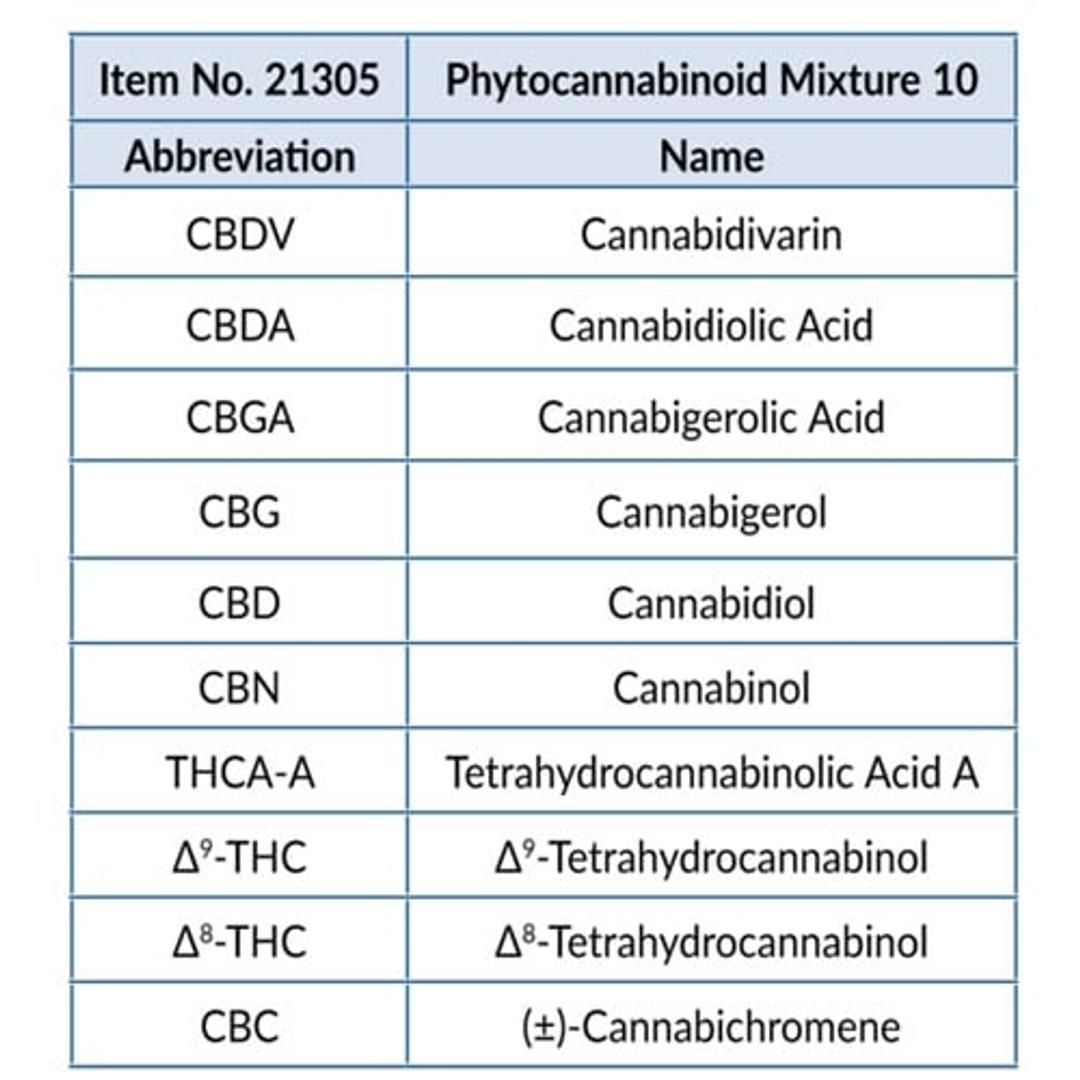
Phytocannabinoid mixture 10 (CRM) (Item No. 21305) is a certified reference material mixture containing tetrahydrocannabinols, which are regulated as Schedule I compounds in the US. Included are Δ9-THC, Δ8-THC, tetrahydrocannabinolic acid A, cannabinol, cannabidiol, cannabidiolic acid, (±)-cannabichromene, cannabigerol, cannabigerolic acid, and cannabidivarin. It is supplied in an amber ampule in which the headspace has been…



The supplier does not provide quotations for this product through SelectScience. You can search for similar products in our Product Directory.
- Each compound provided at 250 µg/ml in acetonitrile (1 ml/ampule, nominal)
- This product is qualified as a Certified Reference Material (CRM) that has been manufactured and tested to meet ISO/IEC 17025 and ISO 17034 international standards
- This CRM has been characterized by metrologically valid procedures and may be used as a quantitative analytical reference standard
- Certificate of analysis provides the certified property values and the associated uncertainties, including a statement of metrological traceability for the certified values
- Possession of a DEA Controlled Substance registration is not necessary nor is a DEA 222 form required to purchase this product
- Bulk material is available for qualified institutions

Certified reference materials for the cannabis industry: Solving the production puzzle
In this technical note, Cayman Chemical discusses how to choose what compounds to make into certified reference materials (CRM) and how long does it take to make a CRM.
Phytocannabinoid guide: Biosynthesis, naming and numbering
In this poster, Cayman Chemical highlights the naming and numbering conventions of phytocannabinoids as well as the biosynthesis for the orcinol, olivtol, and varinol series.
Phytocannabinoids: What is on the horizon?
In this application note, Cayman Chemical discusses the latest developments in phytocannnabinoid research, testing, and legislation.
CRM mixtures improve quantitation accuracy
In this application note, Cayman Chemical explains the key considerations when using certified reference material (CRM) mixtures and highlights how CRMs can improve reproducibility, precision, and accuracy of cannabis product quality testing and profiling.
Comparison of CRM concentrations among four different reference material producers
In this application note, Cayman Chemical compares the reported concentration of 11 individual cannabinoid CRMs from four different reference material producers. Cayman found no significant variability in CRM concentrations among products produced under the ISO 17034 standard, reaffirming the competence of manufacturers.
Cannabis testing standards: Improve accuracy and reduce consumable cost, variability, and time
In this application note, Cayman Chemical provides analytical reference standards and ISO 17034-produced certified reference materials (CRMs) to identify and quantitatively measure the components found in cannabis products to aid in potency testing, terpene profiling, and analysis of contaminants.
Analytical data confidence is highest with commercially prepared CRM mixtures
In this application note, Cayman Chemical compares a typical method for preparing stock solutions from several single-component certified reference materials (CRMs) against the use of a premade multicomponent CRM.
Phytocannabinoid known unknowns
In this webinar, Jeffery Williams, Process Chemistry Exploration Department at Cayman Chemical, discusses degradation pathways of phytocannabinoids and cannabis sinusoids to try and help the accuracy, reliability, and reproducibility of your workflow.