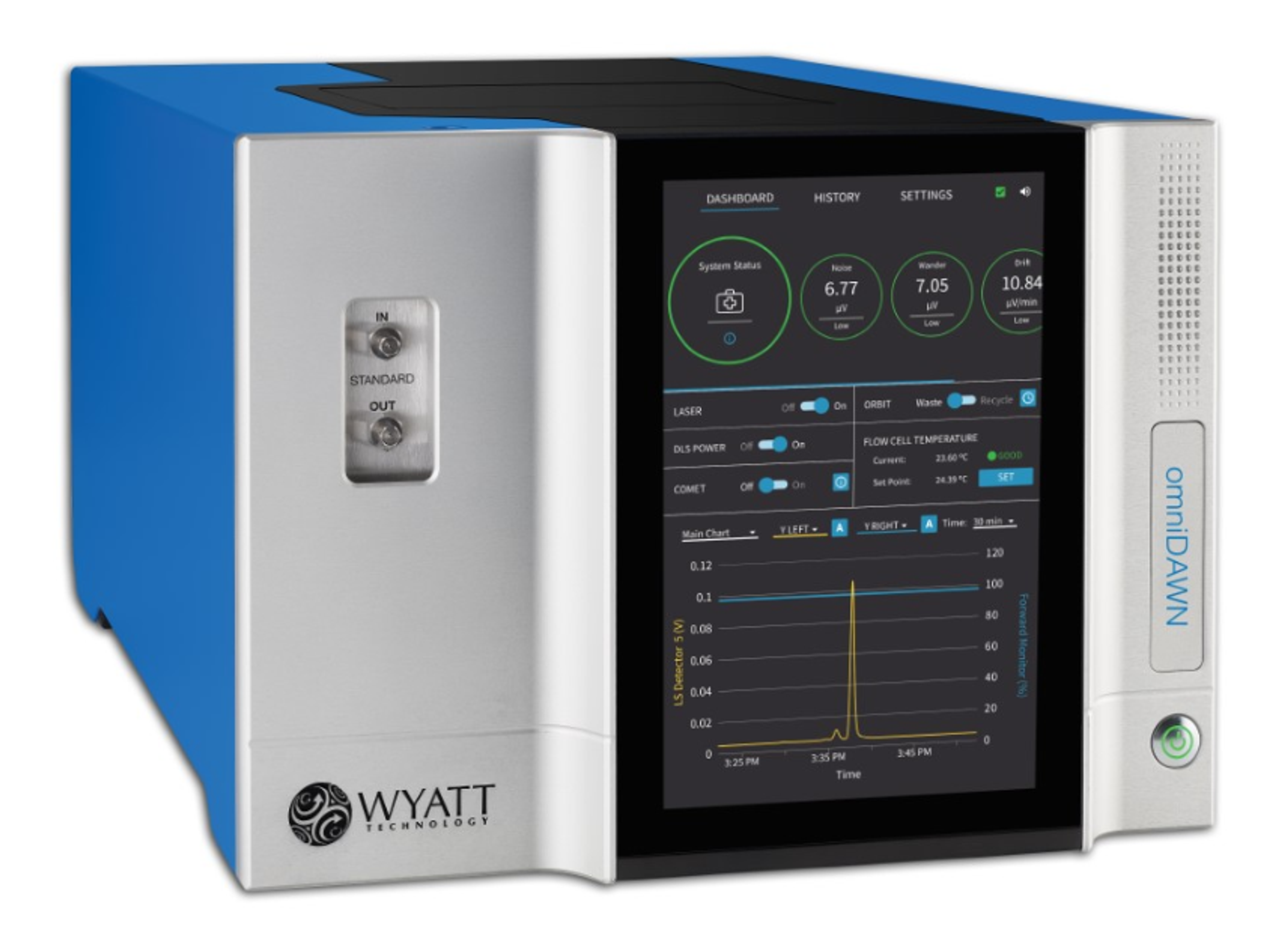
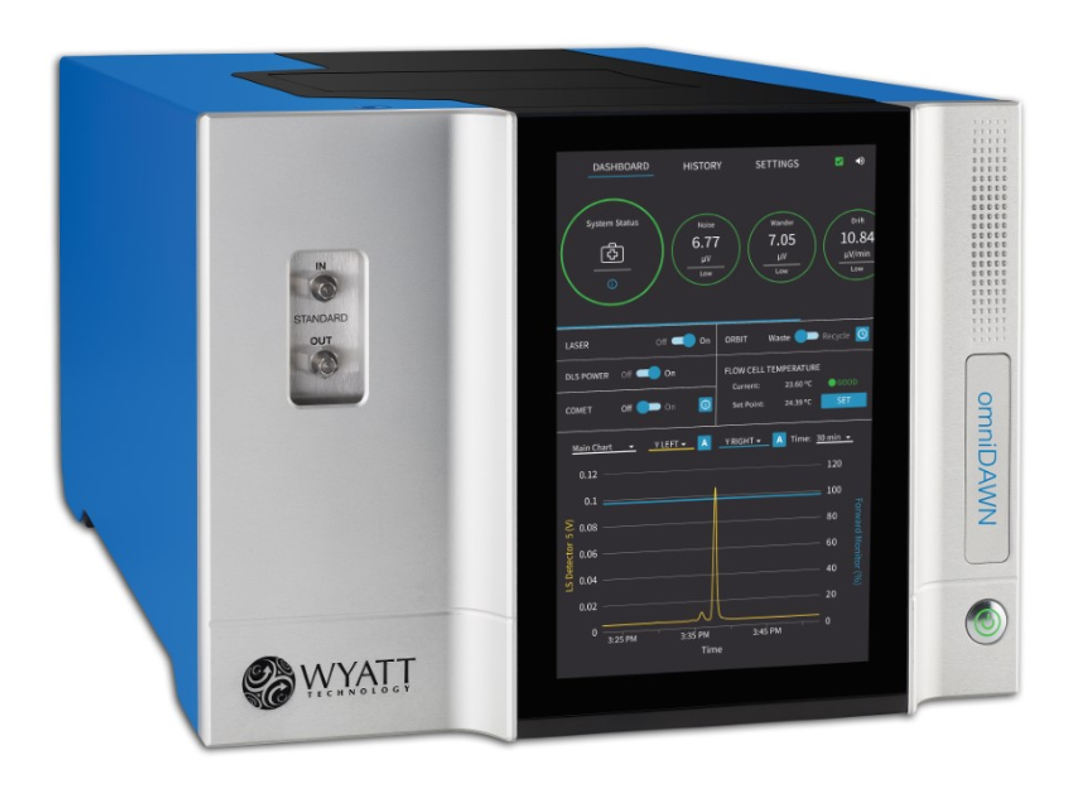
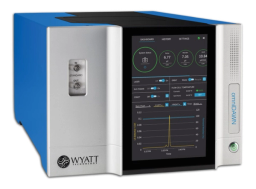
omniDAWN™ Multi-angle Light Scattering (MALS) Instrument
Delivering up to 4× faster runs with half the sample, the omniDAWN™ multi-angle static light scattering (MALS) photometer is purpose-built for UPLC™ and UHPLC systems for non-destructive absolute molar mass and size characterization of macromolecules and nanoparticles in solution.

Receive your quote directly from the manufacturer.
Delivering up to 4× faster runs with half the sample, the omniDAWN™ multi-angle static light scattering (MALS) photometer is purpose-built for UPLC™ and UHPLC systems for non-destructive absolute molar mass and size characterization of macromolecules and nanoparticles in solution. It provides exceptional sensitivity across a broad range of molecular weights, sizes, and concentrations, supported by advanced analysis modules, practical implementation guides, and intelligent system health monitoring to ensure reliable performance and streamlined workflows.
Specifications
| Measurement Mode(s) | 18 angles |
| Applications | With standard SEC/GPC or EclipseTM (FFF system): determination of distributions of molar mass, size, conformation, conjugation ratio and particle concentration. With Calypso composition-gradient system: label-free characterization of biomolecular interactions including self- and hetero-association as well as non-specific interactions. |
| Sensitivity | 10 ng of 100 kDa polystyrene in THF, under typical GPC conditions |
| 0.2 µg of BSA under a typical 30 cm column | |
| Measuring Range | 200 Da to 1000 MDa |
| Wavelength(s) | 658 nm; 785 nm available for fluorescence reduction (with lower sensitivity than 658 nm) |
| Type | MALS and optional DLS |
| Measuring Time | Depedent on LC separation |
| Radius of Gyration Range | Rg (rms radius): 10 nm to 500 nm |
| Rh (hydrodynamic radius): 0.5 nm to 300 nm or up to 1 µm (with optional DLS module; upper limit is configuration-dependent) | |
| Dimensions | (WxDxH) 36 x 60 x 23 cm |
| Detector(s) | High-gain, high-dynamic-range photodiodes at 18 angles for MALS; optional avalanche photodiode that may be placed at any of four angles for DLS. |
| Fluorescence-blocking filters available for use with analytes that fluoresce when illuminated at the MALS wavelength. | |
| Temperature Range | Ambient; Heated/Cooled (HC): -15°C to +150°C; Ultra-High-Temperature (UHT): ambient to +210°C |
| Interface | 10" high-resolution, color LCD multi-touch-screen display, and ASTRA host software |
| Sample Type | Peptides, proteins, nucleic acids, polymers, lipid nanoparticles, viruses, and other macromolecules |
| Control | Programmable 10% - 100% (laser power) |
| Light Source | 658 nm laser, programmable 10% - 100% of maximum power. |
| Optional: 785 nm for fluorescence suppression | |
| Dynamic Range | 3,300,000:1 |
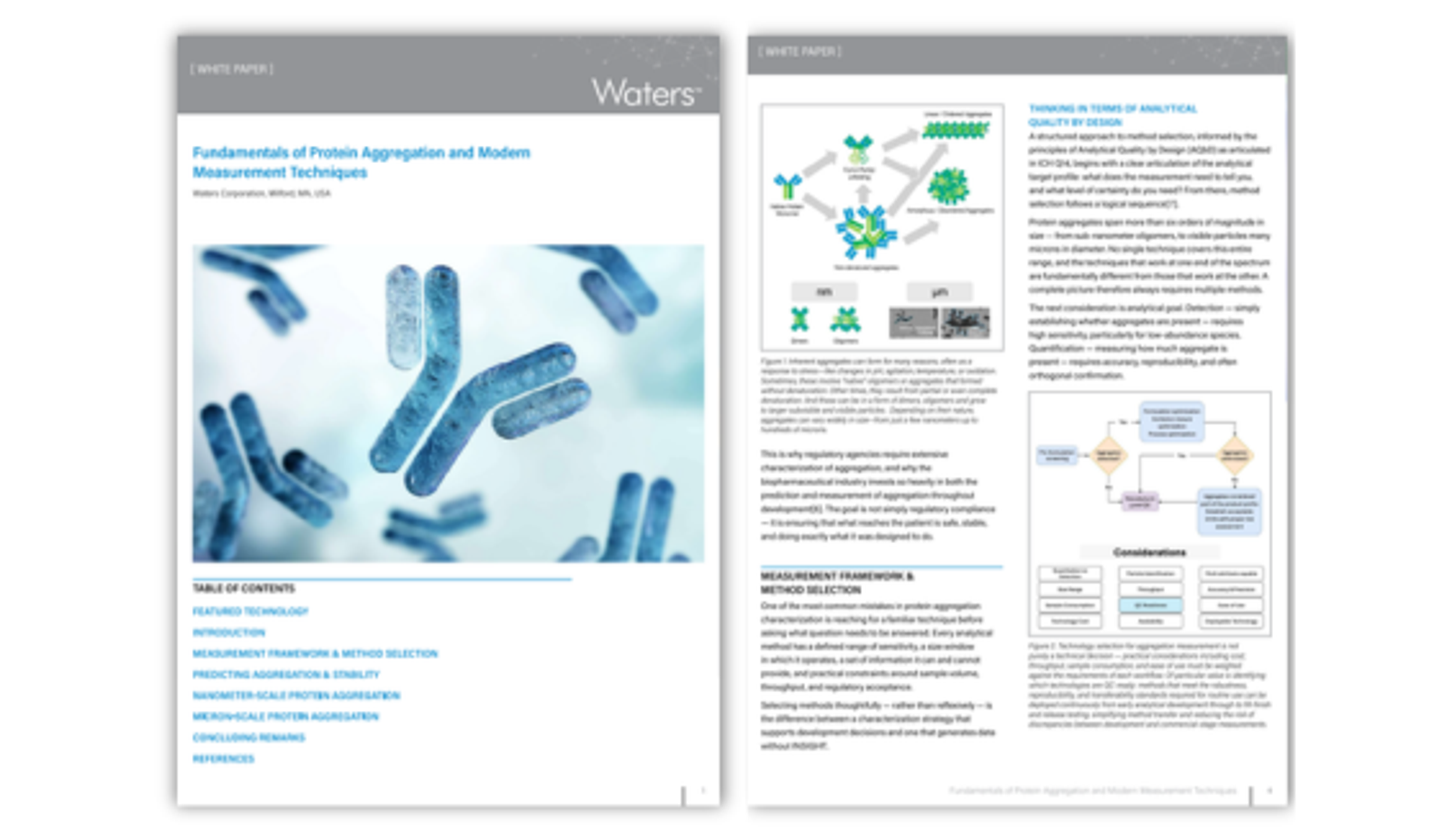
Fundamentals of protein aggregation and modern measurement techniques
Protein aggregation remains one of the most significant challenges in biopharmaceutical development. Aggregates can form during production, purification, formulation, storage, and administration, with sizes ranging from tiny oligomers to visible particles. Detecting, characterizing, and mitigating these species is critical for maintaining product quality, stability, and patient safety.
Explore in this whitepaper the fundamentals of protein aggregation and the modern techniques used to predict, measure, and characterize it throughout development. Learn how dynamic light scattering (DLS), size-exclusion chromatography with multi-angle light scattering (SEC-MALS), and backgrounded membrane imaging (BMI) provide complementary insights to support confident decisions, strengthen product quality, and advance safer biotherapeutics.
Resource details:
Resource type: Whitepaper
Page count: 16
Read time: 22 mins