RapiGest™ SF Protein Solubilization Reagent
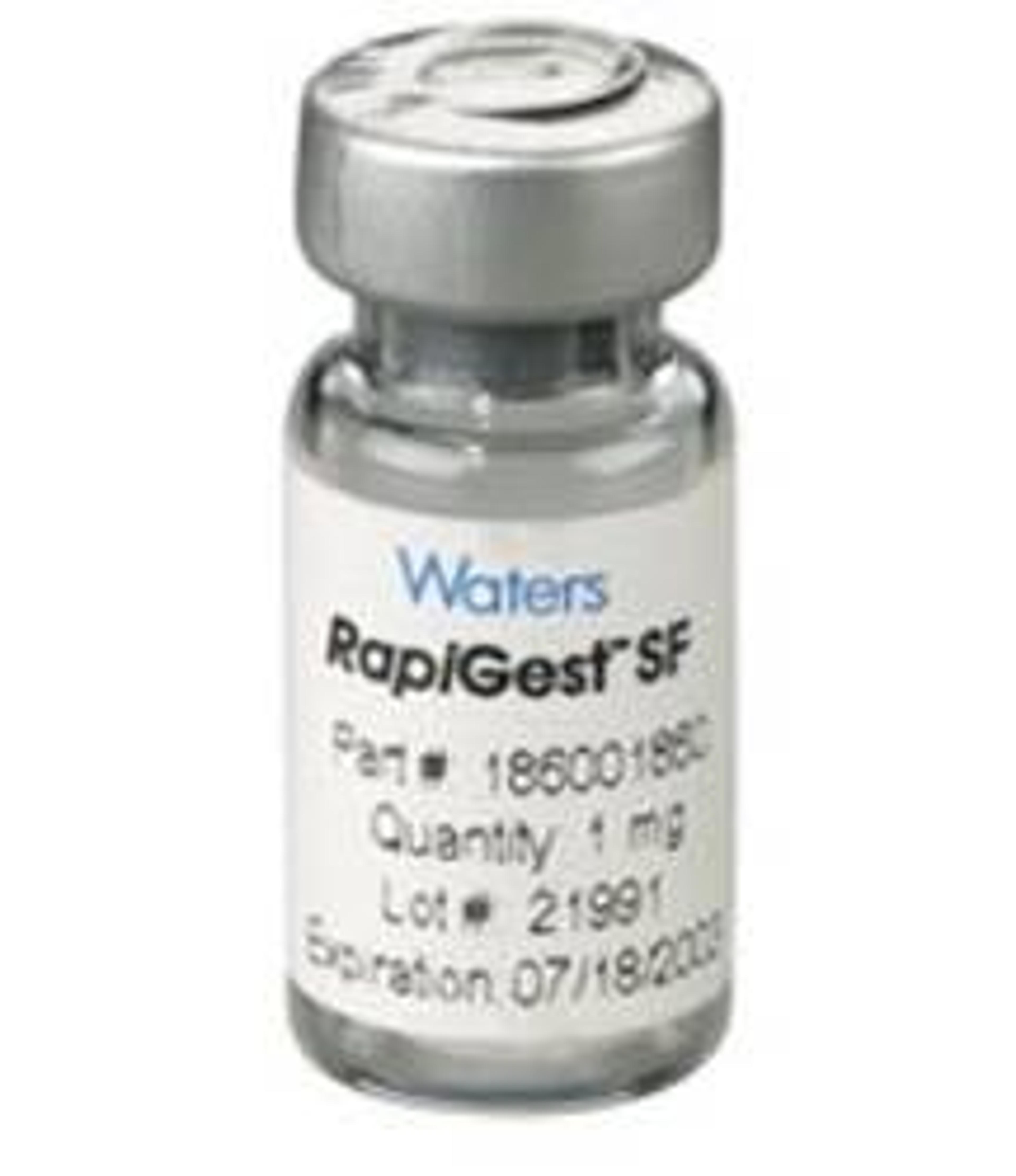
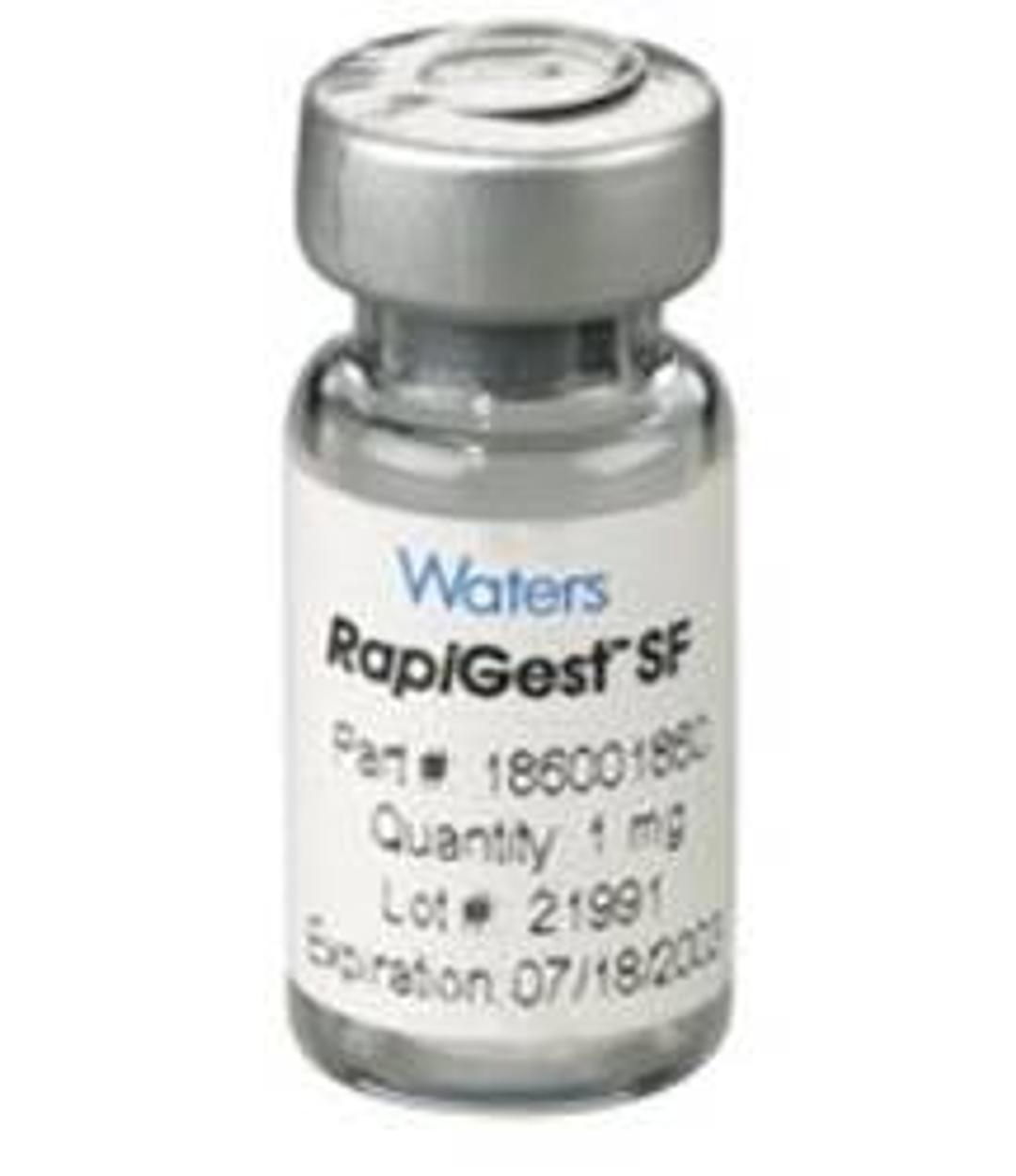
The patented RapiGest™ SF Surfactant is a reagent used to enhance enzymatic digestion of proteins, both in-gel and in-solution. RapiGest SF helps solubilize proteins, making them more susceptible to enzymatic cleavage without inhibiting enzyme activity.Unlike other commonly used denaturants, such as SDS or urea, RapiGest SF does not modify peptides or suppress protease activity. It is compatible with enzymes such as Trypsin,…

Place your order directly with the manufacturer.
Very handy stuff!! Yields good results
Proteomics
It really helps to solve a lot of sample prep issues and alongside fosters efficient digestion.
Review Date: 2 Oct 2017 | Waters
A great tool for producing high quality data for complex analyses
Antibody digestion for peptide level analysis via LC-MS
Provides an easy to use option to help produce more complete, reproducible digests.
Review Date: 29 Sept 2017 | Waters
I am going to try it one more time
Digestion of surface proteins
Initial results look promising but I haven't been able to reproduce it.
Review Date: 29 Sept 2017 | Waters
Fantastic tool for N-glycan analysis, sped up our digestion times by 500%!
Rapidly digest mABs for N-glycan analysis
The RapiGest SF Surfactant is an excellent denaturation reagent and cut the total analysis time for our QC Release assay for N-glycan analysis down from 16 hours to only a few hours!
Review Date: 29 Sept 2017 | Waters
RapiGest gives a better digest for select mAbs, but with some non-specific fragments.
Non-reduced solution digestion of mAbs for identity confirmation by peptide mapping
For select mAbs non-reduced, RapiGest produces more complete digestion than digestion in buffer or in combination with an organic solvent. However, expect to observe some undesired non-specific fragmentation.
Review Date: 29 Sept 2017 | Waters
Useful
study of secretome of MSCs
Rapigest definitely is helping to my sample preparation while trypsin digestion. Easy to use and easy to remove after precipitation. I haven't used filtration of my sample since I can clearly remove the precipitate.
Review Date: 29 Sept 2017 | Waters
Easy to use and reproducible results
Analyze biologics of different modalities (mAb, Fusion protein, BiTE, etc) by peptide mapping
The product has been effective in providing the desired results with reduced and non-reduced peptide mapping for different biologic products with reproducible results.
Review Date: 27 Sept 2017 | Waters
Easy to use!
protein sample
Easy to use, saves time, reliable I use it for N-linked Glycan Profiling Analysis of Protein use , using HILIC UPLC.
Review Date: 25 Sept 2017 | Waters
Very effective and easy to use.
Glycan profiling, peptide mapping
The reagent provides very effective denaturation of proteins for peptide map analysis. The protocols are easy to follow. We also use this as part of the RapiFluor MS kit for glycan profiling as a protein denaturant. It is very effective in this regard.
Review Date: 24 Sept 2017 | Waters
Excellent reagent for Glycan profiling
Glycan profiling of mAbs
Very easy to use, yields high quality and consistent results.
Review Date: 22 Sept 2017 | Waters
The patented RapiGest™ SF Surfactant is a reagent used to enhance enzymatic digestion of proteins, both in-gel and in-solution. RapiGest SF helps solubilize proteins, making them more susceptible to enzymatic cleavage without inhibiting enzyme activity.
Unlike other commonly used denaturants, such as SDS or urea, RapiGest SF does not modify peptides or suppress protease activity. It is compatible with enzymes such as Trypsin, Lys-C, Asp-N, Glu-C, PNGaseF and other enzymes.
- Compatible for LC and MS analysis
- Improves efficiency and speed of digestion
- Degraded at low pH and removed from the sample
- Simplifies preparation protocols and improves throughput of analysis
US Patent No: 7,229,539 and US 8,580,533

A Multi-Omic Approach for the Study of Heart Regeneration Using Zebrafish as a Model Organism
Previous studies involving the excision of heart tissue from zebrafish have shown tissue to regenerate in only a few days following amputation. Detailed analysis using genomic and proteomic approaches have identified a number of potential candidates that may be implicated in the regeneration process.
This application note uses a multi-omics approach to study zebrafish plasma, rather than the excised tissue, to provide a greater understanding of the mechanisms involved in heart tissue regeneration following the operation. Lipidomic and proteomic data have been collected using a label-free LC-HDMS approach.
Absolute Quantitation of RapiFluor-MS Labeled N-Glycans by Calibration of Fluorescence Response
Glycosylation plays an important role in the structure and function of proteins, and altered glycosylation is implicated in numerous diseases such as cancer, autoimmune diseases and neurodegenerative diseases. In this application note, Waters presents a new method for the preparation and analysis of N-glycans and shows how the RapiFluor-MS Quantitative Standard can be used to calibrate fluorescence response and absolute quantitation.
Analysis of Labeled and Non-Labeled Proteomic Data Using Progenesis QI for Proteomics
In this application note, the identification and quantification of isotopically-labeled and label-free proteomic data sets are illustrated using Progenesis QI for proteomics solution. Progenesis QI for proteomics was successfully applied for a number of “bottom-up” proteomic applications, including the analysis of labeled and nonlabeled data acquired in DDA or DIA mode of acquisition.
A Label-Free, Multi-Omic Study to Qualitatively and Quantitatively Characterize the Effects of a Glucosylceramide Inhibitor on Obesity
This study shows a label-free multi-omics approach to collecting qualitative and quantitative information in a single experiment, to help characterize and investigate the effects of a glucosylceramide inhibitor for treatment of obesity.