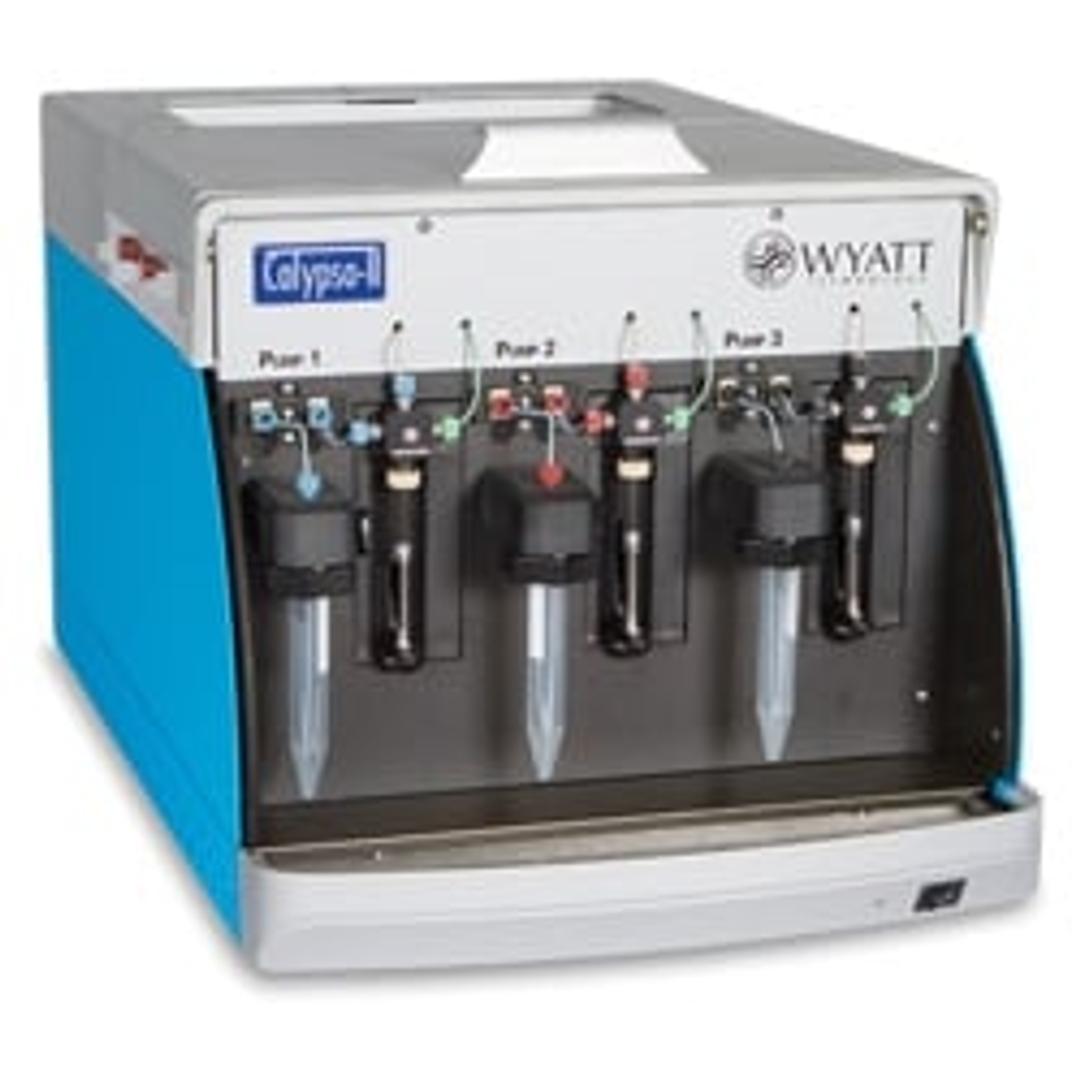
Calypso™ Biomolecular Interaction Analysis System
Absolute characterization of protein-protein and other macromolecular interactions with composition-gradient multi-angle light scattering.

Receive your quote directly from the manufacturer.
Wyatt CG-MALS is a core technique that is invaluable for a protein scientist!
Analysis of protein-protein interactions and protein self-association
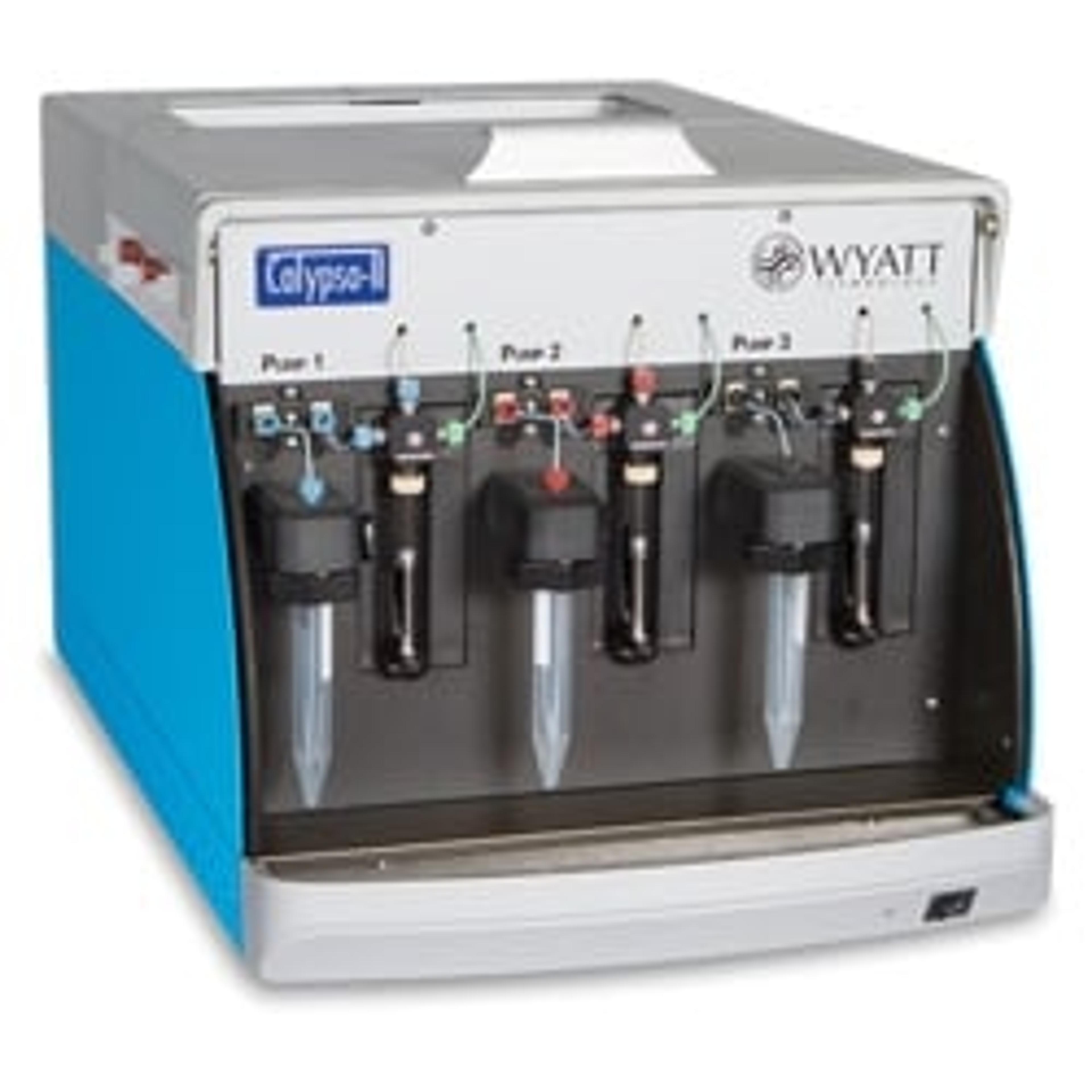
The Calypso II instrument, used in combination with a Wyatt Multi-Angle Light Scattering (MALS) instrument and a Differential Refractive Index instrument, allow for the collection of Composition-Gradient MALS data (CG-MALS). The instrument works as stopped-flow mixer to introduce protein samples, as a function of concentration, into the detectors. Examination of the changes in light scattering and the absolute MW can provide invaluable insight into molecular associations (protein-protein or protein-other molecule). In our laboratory, our main area of investigation is the formation of higher order structures as a function of protein concentration, information that is paramount in the development of both purification processes and formulation selection. The self-interaction application allows for the measurement of the interaction parameter (A2 or B22). The user is able to analyze the data by several different association models to determine how the molecules are interacting and how the size and population of the oligomers change with protein concentration and/or buffer conditions. The instrument is user-friendly, very robust and easy to maintain. The most valuable thing that I have gained from the instrument, aside from high quality results, is how much I have learned from the Wyatt application scientists regarding the fundamentals of protein interactions and how to interpret CG-MALS data. This knowledge goes beyond the use of the Calypso II instrument into other characterization methods that we use and the way we set up experiments and interpret results. Wyatt Technology is a great company to work with!
Review Date: 25 Jul 2017 | Waters
Phenomenal service from hard working technical support staff
Protein interactions
Binding studies with the Calypso are easy to set up, take only a few hours, and are easy to interpret. The technical support from Wyatt is both deeply and broadly knowledgeable. There are few places that offer the scope and quality of training Wyatt provides. I use Calypso II to measure both the stoichiometry and association constants of protein-protein interactions. Most binding methods have readouts that do not have physical meaning, such as maximum amplitude or slope of binding curve. Another major common problem is that models that describe the data contain parameters that are non-identifiable. Most experiments on the Calypso are not subject to the same issues. The determination of mass by the light scattering is not subject to the same concerns as other binding assays. 1) The mass is calculated on a calibrated instrument where all other parameters that affect light-scattering can be measured. 2) The structure that the Calypso data report has a structure that is informative on both the stoichiometry and the Kd. No more slopes or maxima! Even compared to the "Gold standard" analytical ultracentrifugation, Calypso (or composition gradient multi-angle light scattering CG-MALS) is superior. We found that non-1:1 stoichiometries of protein complexes can be very difficult to analyze with AUC data, whether using equilibrium sedimentation or velocity sedimentation. Although we get consistent results for the sedimentation rate for particles, the calculation of mass from any AUC data can run into identifiability issues. In contrast, experiments with CG-MALS can be designed to directly explore which stoichiometries can form at specific molar ratios of each particle. Furthermore, less sample and far less time is required. I strongly recommend using Wyatt instruments for particle characterization. Competitors like Malvern have not caught up and they do not provide any instrument that does anything comparable to the Calypso II. Wyatt provides unmatched service beyond the purchase of the instrument. We have used Wyatt instruments for over a decade without any drop in their excellent support.
Review Date: 26 Jun 2017 | Waters
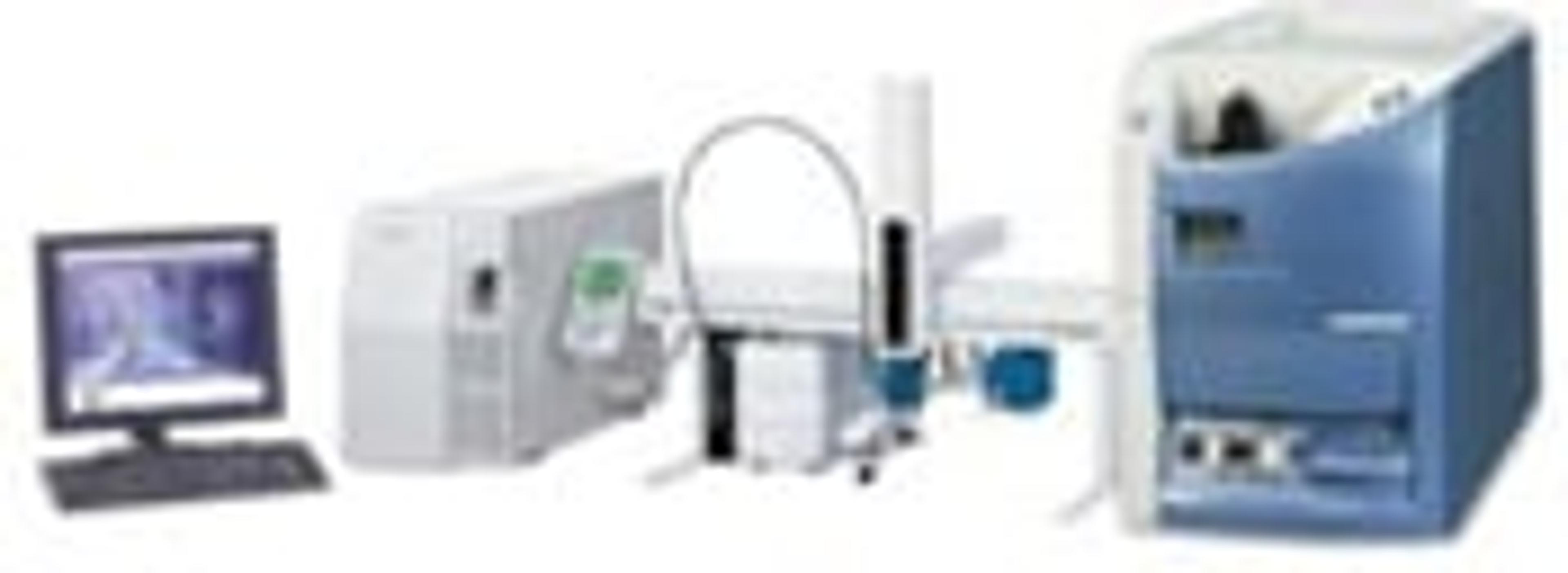
The Calypso™ interfaces with a Wyatt multi-angle light-scattering detector (DAWN™ or miniDAWN™) and a UV or RI concentration detector to analyze biomolecular interactions, without labeling or immobilization. The Calypso™ system determines affinity, absolute molecular stoichiometry of complexes, and the kinetics of self-assembly, aggregation or dissociation of macromolecular complexes, by means of composition-gradient multi-angle light scattering (CG-MALS).
The Calypso™ software for control, data acquisition and analysis offers a comprehensive suite of association models for studying self-association and hetero-association including high-order oligomerization, simultaneous self- and hetero-association, and multi-valent interactions. This unique technology nicely complements surface plasmon resonance (SPR), isothermal titration calorimetry (ITC), and other biophysical techniques for characterizing interactions; in addition, it is much faster and simpler than analytical ultracentrifugation.
Features:
- Range of Kd: sub-pM to mM, depending on molar mass of the analytes
- Sample requirement: depends on molar mass and Kd. A typical interaction analysis in the range of 1 – 100 nM for ~ 100 kDa proteins requires ~ 100 µg of each protein.
- Solvent compatibility: compatible with most aqueous solvents and alcohols
- Supports automated pre- and post-experiment cleaning cycles
- Software: CALYPSO CG-MALS software controls the Calypso composition gradient system, collects and analyzes MALS and concentration data, and performs fitting to a versatile and customizable range of association models to determine equilibrium dissociation constants Kd, absolute stoichiometry, cooperativity, self-and cross-virial coefficients and kinetics rates. Simulation capabilities help design CG-MALS methods. The software may also be used with manual, cuvette-based light-scattering measurements in a DAWN™ or DynaPro™ NanoStar™.

A biopharmaceutical workflow powered by Wyatt Technology
Reliable biophysical characterization is a cornerstone of biologics development, playing a critical role at every stage – from selecting promising drug candidates to optimizing formulations and ensuring consistent manufacturing processes. Explore a comprehensive guide on how to deliver biopharmaceutical solutions, beginning with light scattering technology.
Characterization of self-associating antibody solutions at high concentrations with CG-MALS
This application note describes the use of multi-angle light scattering (MALS) for characterizing the intermolecular interactions between three different high concentration antibody solutions using a Calypso II, a HELEOS II MALS detector, and Optilab T-rEX™ dRI detector. CG-MALS measurements, automated by Wyatt equipment, provided insight into the colloidal behaviors of the antibody solutions and the nature of the intermolecular forces that contribute to high viscosity.
Analysis of hetero-oligomers with CG-MALS
Biomolecular interactions are commonly studied using binding assays. Quantitative binding assays hopefully provide the investigator with a unique value for binding affinity. Affinity is a key energetic parameter required to model how molecules A and B interact. Molecules A and B may bind with different stoichiometries at different molar ratios of A and B. Adding to this complexity, A and B may also self-associate into homo-oligomers.
Explore a method that disentangles all these possibilities in a single experimental run using multi-angle light scattering. Composition-gradient multi-angle light scattering (CG-MALS) provides easily interpreted data for complicated macromolecular interactions. Discover how a simple protocol provides information-rich data with a completion time of a few hours.
Biopharmaceutical characterization: Improve predictive screening
Due to their large size and complex structures, characterizing biotherapeutics requires robust and demanding analytical techniques. Traditional methods can fail to deliver on either the sensitivity required or the speed desired to accelerate the drug development pipeline.
In this eBook, we look at how you can achieve deeper characterization of biotherapeutic proteins using light scattering techniques. We detail how this technique can be applied at almost every stage of the drug development pipeline, and present approaches for different types of biotherapeutics.
Download the guide to learn how this technology can help you:
- Identify insulin oligomeric states
- Characterize monoclonal antibodies and antibody-drug conjugates (ADCs)
- Characterize self-associating antibody solutions
- Quantify insulin self-association
- Measure colloidal and thermal stability
- Assess drug candidate suitability
Aggregate analyses by light scattering – Complementary and orthogonal
Biotherapeutic regulatory filingsrequire detailed characterization of degradation pathways including aggregation. Learn how three orthogonal light scattering techniques complement each other to analyze and quantify soluble and sub-micron insoluble aggregates. This poster describes the capabilities of SEC-MALS, FFF-MALS and CG-MALS and how they work together to provide a comprehensive picture of irreversible and reversible aggregates.
Evaluation binding of individual and combined domains in the bacterial flagellar motor complex by CG-MALS
In this application note, Wyatt Technology utilizes composition-gradient multi-angle static light scattering (CG-MALS) to explore the interactions of FliG with FliM, two key proteins involved in the bacterial flagellar motor switching mechanism. This technique, incorporating the Calypso system with the inline DAWN MALS detector, facilitates the confirmation of specific binding, measurement of equilibrium dissociation constants, and the identification of the stoichiometries of formed complexes.
Fusion protein complexes analyzed by CG-MALS
In this application note, Wyatt Technology explores the use of composition-gradient multi-angle light scattering (CG-MALS) to quantify the interaction affinity and stoichiometry of species with multiple binding sites.
Metacomplex Formation & Binding Affinity of Multivalent Binding Partners
This application note describes the use of (CG-MALS) to investigate formation of a metacomplex between streptavidin (SA), and a bivalent antibody (Ab) in solution. A Calypso® II connected to an inline UV/Vis concentration detector and DAWN® HELEOS® MALS detector were used to create automated composition gradients. This article highlights the uniquie suitability of CG-MALS for investigating complex systems of macromolecules in solution.

Solutions for vaccine characterization and development
Discover how light scattering provides essential biophysical insight and reliable quantification of critical quality parameters for vaccine research, development, production and quality control