
Meet the winners of the 2023 Scientists' Choice Awards for Analytical Sciences
Agilent Technologies, Restek Corp., and Thermo Fisher Scientific among those recognized
4 Jun 2023
Editorial article
The world’s most innovative and effective analytical technologies have been recognized in the 2023 Scientists’ Choice Awards®.
Each year, we invite scientists around the globe to participate by nominating, reviewing, and voting for the lab products that have had the greatest impact on their work. Read on to reveal their chosen winners.
Best Spectroscopy Product of 2022
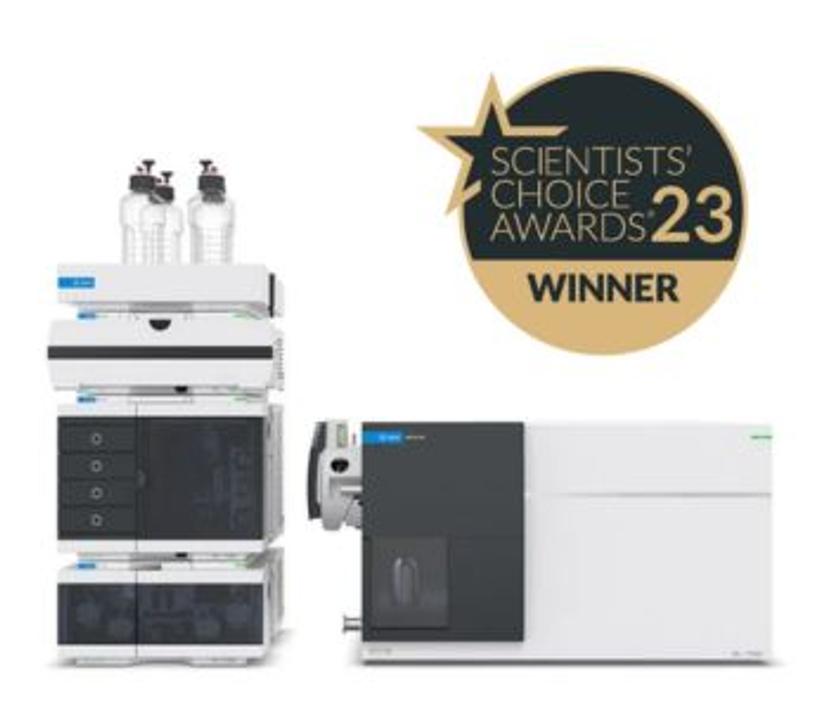
The award for Best New Spectroscopy Product of 2022 goes to the 6475 triple quadrupole LC/MS system from Agilent Technologies, as voted for by scientists around the world.
The Agilent 6475 triple quadrupole LC/MS employs several technological advantages like the superheated Agilent Jet Stream (AJS) ion source, curved and tapered collision cell, heated hyperbolic quadrupoles, and ± 20 kV high-energy dynode detector system. The system also features instrument intelligence technologies such as early maintenance feedback, scheduled tune and check-tune, and intelligent secondary injection workflows
Your runners-up are:
- DART-EVOQ® triple quadrupole mass spectrometer from Bruker
- X-Pulse benchtop NMR spectrometer from Oxford Instruments America Inc
- Zeno SWATH DIA for the ZenoTOF 7600 system from SCIEX
- iMScope QT Imaging Mass Microscope (for MS imaging with a Q-TOF MS) from Shimadzu Corporation
- Thermo Scientific™ Orbitrap™ Ascend Tribrid™ mass spectrometer from Thermo Fisher Scientific
- Xevo G3 Qtof mass spectrometer from Waters
Best New Separations Product of 2022
The award for Best New Separations Product of 2022 goes to the Rxi-SVOCms Columns from Restek Corp., as voted for by scientists around the world. Designed specifically for semivolatile organic compound (SVOC) analysis, Rxi-SVOCms columns are designed to provide a consistent performance that will keep calibrations passing longer so more samples can be run before needing to recalibrate the instrument or replace the column.
Your runners-up are:
- PFAS Extended volume sorbent tubes from Markes International Ltd
- Collision Gas Add-On from PEAK Scientific Instruments
- GC 2400™ Platform with Detachable Touchscreen from PerkinElmer, Inc.
- Thermo Scientific™ EXTREVA™ ASE™ Accelerated Solvent Extractor from Thermo Fisher Scientific
- MaxPeak Premier Protein BEH C4 300Å Columns from Waters
- ChroZen HPLC from YOUNG IN Chromass
Reviewers' Choice: Analytical Science Company of the Year
This year’s coveted Reviewers’ Choice Award for Analytical Science Company of the Year goes to Metrohm AG, in acknowledgment of the positive feedback it has received from scientists sharing their opinions via reviews on the SelectScience website over the past year.
Reviewers' Choice: Analytical Science Customer Service of the Year
In recognition of receiving consistently positive after-sales feedback from scientists around the globe via SelectScience reviews, Agilent Technologies takes home the customer service award.
Analytical Science Video Interview of the Year – in association with The Scientists’ Channel
This year’s winning video ‘Is our water safe to drink? Determining the quality of water’ is an interview with Prof. Detlef Knappe, from North Carolina State University.
In the winning video, Knappe outlines the analytical methods used to identify and assess contaminants, including per- and polyfluoroalkyl substances (PFASs), to understand routes of contamination and determine the safety of drinking water. Knappe highlights how technology from Agilent Technologies has assisted in his work analyzing contaminants in drinking water.
Analytical Science Application eBook of the Year
The Analytical Science Application eBook of the Year Award goes to Specac Ltd. for ‘FTIR spectroscopy: Sampling accessories to boost your research’. This application eBook, reviews the literature for some of the most advanced FTIR spectroscopy products and explores cutting-edge research across a diverse range of fields.
Analytical Sciences Editorial Article of the Year
This year’s winning article is titled ‘Leading pesticide analysis experts tackle the challenges and future outlooks of residue testing’ and features technology from Thermo Fisher Scientific.
In this interview, Susanne Ekroth from the Swedish Food Agency EU, Dr. Jim Garvey from the Department of Agriculture, Food and the Marine, Ireland, and Steven Lehotay, from the USDA’s Agricultural Research Service, explore the changes to residual pesticide testing that have occurred in the past few years, what the key areas for improvement are, and what the future of this field might look like.
Analytical Science Webinar of the Year
This year’s Webinar Series of the Year is awarded to CAMAG and the HPTLC Association. The series, title ‘HPTLC Online User Meeting’, available to watch on demand, facilitated a worldwide exchange of knowledge between HPTLC users to share in the spirit of working in an exciting analytical field.
Analytical Science Email of the Year
The winner in the Email of the Year category goes to ‘Comprehensive Solutions for Honey Testing’, from Shimadzu. The winning email featured a free download of an eBook on honey analysis techniques for a range of analytes including carbohydrates, water-soluble vitamins, and sugars.