
Köttermann marks 80 years of innovation with connected laboratory platform solutions
Anniversary milestone highlights the transition from standalone lab equipment to integrated and digital laboratory ecosystems
24 Mar 2026
In 2026, Köttermann celebrates its 80th anniversary by demonstrating at analytica 2026 in Munich, Germany, how traditional laboratory furniture is evolving into digitally connected platform solutions that link devices, data and safety systems to support laboratory digitalisation and sustainable planning.
From isolated laboratory furniture to connected platforms
In the past, a fume cupboard functioned primarily as an extraction workstation, while a refrigerator next to the workstation cooled samples. These units operated independently, without any communication between them or with other systems. This situation has fundamentally changed as laboratory infrastructure has become an active part of connected laboratory environments.
Modern laboratory infrastructure now goes beyond protective and storage functions. It integrates devices and monitoring technologies into connected processes, transforming previously isolated solutions into communicating systems. At analytica 2026, Köttermann demonstrates this shift through a connected sample workflow that links storage, preparation, analysis and documentation.
Connected sample workflows at analytica 2026
At analytica 2026, Köttermann presents a connected sample workflow that illustrates how laboratory infrastructure can support end-to-end digital processes. The workflow begins with cooled and continuously monitored sample storage, continues with sample preparation and analysis inside the fume cupboard, and concludes with digital documentation.
All components in this workflow interact seamlessly. Siemens technologies record energy consumption and quality data in real time, while laboratory processes are digitally documented. In laboratory environments, this level of transparency creates new opportunities to identify sources of error at an early stage and to optimise energy-intensive processes in a targeted manner.
Laboratory infrastructure as a driver of sustainability
Laboratory infrastructure is becoming an active component of sustainable laboratory planning. Fume cupboards are among the largest consumers of energy in laboratories, making efficient operation increasingly important for operators and planners.
Modern exhaust air control systems regulate air volumes according to demand and, in combination with intelligent control technology, enable significant energy savings. A closed sash reduces energy consumption considerably. In Köttermann fume cupboards, the electronic control unit Köttermann TouchTronic enables users to adjust the sash effortlessly and to control exhaust air individually according to specific requirements.
Connectivity enhances laboratory safety
Connectivity in laboratory infrastructure also improves safety in day-to-day operations. Systems that monitor devices and operating conditions detect irregularities and support rapid responses in exceptional situations.
At analytica 2026, Köttermann presents Siemens fire protection solutions that can be integrated directly into the fume cupboard. Special sensor technology automatically activates fire suppression when a critical temperature threshold is reached. Fires are therefore detected and extinguished quickly. This increases safety in everyday laboratory work and allows staff greater freedom to focus on other tasks away from the fume cupboards.
Early digitalization: Köttermann in the 1980s
Köttermann’s role in laboratory digitalisation dates back to the early 1980s, when the company integrated digital control technology into environmental simulators. To achieve this, an interface between analogue and digital technology first had to be created. Köttermann technician Walter Schacht, together with another expert, succeeded in developing this interface.
The result was the first computer-supported climate control programme. “Even a child could program sequences with it,” recalled Walter Schacht. In many laboratories, computers entered everyday operations through this route, as purchasing departments often rejected computers as standalone investments due to high costs. Combined with the simulator, however, the new technology became economically viable for laboratory use.
The computer-controlled environmental simulators enabled both graphical visualisations and automated workflows. As a result, a purely functional device evolved into a controllable technical platform that anticipated many aspects of later smart laboratory concepts.
Foundations for the smart laboratory
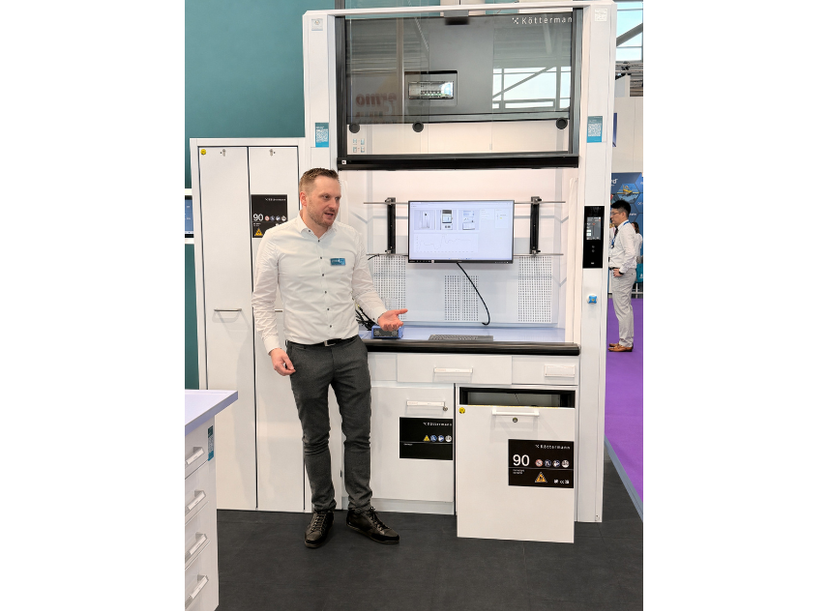
Dr. Christof Behrens, Head of Product Management at Köttermann
Köttermann’s long-standing work with digital control systems underpins current developments in connected laboratory platforms. “Digitalization in the laboratory did not begin at Köttermann today. Many of the requirements now discussed under the term ‘smart laboratory’ have accompanied us for decades,” explains Dr. Christof Behrens, Head of Product Management at Köttermann.
By combining robust physical infrastructure with digital monitoring, control and data capture, Köttermann aims to support laboratories in implementing smart laboratory strategies that enhance efficiency, safety and data quality.
Steel-based infrastructure as a stable platform
Köttermann laboratory infrastructure made of steel is designed to be durable and flexibly expandable, creating a stable framework into which modern technologies can be safely integrated. This approach supports laboratories that not only fulfil functional requirements but also actively support processes and minimise risks.
Such laboratories are the result of close cooperation between different technology partners. Strong networks are becoming increasingly important in the laboratory sector, enabling integrated solutions that combine furniture, devices, digital systems and safety technologies.
Want the latest science news straight to your inbox? Become a SelectScience member for free today>>
Links
Tags
Frequently asked questions
Show frequently asked questions
How is Köttermann showcasing connected laboratory infrastructure at analytica 2026?
Köttermann is demonstrating a connected sample workflow at analytica 2026 in Munich. The workflow links cooled, monitored sample storage with preparation and analysis inside the fume cupboard, followed by digital documentation. Siemens technologies record energy consumption and quality data in real time, enabling transparent, end-to-end digital processes that help identify errors early and optimise energy‑intensive laboratory operations.
How do Köttermann steel fume cupboards and TouchTronic controls support sustainable, energy-efficient laboratories?
Köttermann steel fume cupboards use modern exhaust air control systems that regulate air volumes according to demand. A closed sash significantly reduces energy consumption. The Köttermann TouchTronic electronic control unit lets users adjust the sash effortlessly and control exhaust air individually, supporting efficient operation of one of the most energy‑intensive laboratory infrastructure elements and contributing to sustainable laboratory planning.
What role do Siemens fire protection solutions play in Köttermann’s smart laboratory platforms?
At analytica 2026, Köttermann presents Siemens fire protection solutions integrated directly into the fume cupboard. Special sensor technology detects when a critical temperature threshold is reached and automatically activates fire suppression. This rapid detection and extinguishing of fires enhances day-to-day laboratory safety and allows staff to focus on other tasks away from the fume cupboards within connected, smart laboratory environments.