
EMD Millipore Launches First Commercially Available Multiplexed Assays for Stem Cell Protein Markers
6 May 2013EMD Millipore, the life science division of Merck KGaA of Darmstadt, Germany, today announced availability of the MILLIPLEX® map Human Stem Cell Pluripotency Magnetic Bead Kits, which enable the analysis of many different pluripotency biomarkers in a single measurement. These kits are the first commercially available multiplexed protein biomarker assays based on the Luminex® xMAP® platform for this important research area. This new application of trusted bead-based multiplex technology gives researchers rapid feedback on the potency status of stem cell cultures and offers a significant advantage over existing techniques, which detect a limited number of proteins with a semi-quantitative output for a single sample.
EMD Millipore's new MILLIPLEX® map kits examine protein biomarkers that indicate the potency of stem cells, enabling pluripotent stem cells to be distinguished from multipotent or differentiating cells. These new kits save time and resources by accurately detecting large numbers of pluripotency markers in one measurement. Kits can be used on cultures of induced pluripotent stem cells, human embryonic stem cells, cancer stem cells or cancer cell lines.
Two kits are available for assessing stem cell pluripotency. The MILLIPLEX® map Human Stem Cell Pluripotency Magnetic Bead Kit 1 monitors the expression of the transcription factors Oct 3/4, Sox2, Nanog and c-Myc, which play critical roles in the maintenance of pluripotency and self-renewal in stem cells. The MILLIPLEX® map Human Stem Cell Pluripotency Magnetic Bead Kit 2 contains seven additional pluripotency-related markers, including a transcription factor, a translational regulator, transmembrane proteins and cell surface glycostructures. These assays are essential for assessing the potency of stem cell cultures in studies ranging from cancer and developmental biology research to bioprocess monitoring. MILLIPLEX® map assays make it easy to analyze both cell surface and intracellular proteins.
"The MILLIPLEX® map Stem Cell Pluripotency Kit 1 is a valuable tool for stem cell research. We obtained very interesting and promising results," said Frank Edenhofer, Ph.D., Head of the Stem Cell Engineering Group, Institute of Reconstructive Neurobiology, University of Bonn, LIFE & BRAIN Center. "It is noteworthy that this assay enabled us to observe even early onset of differentiation in iPS cell cultures."
"Stem cells are of great interest for regenerative medicine and drug discovery efforts, and researchers must be able to effectively characterize the potency status of pluripotent stem cells to advance their progress toward clinical use," said Linda Meeh, Ph.D., Director of Marketing for Immunoassays and Multiplexing. "MILLIPLEX® map kits offer a quick and simple way to achieve this characterization, generating a comprehensive assessment of the overall quality of cell cultures."
Related products
Request Quote for All Products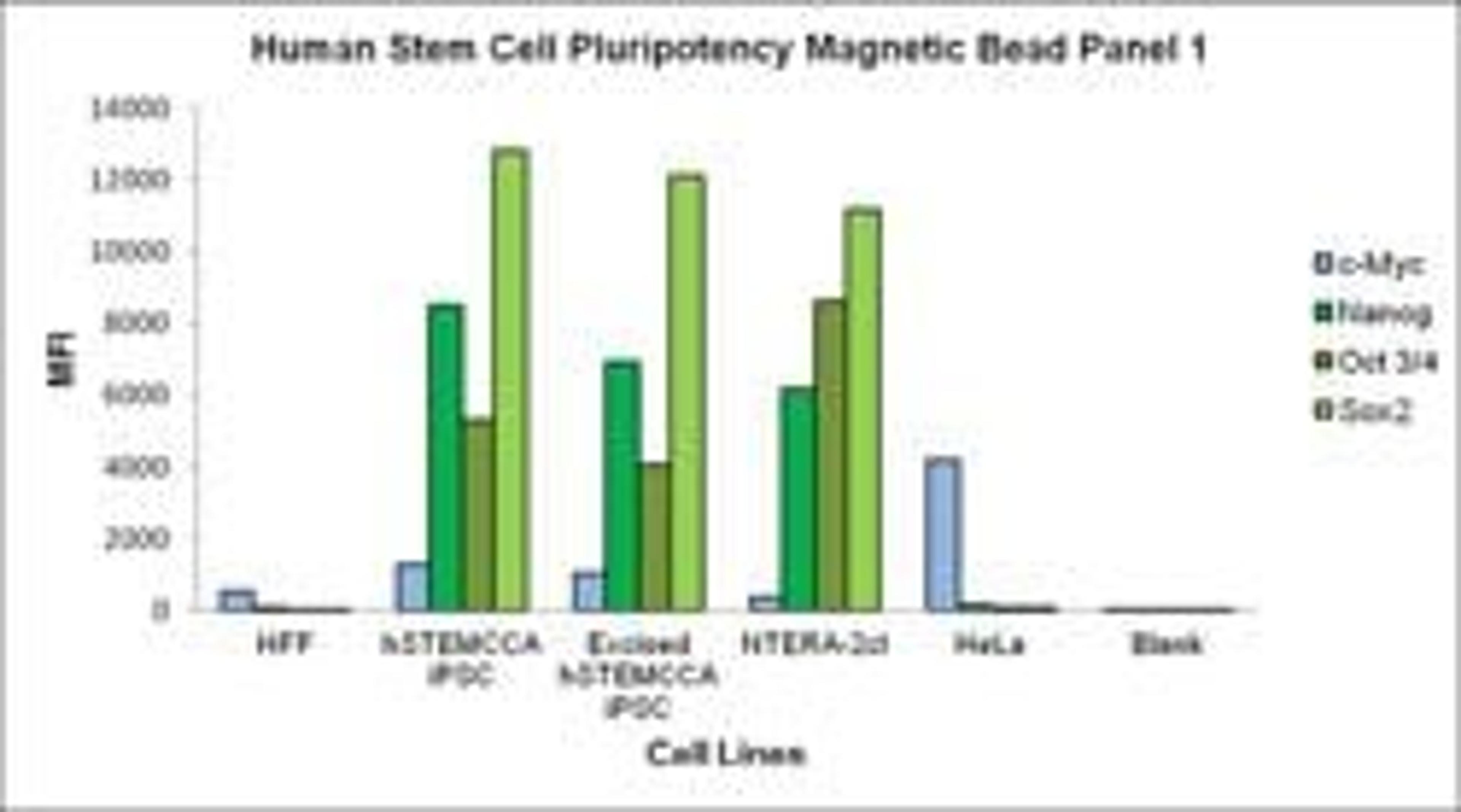
MILLIPLEX MAP Human Stem Cell Pluripotency Magnetic Bead Panel 1 - Stem Cell Multiplex Assay
MerckProduct Overview: The MILLIPLEX® Human Stem Cell Pluripotency Magnetic Bead Panel 1 (Cat. No. 48-617MAG) is a premixed panel to be used for the simultaneous quantification of the following 4 analytes in cell lysates: c-Myc, Nanog, Oct 3/4, and Sox2. The detection assay is a rapid, convenient alternative to Western Blotting and immunoprecipitation procedures. Each kit has sufficient reagents for one 96-well plate assay. Background Information: The expression of the transcription factors Oct 3/4, Sox2 and Nanog play a critical role in the maintenance of pluripotency and self renewal in stem cells. c-Myc, a member of the helix-loop-helix-leucine zipper family, is a transcription factor that regulates the expression of multiple genes involved in apoptosis, cell differentiation and cell proliferation. In stem cells it seems to control the balance between stem cell self-renewal and differentiation. Thus the presence of the four proteins Oct-3/4, Sox2, Nanog and c-Myc are indicators for the pluripotency of iPS cells and human embryonic stem cells. Applications: This MILLIPLEX® MAP Human Stem Cell Pluripotency Magnetic Bead Panel 1 is a Stem Cell Characterization multiplex assay. The analytes available for this multiplex kit are: c-Myc, Nanog, Oct 3/4, Sox2.
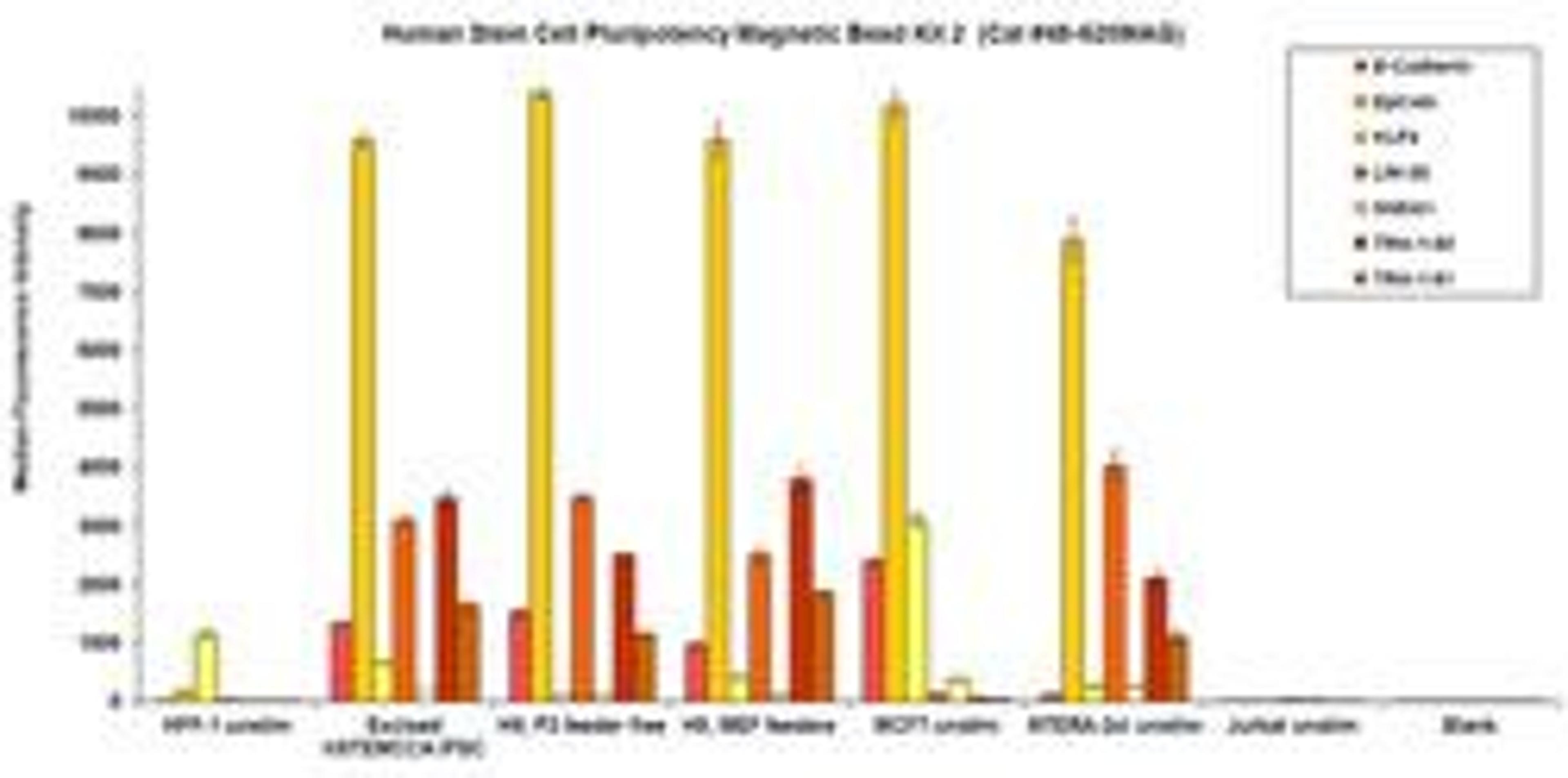
MILLIPLEX MAP Human Stem Cell Pluripotency Magnetic Bead Panel 2 - Stem Cell Multiplex Assay
MerckProduct Overview: The MILLIPLEX® Human Stem Cell Pluripotency Magnetic Bead Kit 2 (Cat. No. 48-620MAG) is a premixed kit to be used for the simultaneous quantification of the following 7 analytes in cell lysates: E-Cadherin, EpCam, KLF4, LIN-28, and the glycostructures TRA-1-60, TRA-1-81 and SSEA1. The detection assay is a rapid, convenient alternative to Western Blotting and immunoprecipitation procedures. Each kit has sufficient reagents for one 96-well plate assay. Background Information: The expression of transcription factors, translational regulators and trans-membrane proteins, as well as cell surface glycostructures, play critical roles in the maintenance of pluripotency and self renewal in stem cells and can serve as markers of cell status. Applications: This MILLIPLEX® MAP Human Stem Cell Pluripotency Magnetic Bead Panel 2 is a Stem Cell Characterization multiplex assay. The analytes available for this multiplex kit are: E-Cadherin, EpCam, KLF4, LIN-28, SSEA1, TRA-1-60, TRA-1-81.