
Harvard researchers leverage spatial glycobiology for cancer research
Hear how the Program of Glyco-Immunology and Oncology (PGIO) is deciphering cancer’s ‘glyco code’ to pave the way for more precise diagnostics and next generation immunotherapies
3 Sept 2026
Virtually all cell surface proteins are decorated with sugars. These carbohydrate chains, known as glycans, play pivotal roles in how cells function and communicate in both health and disease.
The study of glycans, and the process by which they attach to proteins and lipids, known as glycosylation, has gained increasing attention in recent years, particularly in oncology. Research has shown that cancer cells leverage cell-surface glycans to shape interactions within the tumor microenvironment, enabling cancer cells to evade the host immune system, grow, and spread throughout the body.
For Harvard researchers Dr. Tobias Schatton and Dr. Steven Barthel, deciphering this “glyco-code” on the surface of cancer cells is a key priority – one they believe could lead to new diagnostic biomarkers and offer promising targets for more effective cancer immunotherapies.

Tobias Schatton, Pharm.D., Ph.D. (left) and Steven Barthel, Ph.D., (right) are Co-Directors of the Program of Glyco-Immunology and Oncology (PGIO) in the Department of Dermatology at Mass General Brigham (MGB), Harvard Medical School (HMS).
Cracking the glyco-code
The PGIO at Mass General Brigham, Harvard Medical School brings together academic scientists, clinicians, and industry partners working at the intersection of glycoscience and immuno-oncology research, with the aim of advancing knowledge and therapeutic applications of glycans.
The initiative is driven by the ongoing need for more effective treatments for cancer and immunological diseases. While the development of immune checkpoint inhibitor (ICI) therapies has transformed cancer treatment, many patients still fail to achieve durable responses.
Drs. Barthel and Schatton believe glycobiology may help bridge this gap. “Our research seeks to overcome this unmet clinical need by harnessing the power of glycobiology to develop and validate innovative immune checkpoint glyco-targeting strategies that outperform existing treatments,” they tell SelectScience®.
Underpinning this work is the fact that glycans themselves can act as immune checkpoints – molecules that cancer cells use to suppress host immune responses – and that many immune checkpoint proteins are decorated with sugar chains that could represent druggable targets. “These glycobiological considerations offer underexplored opportunities to enhance IC therapeutic benefit,” they explain.
But exploring these new avenues isn’t easy. Cracking the glyco-code means mapping out the types, abundance, and spatial distribution of glycans across different cell types, immune checkpoint receptors, and other surface proteins, and understanding how these features shape antitumor immunity and responses to existing cancer immunotherapies.
The task is further complicated by a lack of investigative tools. Traditional methods often struggle to detect glycans in situ or determine their spatial relationships with respect to specific proteins or cell types. Yet this spatial context is essential for understanding how glycans influence cellular interactions within the tumor microenvironment.
One-of-a-kind spatial glycan analysis
To overcome these limitations, Drs. Barthel and Schatton turned to Vector Laboratories, a bioanalytical reagents and services provider with long-standing expertise in glycobiology. The researchers were among the first to test the company’s new Glysite™ Explorer, an in situ assay designed to detect and spatially visualize target proteins and glycans in proximity.
“We leveraged the one-of-a-kind Glysite™ Explorer technology to help fill an ongoing critical gap in our research investigations that, to our knowledge, wasn’t possible with any existing product on the market,” explains Dr. Barthel. “While conventional proximity ligation assay platforms focus on protein-protein interaction analysis, the Glysite™ Explorer provided us with the unique ability to define distinct glycostructures proximal to or located directly on our target IC protein.”
The Glysite™ Explorer is the first commercially available kit designed for the spatial detection of protein glycosylation. The assay uses DNA-labeled probes combined with DNA amplification technology to enable sensitive in situ detection. Researchers can select from a panel of Glysite™ Explorer Lectins covering the major glycan classes and pair them with a primary antibody targeting their protein of interest.
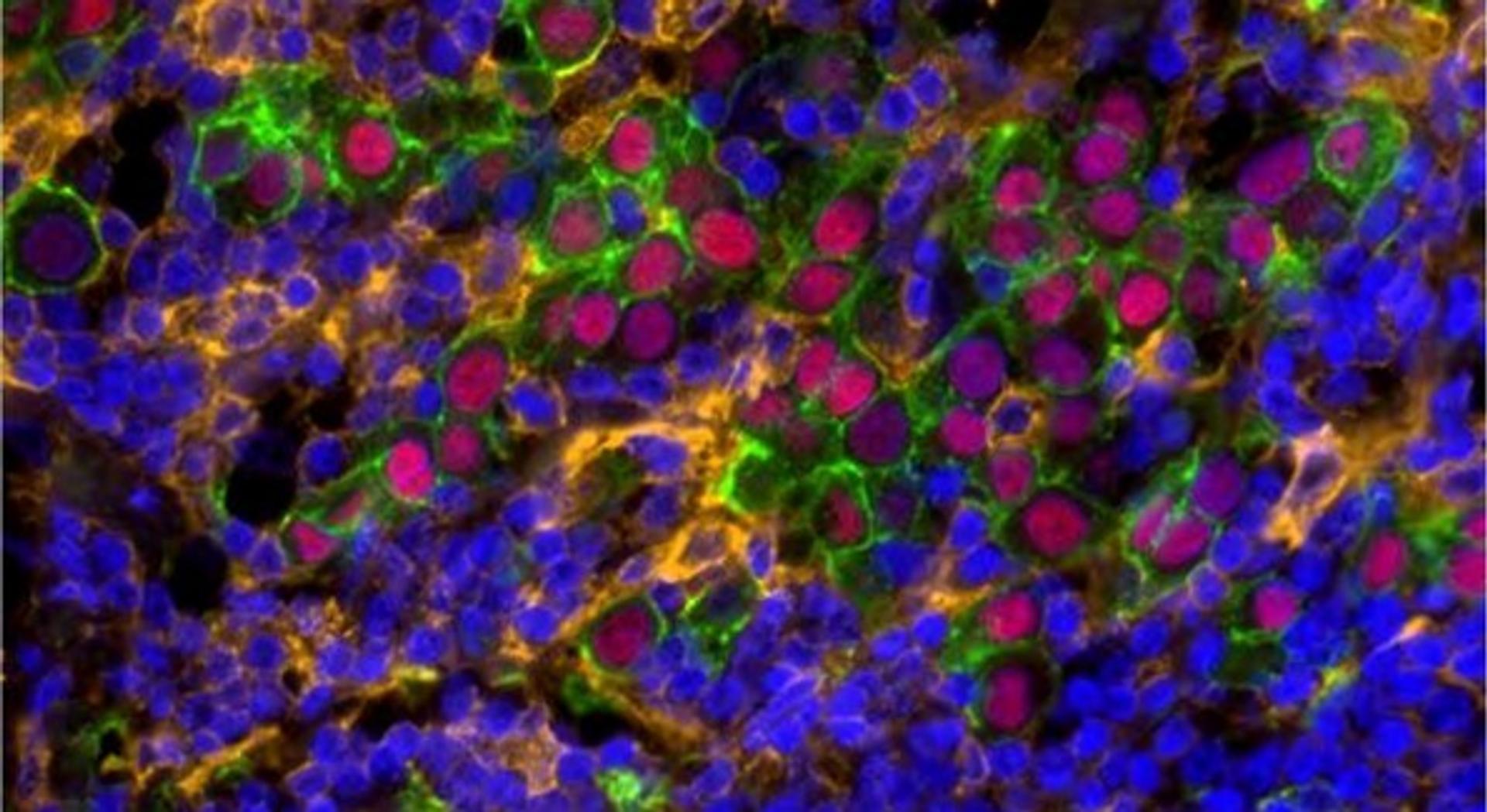
Glyco-immuno oncology in action: Immunofluorescence shows cancer cells (red) surrounded by immune and stromal cells (blue), with glycoprotein receptor (yellow) and ligand (green) interactions regulating cancer outgrowth.
During beta testing, the team combined the kit’s lectin panel with their own antibodies to identify sugar structures associated with immune checkpoint receptors. “We seamlessly integrated the kit’s ready-to-go components and broad lectin panel with our antibodies of choice,” explains Dr. Schatton. “We employed the Glysite™ Explorer with ease on purified cancer and immune cells fixed to slides, enabling the successful identification of diverse sugar structures on a target IC receptor.”
Speed, flexibility, and ease of use
Beyond its analytical capabilities, the researchers also highlight the practical benefits of the kit. “We were extremely impressed by multiple aspects of this technology, including its versatility, convenience, ease of use, and rapid turnaround time,” says Dr. Schatton. “The kit’s components were well organized and ready to use straight out of the box, with clear instructions. The assay could be completed within a single day or split across two or more days if desired.”
They also have high praise for Vector Laboratories as a service provider and partner. “As a premier glycobiology company, it has accelerated our work by providing us with cutting-edge glycoscientific reagents and expertise,” says Dr. Barthel. “These have encompassed highly purified lectins, glyco-reactive antibodies, and glycan motif detection kits.”
In their work, the team applied the Glysite™ Explorer to purified cancer and immune cells fixed onto slides. However, the assay is also compatible with additional sample types, including formalin-fixed paraffin-embedded (FFPE) tissues and cell pellets.
The promising future of glycobiology
Glycobiology is emerging as one of the most exciting frontiers in oncology. Looking ahead, both researchers believe it will be increasingly tied to future advances in cancer research, including the shift to earlier disease detection, the integration of precision and personalized medicine, and the development of novel therapeutics and delivery strategies.
“Harnessing the growing power and opportunities inherent in glycobiology will enable more accurate and sensitive predictive and response biomarkers,” says Dr. Schatton. “It will also create opportunities for more cell type-selective and potent therapies with reduced off-target adverse effects.”
As Vector Laboratories marks its 50th anniversary, its ongoing commitment to innovation in glycobiology and spatial biology will continue to empower scientists exploring this rapidly evolving field. And when it comes to decoding the glyco-code of cancer, researchers are still quite literally scratching the surface.
Learn moreRelated products
Request Quote for All Products
Glycobiology Reagents
Vector Laboratories Inc.Founded on a growing portfolio of purified lectins, lectin conjugates, and lectin screening kits, Vector Laboratories supports the ability to profile, characterize, and capture complex glycans in biological systems.