
Diatron expands Aquila, Aquarius 3, and Abacus 5 hematology analyzers with advanced RUO indices
New RUO parameters enable deeper insights from routine CBC testing without additional workflow steps
28 May 2026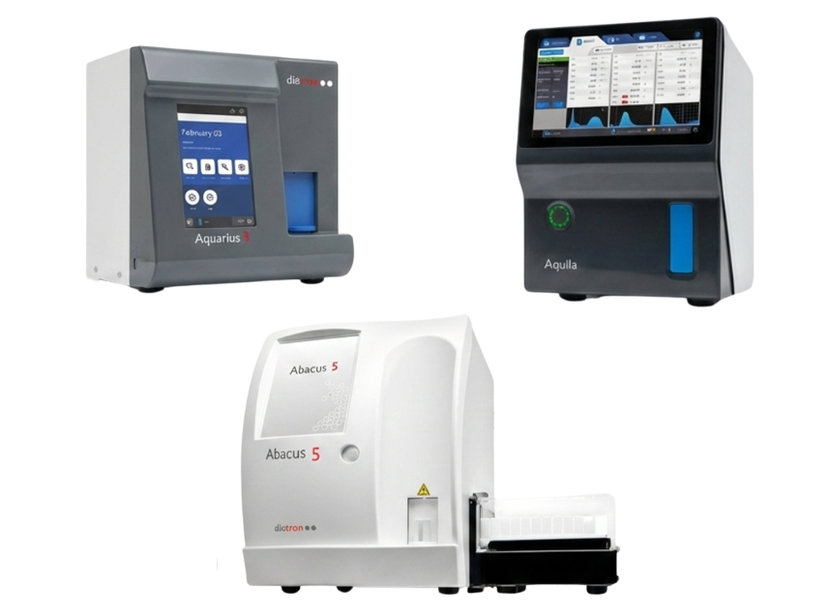
The Aquarius 3 (left), Abacus 5 (centre), and Aquila (right) hematology analyzers
Diatron has expanded the capabilities of its Aquila, Aquarius 3, and Abacus 5 hematology analyzers with six advanced hematological indices for research use only (RUO). This enhancement enables clinical laboratories and research institutions worldwide to gain deeper insights from routine complete blood sount (CBC) tests without additional samples, consumables, or workflow steps.
Unlock enhanced insights directly from routine CBC tests
The new RUO indices available on the Diatron Aquila, Aquarius 3, and Abacus 5 hematology analyzers are:
- Neutrophil-to-Lymphocyte Ratio (NLR)
- Platelet-to-Lymphocyte Ratio (PLR)
- Monocyte-to-Lymphocyte Ratio (MLR)
- Mentzer Index
- Red Cell Distribution Width Index (RDWI)
- Green & King Index
These indices provide laboratories with deeper insights directly from routine CBC tests, without extra costs or workflow burden. They are automatically calculated from existing CBC parameters, allowing laboratories to unlock additional hematological information from the same blood sample.
Why these parameters matter
NLR, PLR and MLR – Inflammatory and immune status biomarkers*
NLR, PLR, and MLR are widely described in the scientific literature as markers that reflect immune and inflammatory status. In research settings, these indices can offer non-invasive insight into systemic inflammation, infection severity, and immune activation.
They have been investigated across different research areas, including infections, cardiovascular disease, oncology, and autoimmune conditions. Published studies have reported associations between:
- Elevated NLR and outcomes such as infections, cancer prognosis, and cardiovascular risk
- PLR and pro-inflammatory or pro-thrombotic states
- MLR and chronic inflammation, such as tuberculosis and autoimmune diseases
By making these indices readily available from routine CBC data, Diatron analyzers support research into inflammatory and immune-related conditions without requiring additional specialized tests.
Mentzer Index, RDWI, Green and King Index – Differentiation of microcytic anemias*
The Mentzer Index, RDWI, and Green ans King Index have been described in the literature as tools to support the differentiation between Iron Deficiency Anemia (IDA) and Beta-Thalassemia Trait (BTT). By combining key CBC parameters, these indices can facilitate investigations into diagnostic strategies and algorithms in hematology research.
These indices enable researchers to explore the performance of different approaches to microcytic anemia differentiation, supporting method development, validation, and comparison studies in hematology.
*These parameters are not available in the USA.
Operational benefits for laboratories and researchers
The integration of these six advanced RUO indices into Diatron hematology analyzers delivers meaningful operational advantages for laboratories and research centers. Because the indices are automatically calculated from existing CBC results, there is no need for manual calculation or additional testing.
Key operational benefits include:
- Automatic calculation from standard CBC parameters
- Seamless integration into existing laboratory workflows
- No requirement for additional blood samples
- No increase in consumable usage
- No added workflow steps
These indices can support retrospective and prospective studies, method comparison and validation projects, and exploratory research into new risk scores and algorithms. By enhancing the information content of routine CBC results, they help boost laboratory and researcher awareness and can enable timely, well-informed decisions in research settings.
The advanced RUO indices are particularly valuable in resource-limited settings, where access to specialized testing or high-cost assays may be restricted. In such environments, maximizing the diagnostic and research value of routine CBC tests is especially important.
Seamless integration on Diatron analyzers
The Aquila, Aquarius 3, and Abacus 5 hematology analyzers present these indices through intuitive software interfaces, making additional research indices instantly accessible without added complexity. Users can view and interpret NLR, PLR, MLR, Mentzer Index, RDWI, and Green & King Index alongside standard CBC parameters within the same workflow.
Want the latest science news straight to your inbox? Become a SelectScience member for free today>>
Links
Tags
Frequently asked questions
Show frequently asked questions
How do Diatron’s Aquila, Aquarius 3, and Abacus 5 hematology analyzers enhance routine CBC tests with new RUO indices?
Diatron’s Aquila, Aquarius 3, and Abacus 5 hematology analyzers now include six advanced hematological indices for research use only (RUO): Neutrophil-to-Lymphocyte Ratio (NLR), Platelet-to-Lymphocyte Ratio (PLR), Monocyte-to-Lymphocyte Ratio (MLR), Mentzer Index, Red Cell Distribution Width Index (RDWI), and Green and King Index.
These indices are automatically calculated from existing complete blood count (CBC) parameters, enabling laboratories and research institutions to gain deeper insights from the same blood sample without additional samples, consumables, or workflow steps. The indices are seamlessly integrated into the analyzers’ software interfaces, allowing users to view them alongside standard CBC parameters within the same workflow.
What research applications are supported by the new NLR, PLR, and MLR indices on Diatron hematology analyzers?
The NLR, PLR, and MLR indices available on Diatron’s Aquila, Aquarius 3, and Abacus 5 hematology analyzers are described in the scientific literature as markers of immune and inflammatory status. In research settings, they provide non-invasive insight into systemic inflammation, infection severity, and immune activation. These indices have been investigated in infections, cardiovascular disease, oncology, and autoimmune conditions.
Published studies have reported associations between elevated NLR and infections, cancer prognosis, and cardiovascular risk; PLR and pro-inflammatory or pro-thrombotic states; and MLR and chronic inflammation, such as tuberculosis and autoimmune diseases. By making these indices readily available from routine CBC data, Diatron analyzers support research into inflammatory and immune-related conditions without requiring additional specialized tests.
How do the Mentzer Index, RDWI, and Green and King Index on Diatron analyzers support microcytic anemia research, especially in resource-limited settings?
The Mentzer Index, RDWI, and Green and King Index on Diatron’s Aquila, Aquarius 3, and Abacus 5 hematology analyzers are described in the literature as tools to support differentiation between Iron Deficiency Anemia (IDA) and Beta-Thalassemia Trait (BTT). By combining key CBC parameters, these indices help researchers investigate diagnostic strategies and algorithms for microcytic anemia. They can be used in retrospective and prospective studies, method comparison and validation projects, and exploratory research into new risk scores.
Because the indices are automatically calculated from routine CBC results without extra samples, consumables, or workflow steps, they are particularly valuable in resource-limited settings where access to specialized testing or high-cost assays is restricted, maximizing the diagnostic and research value of standard CBC tests. These parameters are not available in the USA.