
Blood-based α-synuclein and pS129-α-synuclein biomarkers for Parkinson’s disease research
Explore the role of alpha synuclein biomarkers in supporting the detection and monitoring of Parkinson’s disease
12 May 2026
Alpha-synuclein blood biomarkers are an important area of investigation in Parkinson’s disease and synucleinopathy research. For teams studying disease mechanisms, evaluating therapeutic strategies, or building better tools to monitor biological change, one question remains central: how can disease-relevant α-synuclein biology be measured sensitively, reliably, and at scale?
Alpha-synuclein (α-synuclein) has long been central to Parkinson’s disease and synucleinopathy research. Misfolding and aggregation of α-synuclein form the pathological inclusions known as Lewy bodies and Lewy neurites, which are hallmarks of synucleinopathies, including Parkinson’s disease, dementia with Lewy bodies, and multiple system atrophy. Within these inclusions, α-synuclein phosphorylated at serine 129, or pS129-α-synuclein, is highly enriched, making both total α-synuclein and pS129-α-synuclein promising candidate biomarkers for studying synuclein-driven neurodegeneration.
The field has made important progress with CSF-based, tissue-based, and seed amplification approaches for detecting disease-associated α-synuclein biology. Blood-based biomarkers remain an important area of investigation because they could offer a less invasive and more scalable path for repeated sampling, longitudinal studies, and broader translational research.
The challenge is that α-synuclein biology is not simple. Total α-synuclein, phosphorylated α-synuclein at serine 129, extracellular vesicle-associated α-synuclein, and other disease-associated forms may each provide different information. Understanding how these signals relate to Parkinson’s disease and broader synucleinopathy biology requires both biological context and analytical tools capable of measuring low-abundance targets in complex biofluids.
Why alpha-synuclein matters in synucleinopathy research
Alpha-synuclein is a presynaptic protein closely associated with Parkinson’s disease and other synucleinopathies. In disease, α-synuclein can misfold, aggregate, and accumulate in pathological inclusions. These inclusions, known as Lewy bodies and Lewy neurites, are hallmarks of synucleinopathies, including Parkinson’s disease, dementia with Lewy bodies, and multiple system atrophy.
Total α-synuclein measurement can provide a broad view of α-synuclein abundance across biofluids. This can be useful in studies comparing cohorts, tracking biological change over time, or evaluating how α-synuclein relates to other markers of neurodegeneration, inflammation, or neuronal injury.
But total α-synuclein is only one part of the story. Blood is a challenging matrix, and α-synuclein is also present in peripheral blood components such as red blood cells. That can complicate interpretation in plasma and serum studies, particularly when researchers are trying to detect subtle disease-associated differences.
For this reason, many groups are looking beyond total α-synuclein concentration alone and asking whether more disease-associated forms of the protein can provide a more informative signal.
Why pS129-alpha-synuclein is a compelling biomarker candidate
Phosphorylation of alpha-synuclein at serine 129 is one of the most widely studied disease-associated post-translational modifications in synucleinopathy research. While only a small fraction of α-synuclein is phosphorylated at S129 in healthy brains, more than 90% of α-synuclein within Lewy bodies is phosphorylated at this residue.
That enrichment has made pS129-α-synuclein a compelling candidate biomarker for Parkinson’s disease and synucleinopathy research. Rather than simply reflecting total α-synuclein abundance, pS129-α-synuclein may provide a window into a phosphorylation state closely linked to pathological α-synuclein accumulation.
For translational teams, the value lies in the questions this marker can help explore. Does pS129-α-synuclein change across disease stages? Can it help characterize patient heterogeneity? Does it shift in response to therapeutic intervention? Can the ratio of pS129-α-synuclein to total α-synuclein provide a more interpretable readout than either marker alone?
These are the kinds of questions that make α-synuclein biomarker research both promising and technically demanding.
Why alpha-synuclein blood biomarkers are important
Blood-based biomarkers are attractive because they can support repeated sampling, larger cohorts, and more accessible study designs than CSF-based approaches. This matters in Parkinson’s disease and synucleinopathy research, where disease timelines are long, clinical trajectories vary, and longitudinal measurement can be essential.
Blood-based α-synuclein biomarkers may support several research goals:
- Studying disease biology earlier and more frequently
- Monitoring biomarker dynamics over time
- Enabling larger observational and interventional studies
- Preserving CSF and other precious samples for complementary analyses
- Building multi-marker panels that reflect different dimensions of neurodegeneration
At the same time, blood-based α-synuclein measurement remains technically challenging. Biomarkers may be present at very low concentrations. Matrix effects can interfere with measurement. Peripheral sources of α-synuclein can complicate interpretation. Small biological differences may be difficult to distinguish from analytical variability.
As alpha-synuclein blood biomarkers continue to evolve, their value will depend on both biological relevance and analytical reliability. In this setting, the question is not only whether α-synuclein can be detected in blood, but whether it can be measured with enough sensitivity and reproducibility to support meaningful biological interpretation.
The emerging role of extracellular vesicles in alpha-synuclein biomarker research
Extracellular vesicles, or EVs, are gaining attention as a potential window into neurodegenerative disease biology. These small, membrane-bound particles are released by cells and can carry proteins, nucleic acids, lipids, and other molecular cargo that reflect aspects of their cell of origin.
In Parkinson’s disease and related synucleinopathies, EVs are especially interesting because they may contain disease-relevant forms of alpha-synuclein, including phosphorylated and aggregation-prone species. For blood-based biomarker research, EVs may offer a way to enrich for more biologically informative signals from plasma or serum, particularly when investigators are focused on CNS-enriched or neuronally derived vesicle populations.
EV-associated α-synuclein also raises important mechanistic questions. EVs are involved in intercellular communication, and they are being studied for their possible role in transporting misfolded or aggregation-prone proteins between cells. In that context, EVs are not only a potential biomarker source; they are also part of the broader conversation about how synuclein pathology may spread or evolve.
The promise is substantial, but so are the technical considerations. EV workflows can yield limited material, and EV-associated proteins are often present at very low abundance. Isolation methods, characterization standards, and pre-analytical variables can all influence results.
EVs add another layer of opportunity, but also another layer of complexity. As EV workflows mature, the ability to measure low-abundance α-synuclein species from limited material will likely become an important factor in how useful these approaches can be.
Low-abundance biology requires ultra-sensitive measurement
Many neurodegenerative biomarkers are present at very low concentrations in blood. Measuring them reliably requires more than nominal sensitivity. It places a premium on precision, broad dynamic range, matrix compatibility, and sample efficiency.
For total alpha-synuclein and pS129-alpha-synuclein, analytical performance is especially important because the biological differences of interest may be subtle. In longitudinal studies, small shifts within an individual may matter. In therapeutic research, modest biomarker changes may be relevant if they reflect target biology or pharmacodynamic response. Without sufficient precision, those signals can be obscured by assay noise.
Ultra-sensitive quantification is also important in EV-focused workflows, where target abundance may be even lower and sample volume may be limited. In these settings, sample-efficient assays can help preserve precious material while still enabling quantitative readouts.
For alpha-synuclein blood biomarkers, ultra-sensitive measurement can be especially important when subtle differences may carry biological meaning. As alpha-synuclein biomarker research moves further into plasma, serum, CSF, and EV-focused applications, measurement tools must be sensitive enough to detect low-abundance biology and precise enough to make the resulting data interpretable.
Measuring total alpha-synuclein and pS129-alpha-synuclein together
A single biomarker rarely captures the full complexity of neurodegenerative disease. Measuring both total α-synuclein and pS129-α-synuclein can provide a more nuanced view of α-synuclein biology.
Total α-synuclein offers a broader measure of protein abundance. pS129-α-synuclein provides a pathology-associated readout linked to phosphorylation at serine 129. Together, they may support both individual biomarker quantification and ratio-based analysis, such as pS129-α-synuclein relative to total α-synuclein.
This type of ratio-based approach may help researchers evaluate disease-associated phosphorylation in the context of overall α-synuclein abundance. It can also help frame more specific biological questions: is the observed signal driven by a change in total α-synuclein, a change in phosphorylated α-synuclein, or a shift in the relationship between the two?
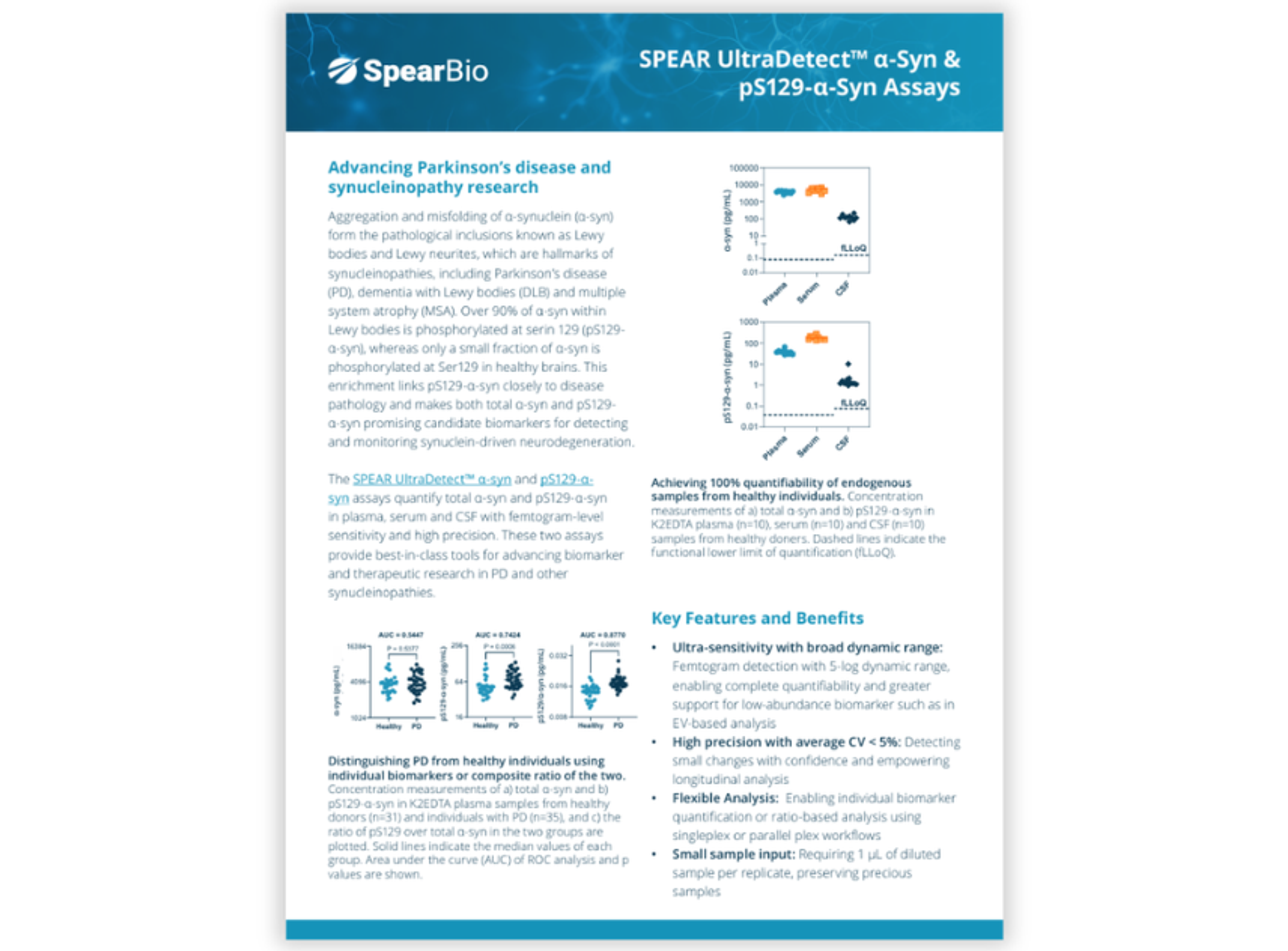
In example plasma data generated using SPEAR UltraDetect™ assays, total α-synuclein alone showed limited separation between healthy and Parkinson’s disease samples, while pS129-α-synuclein and the pS129/total α-synuclein ratio showed stronger differentiation in the tested cohort. These data are intended for research-use context and should be interpreted based on study design, cohort size, and application.
The value of this approach is not simply more data. It is the possibility of a more interpretable biomarker profile: one that captures both total protein abundance and a disease-associated phosphorylation state.
Supporting the next phase of Parkinson’s Disease biomarker research
As Parkinson’s disease and synucleinopathy research advances, biomarker strategies will need to support more than detection. They will need to help characterize biology, monitor change, and support therapeutic development.
Blood-based total α-synuclein and pS129-α-synuclein assays may be useful across several research contexts, including cohort comparison, longitudinal biomarker tracking, EV-focused studies, pharmacodynamic research, and multi-marker panel development.
For groups developing α-synuclein-targeted therapeutics or studying synucleinopathy biology more broadly, scalable biomarker measurement can help generate more informative data from limited clinical samples. The key is not simply access to a blood-based readout. It is confidence that the readout is sensitive, reproducible, and biologically meaningful.
That is why assay selection matters.
Assay considerations for alpha-synuclein blood biomarkers
When selecting assays for alpha-synuclein blood biomarkers, several performance considerations are especially important:
- Sensitivity: Can the assay detect low-abundance α-synuclein species in plasma, serum, CSF, or EV-focused workflows?
- Precision: Can it support confidence in small biomarker changes across cohorts or longitudinal samples?
- Dynamic range: Can it quantify across diverse biological concentrations without excessive dilution or repeat testing?
- Sample efficiency: Can it preserve limited or precious clinical samples?
- Workflow flexibility: Can researchers measure individual biomarkers or evaluate ratio-based approaches?
SPEAR UltraDetect™ α-synuclein and pS129-α-synuclein assays are designed to address these needs, with femtogram-level sensitivity, 100% quantifiability of healthy and diseased samples, 5-log dynamic range, average CVs below 5%, and only 1 µL of diluted sample per replicate. The assays support quantification of endogenous α-synuclein and pS129-α-synuclein in EDTA plasma, serum, and CSF.
From better detection to better biological insight
The future of Parkinson’s disease and synucleinopathy research will depend on biomarker strategies that are sensitive, scalable, and biologically informative. Total α-synuclein and pS129-α-synuclein are central to that future because they connect directly to the molecular pathology of synuclein-driven neurodegeneration.
Still, the path forward requires rigor. Blood-based α-synuclein biomarkers must be interpreted carefully, validated across cohorts, and integrated into broader research frameworks. As studies continue to evaluate total α-synuclein, phosphorylated α-synuclein, EV-associated α-synuclein, seed amplification assays, and other emerging approaches, analytical tools will need to keep pace with the complexity of the biology.
For researchers, the opportunity is not simply to measure more. It is to measure better.
Learn how SPEAR UltraDetect™ assays support alpha-synuclein blood biomarker research across plasma, serum, and CSF.
Download the α-synuclein and pS129-α-synuclein assays product flyer
Want the latest science news straight to your inbox? Become a SelectScience member for free today>>
Links
Related content
Tags
Frequently asked questions
Show frequently asked questions
How are total alpha-synuclein and pS129-alpha-synuclein used as blood biomarkers in Parkinson’s disease and related synucleinopathies?
Total alpha-synuclein (α-synuclein) and serine 129-phosphorylated alpha-synuclein (pS129-α-synuclein) are emerging as key blood-based biomarkers for Parkinson’s disease and other synucleinopathies, such as dementia with Lewy bodies and multiple system atrophy. Total α-synuclein measurement provides a broad view of protein abundance across biofluids, supporting cohort comparisons, longitudinal tracking, and relationships to other markers of neurodegeneration, inflammation, or neuronal injury. pS129-α-synuclein, which is highly enriched in Lewy body pathology, offers a pathology-associated readout that may more directly reflect disease-relevant α-synuclein states. Measuring both markers together, including their ratio (pS129-α-synuclein/total α-synuclein), can yield a more interpretable biomarker profile and has shown stronger differentiation between healthy and Parkinson’s disease plasma samples than total α-synuclein alone in example data generated with SPEAR UltraDetect™ assays.
Why is pS129-alpha-synuclein considered a compelling biomarker candidate for Parkinson’s disease and synucleinopathies?
Phosphorylation of alpha-synuclein at serine 129 (pS129-α-synuclein) is one of the most widely studied disease-associated post-translational modifications in synucleinopathy research. In healthy brains, only a small fraction of α-synuclein is phosphorylated at S129, whereas more than 90% of α-synuclein within Lewy bodies is phosphorylated at this residue. This strong enrichment in Lewy body pathology makes pS129-α-synuclein a compelling biomarker candidate that may provide a more direct window into disease-associated α-synuclein states than total protein abundance alone. It raises critical translational questions about how pS129-α-synuclein changes across Parkinson’s disease stages, characterizes patient heterogeneity, responds to therapeutic intervention, and whether its ratio to total α-synuclein offers a more interpretable readout of synuclein-driven neurodegeneration.
What role do extracellular vesicles and ultra-sensitive assays play in advancing alpha-synuclein biomarker research for Parkinson’s disease?
Extracellular vesicles (EVs) are gaining attention as a window into neurodegenerative disease biology because they can carry disease-relevant forms of alpha-synuclein, including phosphorylated and aggregation-prone species, from their cells of origin. In Parkinson’s disease and related synucleinopathies, EV-focused workflows in plasma or serum may enrich for CNS-relevant or neuronally derived signals, supporting studies of how synuclein pathology may spread and evolve. However, EV-associated α-synuclein is often present at very low abundance, making ultra-sensitive, sample-efficient assays essential. SPEAR UltraDetect™ α-synuclein and pS129-α-synuclein assays are designed for this low-abundance biology, offering femtogram-level sensitivity, 5-log dynamic range, average coefficients of variation below 5%, and quantification from just 1 µL of diluted sample in EDTA plasma, serum, and CSF. These performance characteristics help researchers reliably detect subtle biomarker changes across cohorts, longitudinal studies, and EV-focused applications in Parkinson’s disease biomarker research.