
Beckman Coulter Introduces Total Laboratory Automation Solution That Sets New Standard for Turnaround Time
The DxA 5000 delivers rapid and consistent turnaround time, provides the industry’s most comprehensive pre-analytical sample quality assessment and improves laboratory efficiency
20 Jul 2019Beckman Coulter, a global leader in clinical diagnostics, have announced that the latest addition to its market-leading automation portfolio, the DxA 5000 total laboratory automation solution has achieved European CE Mark and China Food and Drug Administration approval. In today’s healthcare environment, laboratories are highly focused on enhancing patient care by driving faster turnaround time, delivering quality results and improving laboratory operations. The DxA 5000 helps laboratories meet these challenges through a collection of patented innovations that deliver rapid and consistent turnaround time, provide a new level of comprehensive pre-analytical sample quality detection, and reduce the number of manual processing steps to significantly improve laboratory efficiency.
Reporting results faster to physicians can positively impact patient outcomes. In the laboratory, specimen centrifugation is typically the most time-consuming pre-analytical activity. The DxA 5000 sets a new standard by utilizing a universal centrifugation protocol that significantly reduces the pre-analytical processing time by up to 73% for connected analyzers across multiple disciplines.
Additionally, the DxA 5000 supports laboratories in delivering highly consistent turnaround time to their physicians. Leveraging first-of-its-kind dynamic system software, the DxA 5000 utilizes Intelligent Routing to bring automated patient-centric workflow to the laboratory. By understanding the tests requested, sample volume available and real-time analyzer capacity and status, the DxA 5000 continuously calculates the most expeditious route for every patient sample—both STAT and routine.
“The DxA 5000 is a breakthrough solution in total laboratory automation, focused on enhancing the efforts of our laboratory partners to positively impact patient outcomes,” said John Blackwood, Beckman Coulter’s senior vice president of products and services. “By accelerating and reducing variability in turnaround time, laboratories can more efficiently provide physicians with the critical information they need to best manage patient care in an environment where every minute matters.”
Unmatched Quality Assessment and Improved Efficiency
Research shows errors that occur in the pre-analytical phase of testing may contribute up to 75% of erroneous test results, with 26% possibly having adverse effects on patient care. Moreover, a vast majority of the factors causing erroneous results occur outside the laboratory, including inadequate volume, mislabeled samples and incorrect tube type. The DxA 5000 is designed with a sharp focus on sample quality assessment, screening each sample at multiple points to help laboratories substantially reduce the risk of errors. In three seconds, the system detects patient tube parameters such as volume, sample identification, tube type, cap color, orders pending and tube weight. The system is also designed to check for sample volume at three separate points: pre-centrifugation, post-centrifugation and prior to sample storage to continually ensure sufficient volume is available for the tests ordered. Together, these quality assessments reduce the potential for release of erroneous results and can help accelerate time to result by quickly alerting the laboratory when a new patient sample is needed.
In addition to improving sample quality, laboratories also require workflow solutions that help them manage high volumes of outpatient, outreach and network samples, while processing urgent requests for both patient wards and emergency departments. The DxA 5000 simultaneously manages high volumes of multiple discipline requests, with a large variety of patient sample tubes and sizes, without impact to overall system throughput or STAT turnaround time. By automating sample processing steps, the DxA 5000 supports laboratories in delivering a higher number of results per hour with the same staffing level.
“Based on research and work performed with our laboratory partners, sample processing steps are shown to make up approximately 70% of a laboratory’s labor hours,” continued Blackwood. “The DxA 5000 significantly reduces the number of manual steps in sample processing to as few as one. From sample accessioning and quality assessment to add-on test management and sample disposal, the DxA 5000 enables laboratory professionals to deliver high-quality results and improve efficiency, empowering them to focus their efforts and skills on managing patient sample exceptions.”
The first in a suite of DxA systems currently in development, the DxA 5000 enhances Beckman Coulter’s comprehensive portfolio of scalable solutions and is a key component of its vision to bring workflow automation to laboratories of all sizes. This launch is the culmination of years of customer-inspired design and rigorous reliability testing and strengthens Beckman Coulter’s ongoing commitment to providing solutions that deliver accurate results with fast, consistent turnaround time, better detection of pre-analytical errors, and more efficient workflows designed to fit the needs of any-sized laboratory.
Beckman Coulter has received purchase orders for more than 20 DxA 5000 systems across multiple countries where regulatory clearance has been achieved. A 510(k) submission for the DxA 5000 is pending clearance with the U.S. Food and Drug Administration and is not yet available in the United States.
Join Beckman Coulter and get an in-depth view of the innovative DxA 5000 at this year's AACC conference in Anaheim, California, from August 4-8, 2019.
Related products
Request Quote for All Products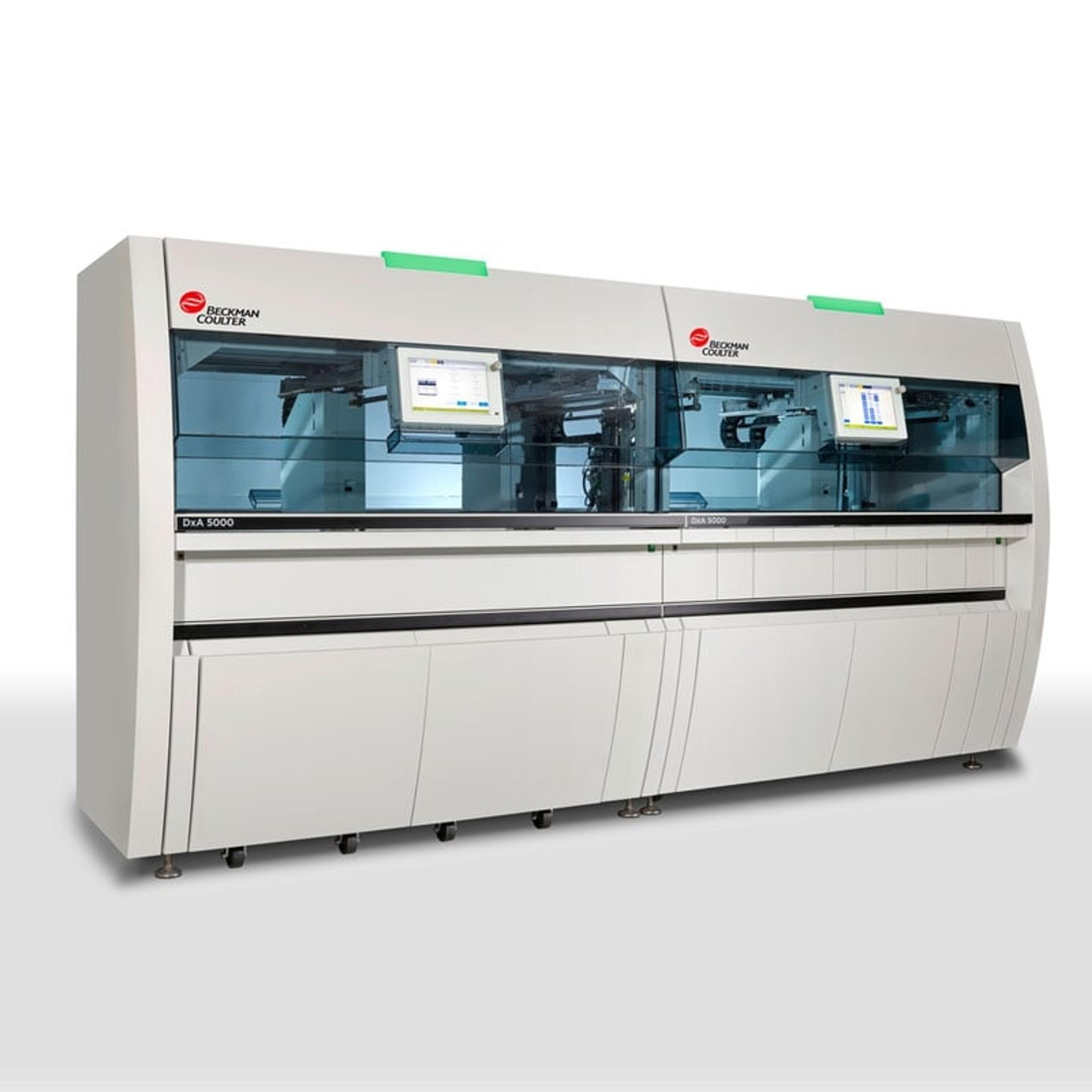
DxA 5000
Beckman Coulter DiagnosticsLab automation that drives consistent and rapid turnaround time results