
Scalability and reproducibility for high-throughput biological modeling in 3D cell culture
21 Mar 2025The RASTRUM™ Allegro platform provides a powerful solution for generating consistent 3D models at scale. While increasingly it is understood that 3D biology can offer insights that 2D monolayers cannot, challenges remain in the development of 3D cell/tissue models. Factors such as cell source, matrix choice, and experimental handling can vary widely and ultimately impact reproducibility. For applications that demand large datasets, such as drug discovery, reproducibility is paramount. The coefficient of variation (CV) offers a standardized measure to evaluate the consistency of data. Whilst the acceptance criteria for CV values can depend on assay type, for multiwell-plate–based biological assays these CV values have typically been defined as 10–30%. Furthermore, CV values less than 10% have been considered as excellent and 10-20% as good in a variety of biological contexts.
Here, Inventia demonstrate that the RASTRUM Allegro is capable of delivering CV values that are reproducible across model architectures and cell types, and suitable for evaluation of various downstream applications. Post-print CVs were consistently <10% across various architectures and plate formats. Over a range of downstream biological assays, it has achieved CVs ranging from 7.1% (96-well drug-dosing viability assay) up to 18.6% (384-well drug-dosing viability assay).
Related products
Request Quote for All Products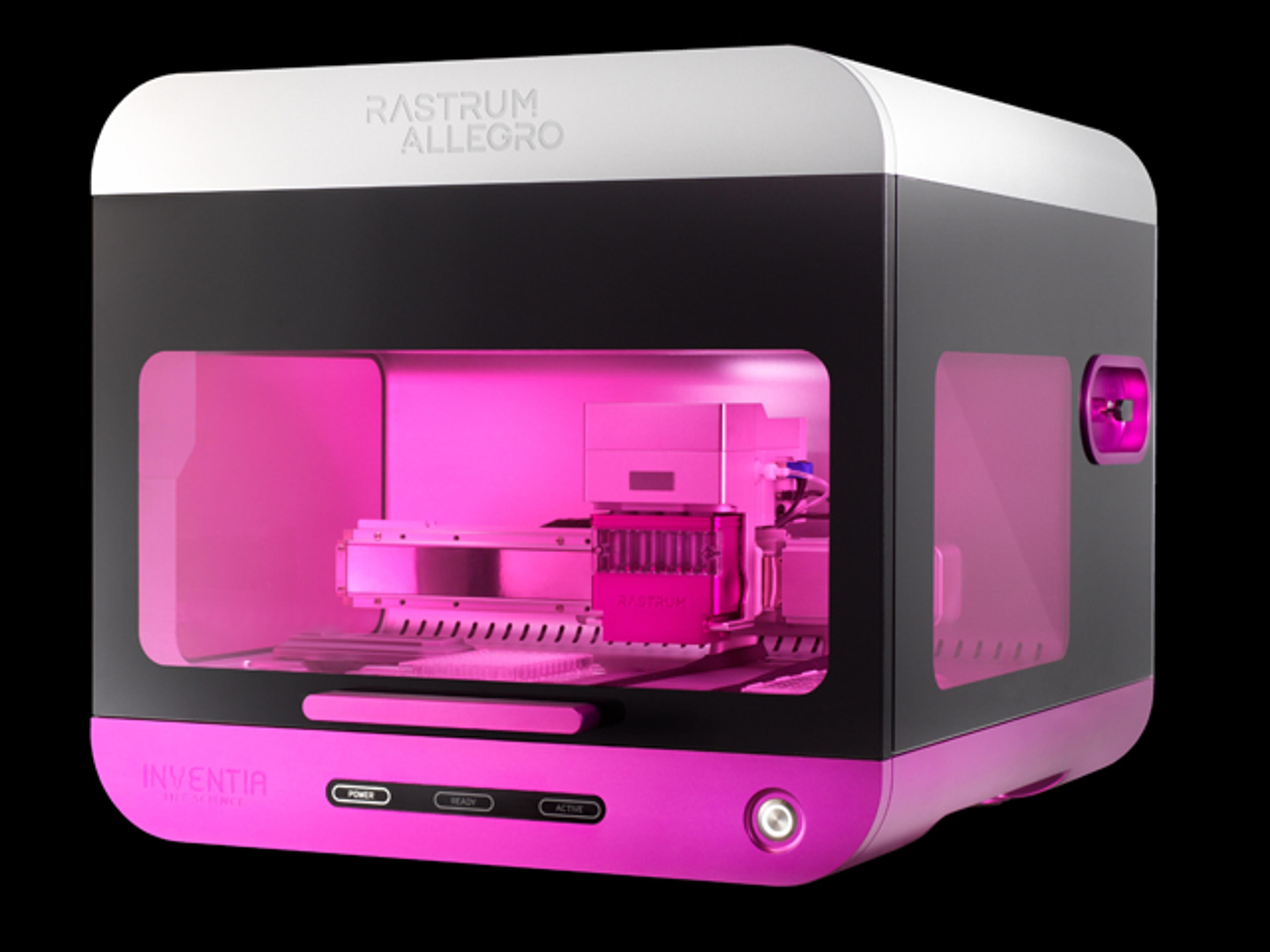
RASTRUM Allegro
InventiaRASTRUM™ Allegro is a revolutionary 3D cell culture platform designed to generate biologically relevant models at scale. It streamlines the creation of complex, structured 3D cell environments, accelerating drug discovery and disease research.