
Rapid Analysis of 303 Pesticide Residues in Green Beans using Triple Quadrupole GC-MS/MS
Rapid Analysis of 303 Pesticide Residues in Green Beans using Triple Quadrupole GC-MS/MS
29 Sept 2015This application note demonstrates the method for analysis of 303 pesticides in green beans by using an acetonitrile extract, followed by SPE clean-up steps, and analysis by the TSQ Quantum GC-MS/MS using timed-SRM mode. The combination of triple quadrupole GC-MS/MS and ion trap GC-MS with QuEChERS sample preparation method has been investigated for the pesticide analysis in different food matrices. However, solid phase extraction (SPE) as a clean-up procedure is still the official analytical method for pesticide residues analysis in some countries.
Related products
Request Quote for All Products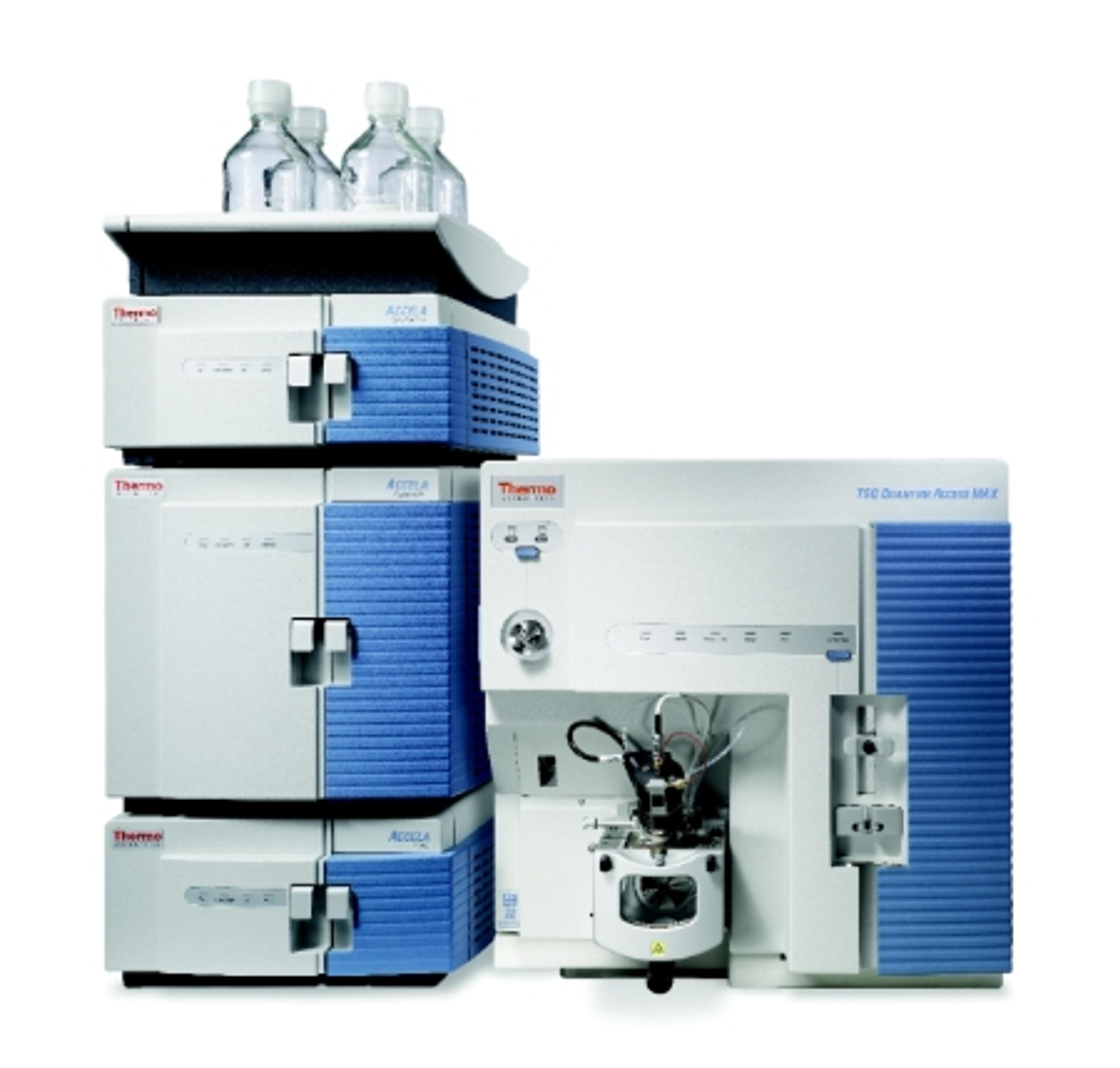
Thermo Scientific™ TSQ Quantum™ Access MAX Triple Quadrupole Mass Spectrometer
Thermo Fisher ScientificAchieve high quantitative sensitivity and specificity economically with the Thermo Scientific™ TSQ Quantum™ Access Max triple quadrupole mass spectrometer. Applications such as pharmaceutical development, environmental and food safety testing, clinical research, and forensic toxicology demand analytical sensitivity and specificity—even when budgets are constrained. The Thermo Scientific™ TSQ Quantum™ Access MAX Triple Quadrupole Mass Spectrometer is an outstanding LC-MS/MS value, providing excellent sensitivity, specificity, and flexibility that is also more affordable. Features: Thermo Scientific™ Ion Max™ API source with HESI-II probe reduces noise and increases sensitivity, enhancing quantitative performance. Up to 3,000 definable, timed SRMs and fast 25 ms positive/negative switching improve productivity. Quantitation-enhanced data-dependent MS/MS (QED-MS/MS) provides simultaneous compound confirmation and quantification. High-resolution selected reaction monitoring (H-SRM) with 2 ms dwell times enables quantification of hundreds of compounds in a single run. Mass range of 10–3000 m/z allows analysis of small molecules and intact proteins. Zero-cross-talk collision cell eliminates false positives. Optional FAIMS interface enhances specificity. Intuitive software with searchable compound libraries and database of methodologies for the analysis of pesticides, azo dyes and banned pharmaceuticals in water and food, make the system easy to use. Self-cleaning Ion Max API source heater with automatic source recognition simplifies use and increases reliability.