
Overcoming the Matrix Effect in LC/MS of Serum or Plasma Samples Using Two Distinct Sample Prep Approaches
19 Apr 2016This article highlights the impact that sample matrix effects can have on LC/MS response and discusses two novel approaches to reduce it. Advancements in electrospray ionization mass spectrometry (ESI-MS) have changed the way identification and quantification of small molecules in biological fluids is conducted. Systems are capable of routinely detecting sub-femtogram levels of analytes. This report demonstrates that targeted phospholipid depletion using HybridSPE-Phospholipid and analyte enrichment using biocompatible SPME, both provide effective means to reduce matrix interference that can rob the method of sensitivity, reproducibility, precision, and accuracy.
Related products
Request Quote for All Products
HybridSPE-PLus Plates Pack of One
Sigma-Aldrich SupelcoThe Next Generation in Hybridspe-Phospholipid Technology
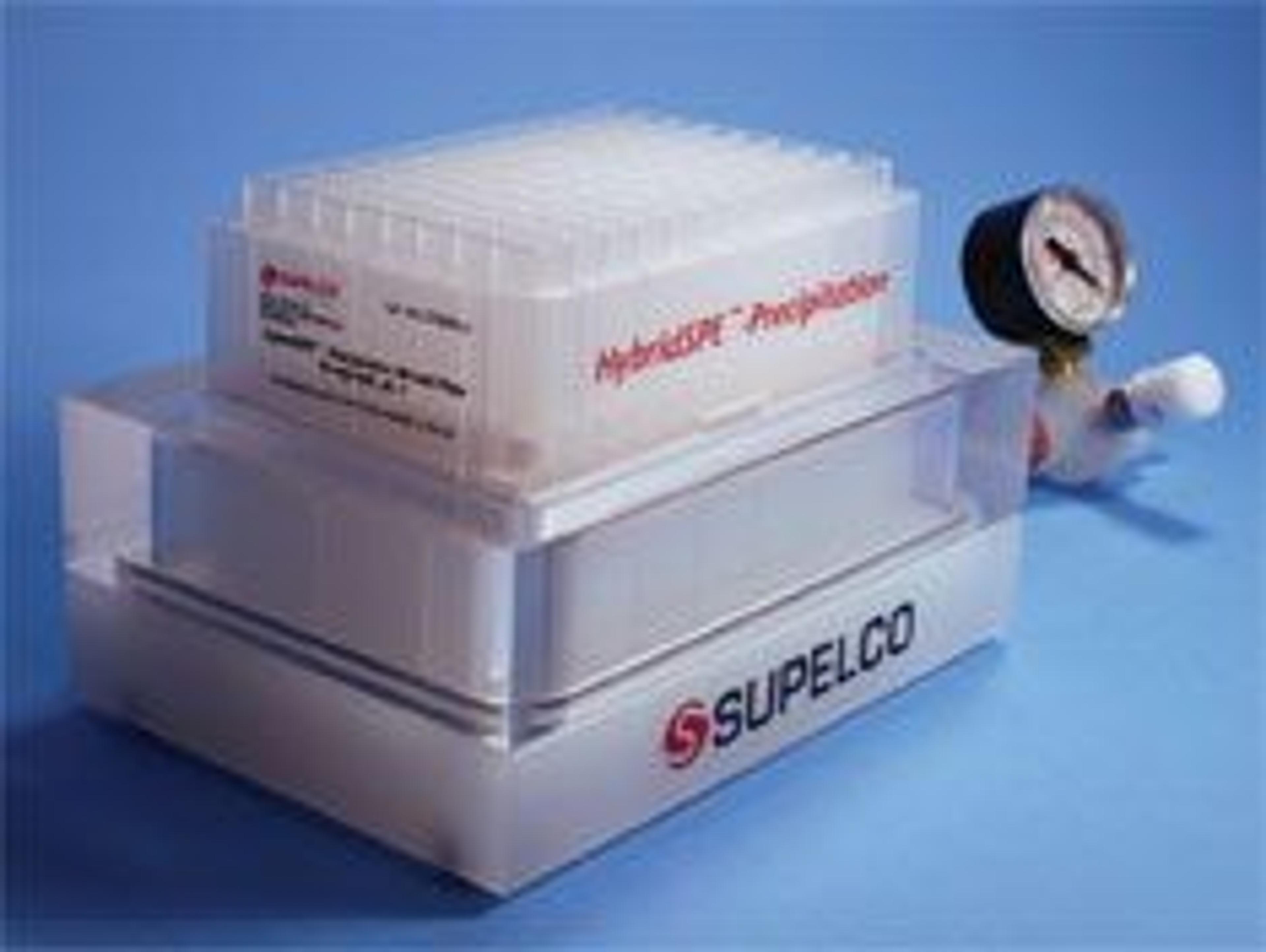
HybridSPE®-Precipitation, 96-well Plate, pk of 1
Sigma-Aldrich SupelcoPatent pending HybridSPE – Precipitation (HybridSPE-PPT) technology is a simple and generic sample prep platform designed for the gross level removal of endogenous protein and phospholipid interferences from biological plasma and serum prior to LC-MS or LC-MS/MS analysis. Biological plasma or serum is first subjected to protein precipitation via the addition and mixing of acidified acetonitrile. Precipitated proteins are then removed by centrifugation and the resulting supernatant is loaded on the HybridSPE-PPT 96-well plate or cartridge which acts as a chemical filter that specifically targets the removal of endogenous sample phospholipids. The phospholipid retention mechanism is based on a highly selective Lewis acid-base interaction between the proprietary zirconia ions functionally bonded to the HybridSPE-PPT stationary phase and the phosphate moiety consistent with all phospholipids. The resulting eluent is ready for immediate LC-MS or LC-MS-MS analysis. An alternative “In-well Precipitation” method is available for the HybridSPE-PPT 96-well version in which biological plasma/serum is first added to the 96-well plate followed by acidified acetonitrile (precipitation agent). After a brief mixing/vortexing step, vacuum is applied to the 96-well plate. Because the 96-well version contains a series of low porosity hydrophobic filters/frits, the packed-bed filter/frit assembly acts as a depth filter facilitating the concurrent removal of both phospholipids and precipitated proteins during the extraction process.