
Novel pGL4 Vectors to Monitor Cellular Stress
20 Jul 2015Promega has created a portfolio of bioluminescence-based reporter gene assays to identify pathways involved in cellular stress. These assays can help identify the cellular mechanisms used by cells to adapt to a perturbation, gaining insight into the potential toxicity of compounds. This scientific poster investigates the efficacy of Promega’s suite of reporter gene assays in detection of activated cellular stress pathways.
Related products
Request Quote for All Products
Nano-Glo® Dual-Luciferase® Reporter Assay System
Promega Corp.Switch Seamlessly from Your Current Dual-Luciferase® Assay!
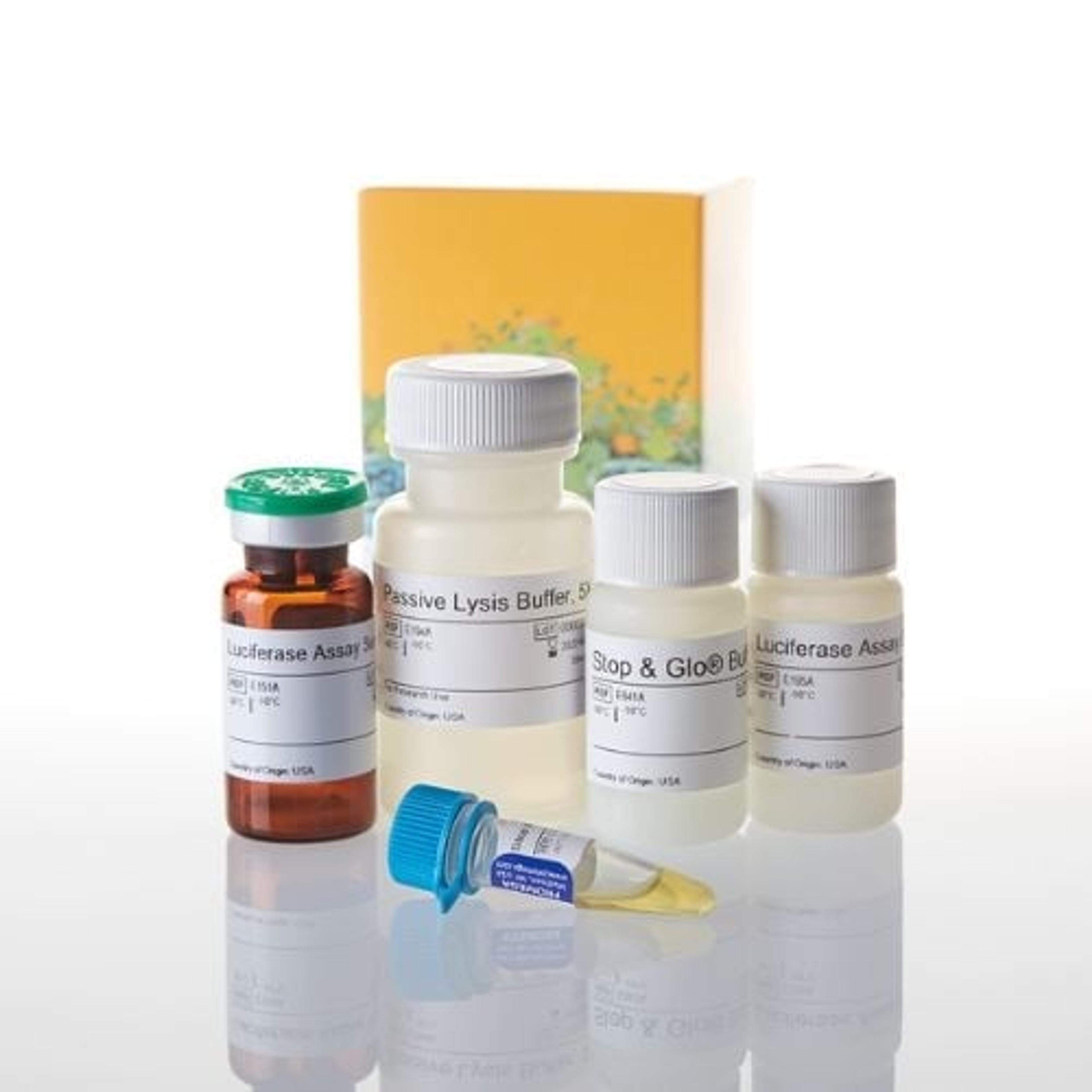
Dual-Luciferase ® Reporter Assay System
Promega Corp.The Dual-Luciferase® Reporter (DLR™) Assay System(a–f) provides an efficient means of performing two reporter assays. In the DLR™ Assay, the activities of firefly (Photinus pyralis) and Renilla (Renilla reniformis or sea pansy) luciferases are measured sequentially from a single sample. The firefly luciferase reporter is measured first by adding Luciferase Assay Reagent II (LAR II) to generate a luminescent signal lasting at least one minute. After quantifying the firefly luminescence, this reaction is quenched, and the Renilla luciferase reaction is initiated simultaneously by adding Stop & Glo® Reagent to the same sample. Both assays can be completed in about 4 seconds using a luminometer with reagent auto-injectors. In the DLR™ Assay System, both reporters yield linear assays with attomole (<10−18) sensitivities and no endogenous activity in the experimental host cells. Furthermore, the integrated format of the DLR™ Assay provides rapid quantitation of both reporters either in transfected cells or in cell-free transcription/translation reactions. The pGL4 and phRL series of synthetic Renilla Luciferase Reporter Vectors are designed for use with the DLR™ Assay Systems. A Renilla luciferase vector with constitutive expression may be used in combination with any experimental firefly luciferase vector to co-transfect mammalian cells.