
Mastering particle characterization for biologics and nanomedicine
31 Jul 2026
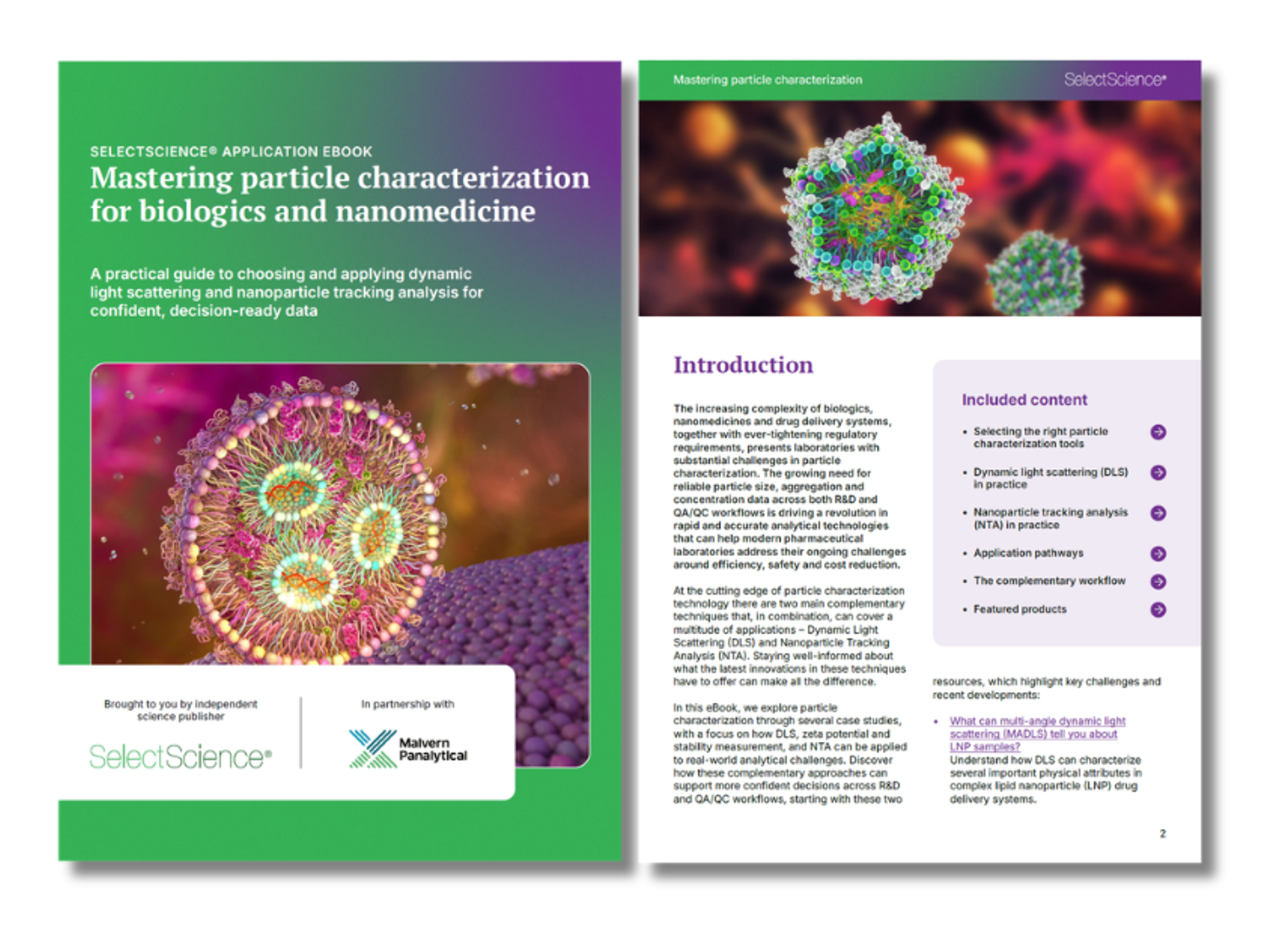
Particle characterization plays a critical role in the development of biologics, nanomedicines, viral vectors, and advanced drug delivery systems. As therapeutic modalities become increasingly complex, laboratories need reliable ways to measure particle size, aggregation, concentration, and stability to generate the high-quality data required for confident decision-making across R&D and QA/QC workflows.
This SelectScience eBook explores how dynamic light scattering (DLS) and nanoparticle tracking analysis (NTA) can be used to address real-world particle characterization challenges. Through expert commentary, practical guidance, and application-focused case studies, you'll discover how these complementary techniques can help you generate more meaningful and reproducible data across a range of biologics and nanoparticle-based applications.
From lipid nanoparticles and extracellular vesicles to viral vectors and protein therapeutics, learn how researchers are applying DLS and NTA to characterize critical quality attributes, investigate stability, monitor aggregation, and support the development of next-generation medicines.
Download this SelectScience guide to explore:
- Selecting the right particle characterization tools
- Dynamic light scattering (DLS) in practice
- Nanoparticle tracking analysis (NTA) in practice
- Application pathways
- The complementary workflow
Resource details:
- Document type: SelectScience application eBook
- Page count: 53
- Read time: 80 mins
- Edition: 1st
Related products
Request Quote for All Products
NanoSight Pro
Malvern PanalyticalCharacterizing Nano- and Biomaterials has never been so quick, easy, and accurate.
Links
Tags
Frequently asked questions
Show frequently asked questions
What is particle characterization and why is it important in biologics development?
Particle characterization helps scientists understand attributes such as particle size, concentration, aggregation, and stability. These measurements are critical for supporting the development, quality control, safety, and performance of biologics, gene therapies, and nanomedicine.
What is the difference between dynamic light scattering (DLS) and nanoparticle tracking analysis (NTA)?
DLS measures particle size using an ensemble approach and is often used for aggregation and stability studies, while NTA tracks individual particles and provides high-resolution particle size distribution and concentration data. The techniques are often used together to generate complementary insights.
How are lipid nanoparticles (LNPs) characterized?
Scientists commonly use particle characterization techniques such as DLS and NTA to assess critical quality attributes including particle size, concentration, polydispersity, aggregation, and stability. These measurements help support the development of mRNA therapies and other nanoparticle-based medicines.
How can particle characterization support gene therapy development?
Particle characterization techniques can help researchers measure viral vector size, concentration, aggregation, and thermal stability, supporting the development, optimization, and quality assessment of gene therapy products.
What techniques are used to measure extracellular vesicles (EVs)?
Nanoparticle tracking analysis (NTA) is widely used to measure extracellular vesicle size and concentration, while fluorescence-enabled workflows can help identify and characterize specific EV subpopulations and biomarkers.
How can scientists detect protein aggregation and stability issues?
Particle characterization tools can be used to study aggregation behavior, monitor stability under stress conditions, and assess thermal stability, helping researchers better understand the performance and shelf life of protein therapeutics.
When should I use DLS vs NTA for particle characterization?
The choice depends on your sample type and analytical goals. DLS is often used for rapid size, aggregation, and stability measurements, while NTA can provide higher-resolution particle-by-particle analysis, making it particularly valuable for heterogeneous nanoparticle samples. Many laboratories use both techniques as complementary approaches.