Lateral Flow: Making Magnetic Particles a Viable and Easier to Use Replacement to Gold Nanoparticles

20 Sept 2016

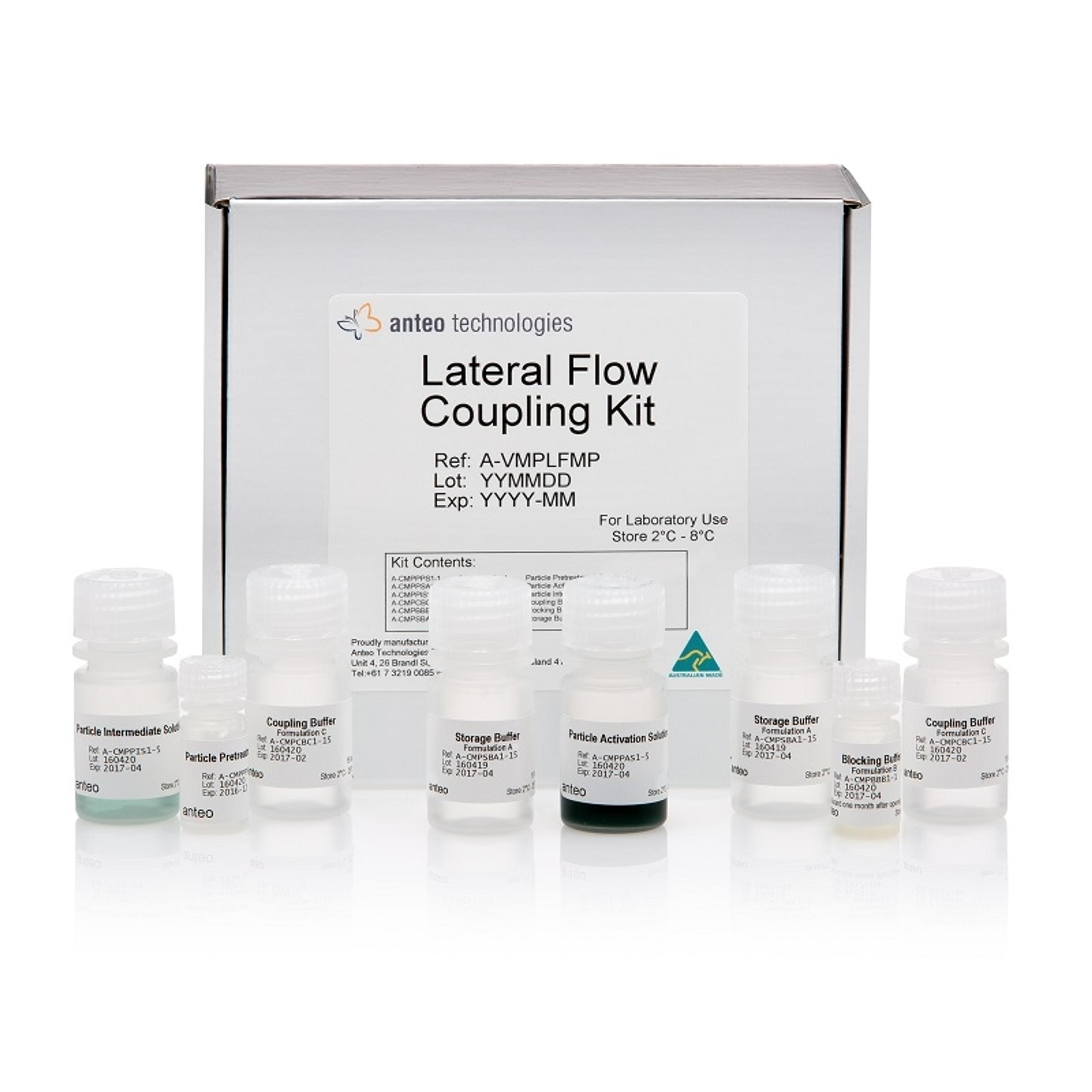
This application note outlines the preparation of 200nm magnetic particles conjugates for use in an anti-hepatitis B surface antigen based lateral flow assay, using the Lateral Flow Coupling Kit from Anteo Technologies.

Lateral Flow Coupling Kit

Anteo Technologies

Reduce labor costs by using our ready-to-use Lateral Flow Coupling Kit for magnetic and latex particles. No messy pre-preparation of reagents required. Simply pipette Anteo's water-based Activation Reagent onto your chosen particles to activate. Hands-on time for surface activation and coupling is 60 minutes. Magnetic particles are easier to use than gold. Magnetic separation removes the need to perform centrifugation and filtration concentration. This Lateral Flow Coupling Kit has successfully given scientists 5 x more sensitive lateral flow assays and less variation in their experiments than covalent EDAC chemistry when using magnetic particles.                        This kit enables scientist to bind any antibody without pre-treatment. Promoting monolayer binding, this kit greatly reduces the risk of antibody damage, leading to less antibodies required for the experiment, increased antibody functionality, reduced interference and increased uniformity between experiments.   Features: Demonstrated to increase the sensitivity of lateral flow assays and reduce variation in results This kit enables scientist to bind any antibody without pre-treatment Hand on time for surface activation and coupling is 60 minutes An alternative to covalent NHS/EDC and passive binding the Anteo Kit is easy to use, while reducing damage to antibodies Easy to use, you simply pipette the Activation Reagent on your surface to activate. Promotes monolayer binding which increases antibody functionality Reduces aggregation Increases uniformity between experiments  

(0)

Links

Tags

AntibodiesAntibodies are used in techniques such as confocal and fluorescence microscopy, flow cytometry, ELISA, ELISPOT, immunohistochemistry, western blotting and immunopreciptation. Select specific antigen reactivity, high specific affinity, low non-specific binding, monoclonal or polyclonal, primary or secondary antibodies and associated conjugates such as an enzyme or dye for visualization.ProteomicsProteomics is the systemic bioinformatics study of proteins and amino acids, including their structure, size, function and identification. Tools used in proteomics include chromatography, blotting and gels, protein arrays, mass spectrometry and ELISA and associated analysis software. Analyzers and proteomic systems should be sensitive, high resolution, fast and may be automated for high-throughput.Cell-Based AssaysCell-based assays are used to monitor the presence, quantity and activities of a desired cellular analyte including drug molecules or biomarkers. This can reveal information on cell health (apoptosis, cytotoxicity, viability and proliferation assays), cell metabolism, cell migration and cell signaling mechanisms. Find the best cell-based assay products, kits and equipment with our peer reviewed product directory: compare products, check customer reviews and receiving pricing direct from manufacturers.NanotechnologyNanotechnology, or nanotech, is an engineering technique using molecular scale functional systems. Applications of nanotechnology include medicine and medical devices, electronics, air and water purification, food science and energy production.Surface Area TestingPhysisorption studies fundamental parameters essential for the characterization of materials such as the specific surface area and pore size distribution. Properties such as porosity, strength, hardness, permeability, separation selectivity, corrosion, and thermal stress resistance can all be directly correlated to the porous structure of a material.Magnetic BeadsProtein BiologyThe analysis of protein expression, identity and function is vital for many areas of life science research and drug discovery. Some of the most commonly used techniques in protein analysis include Western blotting, electrophoresis and mass spectrometry.ConjugationAntibody Drug ConjugatesSurface AnalysisNanoparticlesNanoparticles are between 1-100nm in size. Nanoparticles can be used for a wide variety of applications including biomedical, catalysis and electronics.