
ResourceSpectroscopy

Discussing the Pros and Cons in Super-Resolution Imaging Techniques

28 Feb 2019

Super-resolution microscopy™, also called nasoscopy, allows for observation of fluorescent samples at resolutions below the limit the diffraction of light imposes on any optical microscope. This limit, defined by Abbe, is at best ~200 nm laterally and ~500 nm axially, which is well above the resolution necessary to discriminate between different single molecules, or even an ensemble of molecules within a cellular compartment. Super-resolution approaches, by breaking this diffraction barrier, are therefore extremely helpful for the visualization of structural organization and the quantification of dynamic processes down to the molecular level. Applications include the study of membrane nanostructure, protein aggregation, nuclear machinery, molecular architecture of cell-cell interface, and synaptic transmission.
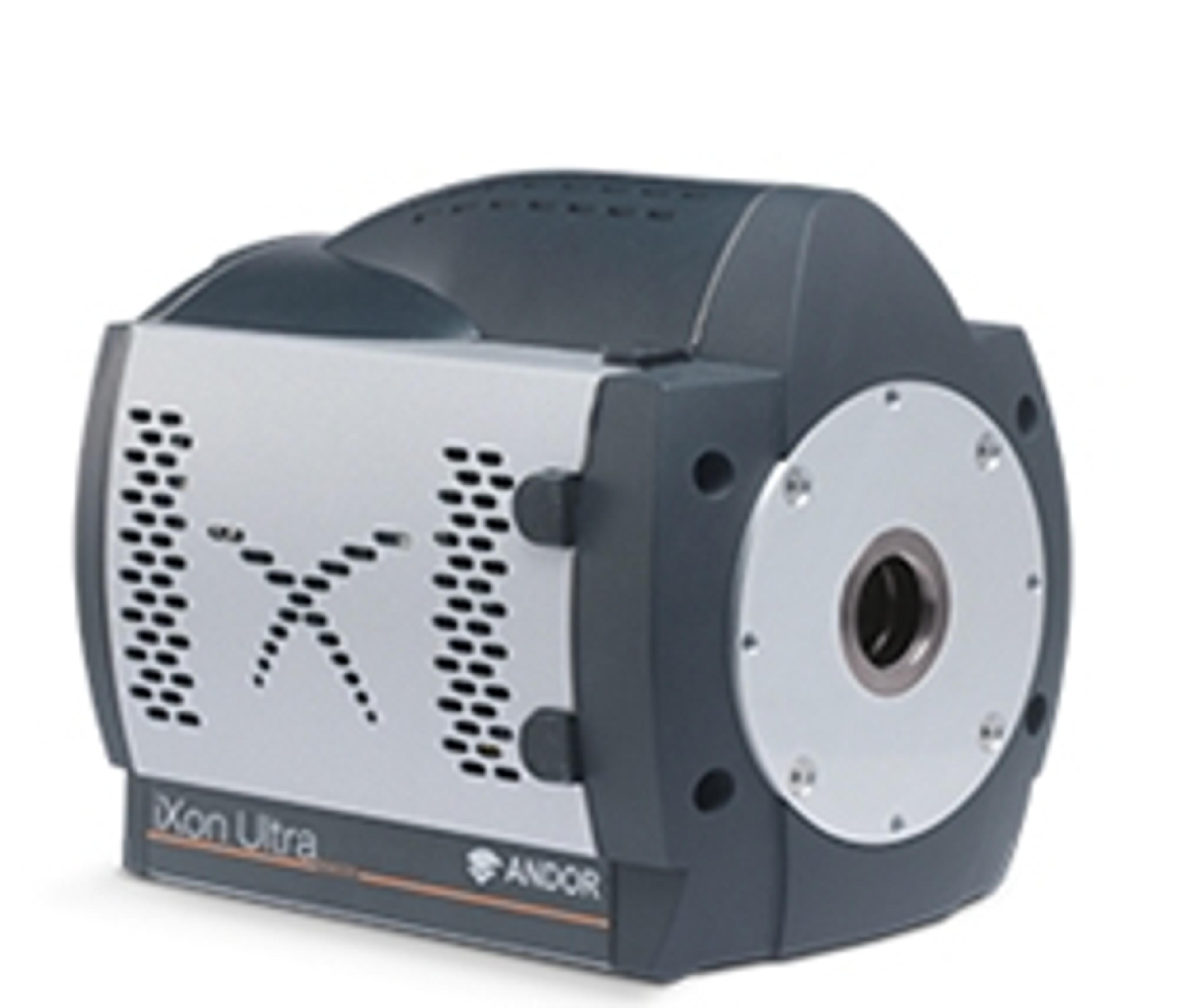
iXon Ultra 888 EMCCD Camera

Oxford Instruments Andor

The highly innovative iXon Ultra 888 is the world’s fastest Megapixel, Back-illuminated EMCCD camera, offering exceptional frame rates and single photon sensitivity across a large field of view. Building on a rich history of first to market innovation, the ‘supercharged’ iXon Ultra 888, represents a massive performance boost for the largest available EMCCD sensor, as well as the first USB3 enabled EMCCD camera. The iXon Ultra 888 has been fundamentally re-engineered to facilitate 3x overclocking of the pixel readout speed to an unprecedented 30 MHz, whilst maintaining quantitative stability, accelerating the full frame rate performance to video rate. Furthermore, Andor’s unique ‘Crop Mode’ can be employed to further boost frame rates from a user defined sub-region, for example pushing a 512 x 512 sub-array to 93 fps and a 128 x 128 area to 697 fps. With a 1024 x 1024 sensor format and 13 µm pixel size, the resolving power, field of view and unparalleled speed of the iXon Ultra 888 render it the most attractive and versatile EMCCD option for demanding applications such as single molecule detection, super-resolution microscopy, live cell imaging and high time resolution astronomy.Features: 30 MHz readout delivering 26 fps at 1024 x 1024 > 2.6x larger Field of View than ‘897’ model Optically Centered Crop Mode – Live Cell Super Resolution at 697fps Single Photon Sensitive EX2 Technology for wider QE response TE Cooling to -95°C

(2)

Links

Tags

Discussing the Pros and Cons in Super-Resolution Imaging Techniques