ResourceLife Sciences
Automation of Non-Alcoholic Fatty Liver Disease Model Assay
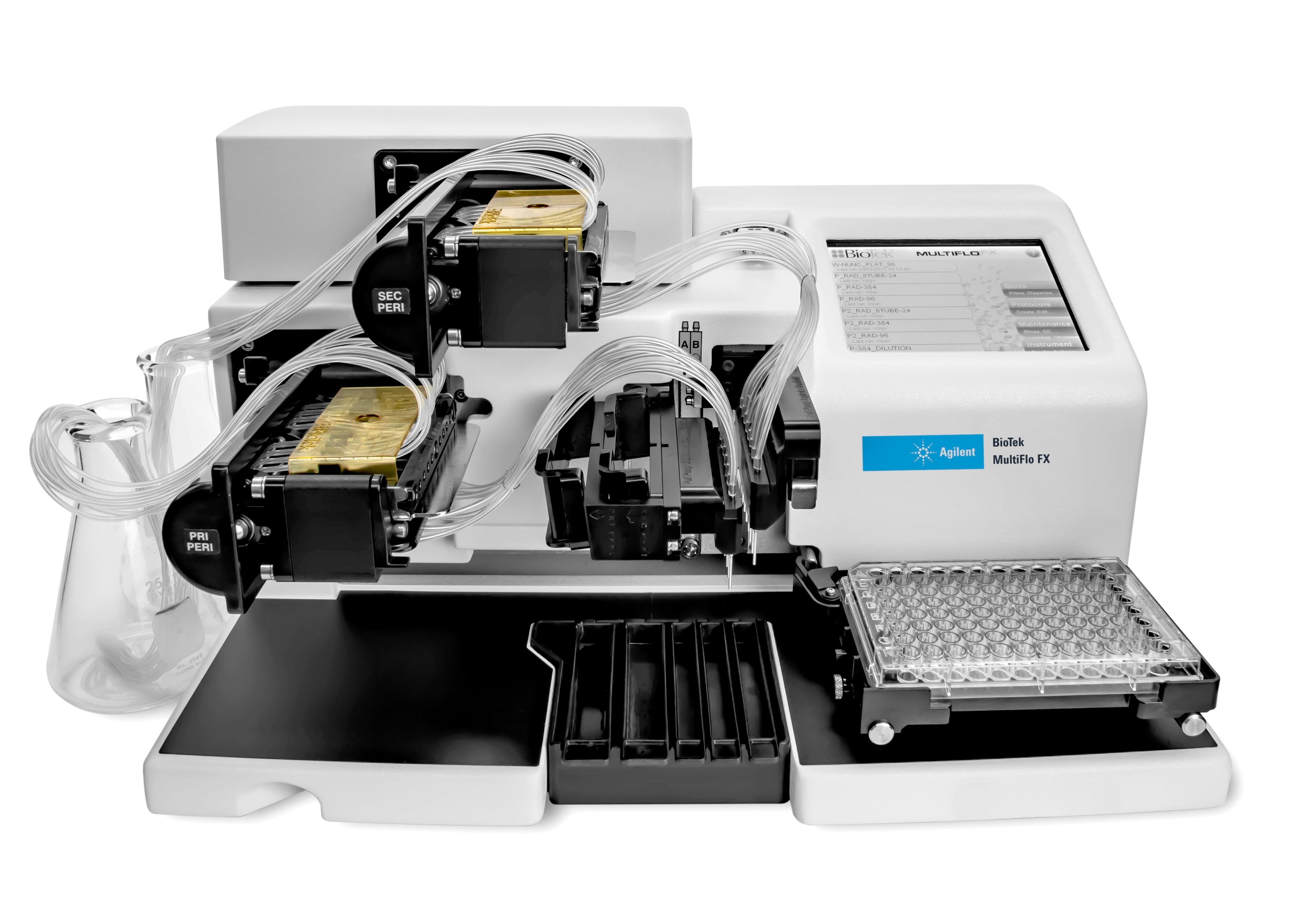
3 May 2018Non-alcoholic fatty liver disease is a common malady whose major feature is fat accumulation in the liver, which can lead to liver damage and cirrhosis. One phenotypic marker for this disease is the presence of intracellular neutral lipid droplets. An in vitro model for this phenotype uses the exposure of cells to free fatty acids to elicit the response. Here we describe the automation of the assay workflow using a BioSpa™ 8 Automated Incubator linked to a Cytation™ 5 Cell Imaging Multi-Mode Reader and a MultiFlo™ FX Microplate Dispenser.
Links
Tags
MicroplatesMicroplates are multi-well plates used to increase the throughput of biological investigations. The number of wells microplates contain can range from 6 to 3243 wells, with the 96-well format being the most commonly used. Microplates can come tailored for a range of applications including cell culture, PCR, filtration, storage, non-binding surface, protein crystallization, as well as pre-coated, deep well and normal Standard microplates. Additionally, options for microplate colors include clear , black, white or black with clear bottom and white with clear bottom for absorbance microplate reader applications. Find the best microplates for your lab in our peer-reviewed product directory: compare products, check customer reviews and receive pricing direct from manufacturers.Microplate Readers / DetectorsMicroplate readers are used to automate the detection and analysis of labeled or label-free components in microplates during assays or live-cell monitoring. Microplate readers are generally distinguished by their mode of detection. Types include absorbance, luminescence, fluorescence intensity, fluorescence polarization, TRF / FRET and multimode microplate readers. Microplate readers deliver a high throughput of samples by reading multiple wells simultaneously, with the 96-well format the most commonly used. As a result, microplate readers are often used in the drug discovery, bioassays, research and pharmaceutical industries for screening applications. Microplate loading can also be automated, with robotic microplate stackers to increase throughput. Find the best microplate readers in our peer-reviewed product directory: compare products, check customer reviews and receive pricing direct from manufacturers.Cell-Based AssaysCell-based assays are used to monitor the presence, quantity and activities of a desired cellular analyte including drug molecules or biomarkers. This can reveal information on cell health (apoptosis, cytotoxicity, viability and proliferation assays), cell metabolism, cell migration and cell signaling mechanisms. Find the best cell-based assay products, kits and equipment with our peer reviewed product directory: compare products, check customer reviews and receiving pricing direct from manufacturers.BiomarkersBiomarkers are biological markers which can be measured and evaluated to indicate a biological state. The use of biomarkers in research and diagnosis can indicate a normal or disease state or drug response of cells / tissues. Biomarkers include genetic markers, cell surface markers such as antigens, antibodies or receptors and secreted molecules such as cytokines. An assay system is required for identification of biomarkers. :Software PlatformsSoftware platforms are useful for various stages of laboratory experiments from data collection to data storage and processing. For instance lab software is available for system control, data management, data analysis and qualification / validation.Plate ProcessingAutomated plate processing is used in microplate technologies for high-throughput, speed and efficiency. Plate processing systems include microplate handlers for moving plates, heat sealers, stackers and carousels for storage, retrieval and delivery, microplate washers and piercers. Useful features of plate processors include walk-away automation, compatibility and easy integration with microplate systems.In VitroIn vitro refers to experiments conducted outside living organisms, often in controlled lab environments such as petri dishes or test tubes. In vitro models are widely used in drug testing, cell biology, and disease research. Explore in vitro research tools in our peer-reviewed product directory; compare products, check reviews, and get pricing directly from manufacturers.AutomationAutomation in laboratories and manufacturing processes enhances efficiency, precision, and scalability by reducing the need for manual intervention. It plays a critical role in improving productivity, minimizing human error, and accelerating workflows in fields like diagnostics, drug development, and industrial testing. Automation technologies include robotic systems, automated liquid handlers, and process control systems that streamline complex tasks and ensure consistent, reproducible results. Explore our peer-reviewed product directory to discover the best automation solutions, compare options, read user reviews, and get prices directly from manufacturers.Liver DiseaseLipidsLipids are a diverse group of organic compounds that are insoluble in water, including fats, oils, and hormones. They are critical for cellular structure and energy storage. Explore lipid analysis tools in our peer-reviewed product directory; compare products, check reviews, and get pricing directly from manufacturers.HepatocytesFatsBiomarker DiscoveryClinical biomarkers refer to substances related to known medical conditions that can be accurately measured <i>in vitro</i>. Biomarkers can be used to diagnose presence of a disease and indicate disease severity. The discovery of new biomarkers is incredibly valuable in the field of diagnostics.