
The Road to Precision Medicine Begins with Simple, Robust Methods
Dr. Michael Bianchi, senior lab manager at Empire Genomics explains the fundamental basis of a successful experiment – a protocol that works well.
12 Dec 2017
Precision medicine aims to fully analyze the human genome and understand mutations, both genetic and epigenetic, that pose a disease risk in an individual. This ultimate goal, when broken down into everyday research projects, begins with a simple choice: a robust experimental design that offers data reproducibility.
Precision medicine aims to fully analyze the human genome and understand mutations, both genetic and epigenetic, that pose a disease risk in an individual. Credit: 123rf.com; Giorgio Bizzotto
In this SelectScience® interview, we speak with Michael Bianchi, senior lab manager at Empire Genomics, a company specialized in providing genomics services with the overarching goal of making personalized medicine a reality in the near future. Bianchi takes us back to the fundamental foundation of successful genomics research – an optimized protocol.
Genomic research is not a novel territory for Empire Genomics, which contributed to the Human Genome Project and the development of the DNA construct – bacterial artificial chromosome (BAC) – that, in turn, was used to sequence the human genome. “We’re currently involved in two clinical trials, one in myeloma and one in prostate cancer,” says Bianchi. “We’re also working on next-generation sequencing technology as companion diagnostics to target mutations in bile duct cancer, known as cholangiocarcinoma.”

Irrespective of the momentous goal of a genomic project, it all starts with accurate sample prep and reproducible protocols. Bianchi is also the quality manager at Empire Genomics. He maintains current practices and implements new quality standards. The building block of analyzing the human genome is the sample tissue; in Bianchi’s case, FFPE (formalin-fixed paraffin-embedded) samples.
“And that’s just the collection process,” Bianchi continues. “The extraction is yet another challenge." Known to be quite a challenge to work with, Bianchi explains, “FFPEs are difficult to handle – the protocols used to collect them can be different. It’s likely that every site that collects FFPE tissue does the formalin fixation and paraffin embedding steps slightly differently. Sometimes the samples might sit in formalin a little longer than in another site. When we analyze the samples, we may not know how the specimen was treated.”
“We have to get all the paraffin out and make sure the tissue is digested enough. And then, depending on what type of cancer we’re looking at, there are hurdles every step of the way – if we’re dealing with a needle biopsy from lung cancer we have very, very small amounts of tissue to work with. So, optimizing the experiment is key.”
Bianchi recalls a time when he had only four slides, each with a 4-micron thick FFPE tissue, and needed to extract RNA for a reverse transcription reaction. “Usually, I’ll do a minimum of five slides with 10-micron thick sections. But here, I feared not getting enough material for the downstream sequencing,” Bianchi admits.
When optimizing genomics experiments, if one can get the FFPE nucleic acid extraction process down, there will be better success with the downstream experiments. Bianchi comments on his validation process: “To be honest, I’ve used multiple kits to do FFPE nucleic acid extraction but I’ve had very good luck with the FormaPure kit.” Recalling the moment with only four available FFPE slides, Bianchi says, “What I couldn’t believe when I used FormaPure for the RNA extraction is that I had microgram amounts of RNA to work with.”
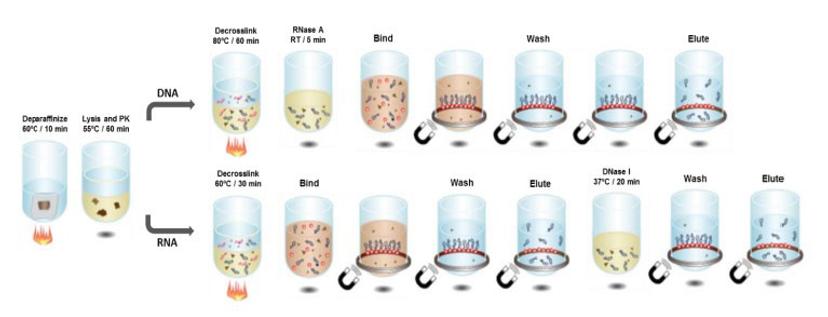
“The nice thing about the FormaPure is that it yields total nucleic acid extraction, so you can use DNA or RNA. I’ve had very good quality yield, and I haven’t had an issue with sequencing reactions or library preps using the specimens I’ve extracted using the FormaPure kit,” Bianchi adds. “If I can get this to work, everything else downstream should be a breeze.”
Like every researcher, Bianchi too has thought about ideas for the future of extraction methods. “I’d love to see a solution where we don’t have to scrape the slide, but we could just dip it in, and it would remove all the paraffin, release the tumor specimen out and do the digestion – an all-in-one step. That would save a lot of time, really.”
With their eyes on precision medicine, Empire Genomics hopes to venture into immuno-oncology in the future, and have begun developing tests for circulating tumors using liquid biopsies. “The biggest milestone for the field would be for reimbursement agencies such as governments and insurance to companies notice the value with these tests, and support the goal of treating each individual differently,” Bianchi says.
This article is a part of the ‘Challenging Samples in Cancer Research’ series produced on SelectScience in association with Beckman Coulter Life Sciences.