Winners of the 2018 Scientists' Choice Awards for General Lab, Separations and Spectroscopy Announced at Pittcon

Prof. Josephine Bunch, Agilent, MilliporeSigma and Bruker among those recognized at SelectSciences special 20th Anniversary Party

1 Mar 2018

Editorial article

SelectScience® is delighted to announce the winners of the 2018 Scientists’ Choice Awards® for General LabSeparations and Spectroscopy as chosen by scientists from around the globe. Winners and nominees were celebrated during a special SelectScience 20th Anniversary Party yesterday evening at the Pittcon 2018 International Conference and Expo in Orlando, USA. Read on to find out who walked away with the coveted awards this year and for other highlights from this exciting event, which marked 20 years of independent, innovative publishing and shared successes.
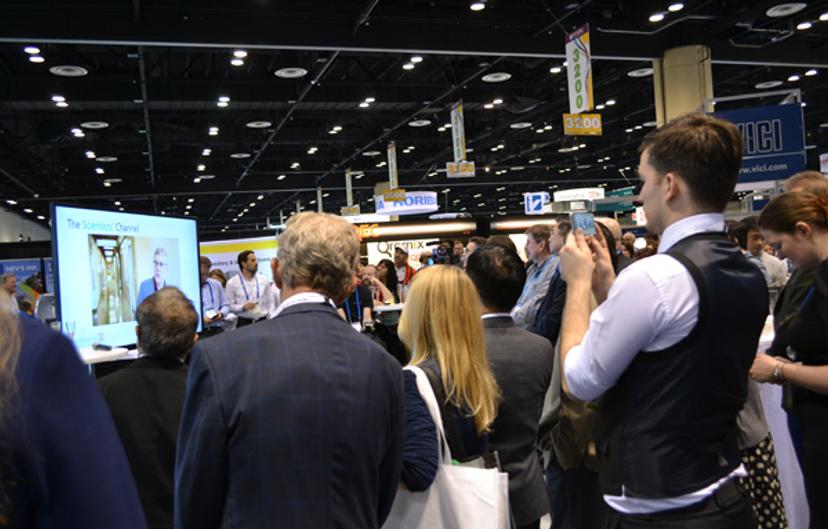
A big crowd gathers for the awards presentation during SelectScience's 20th Anniversary Party

Best New General Laboratory Product 2017

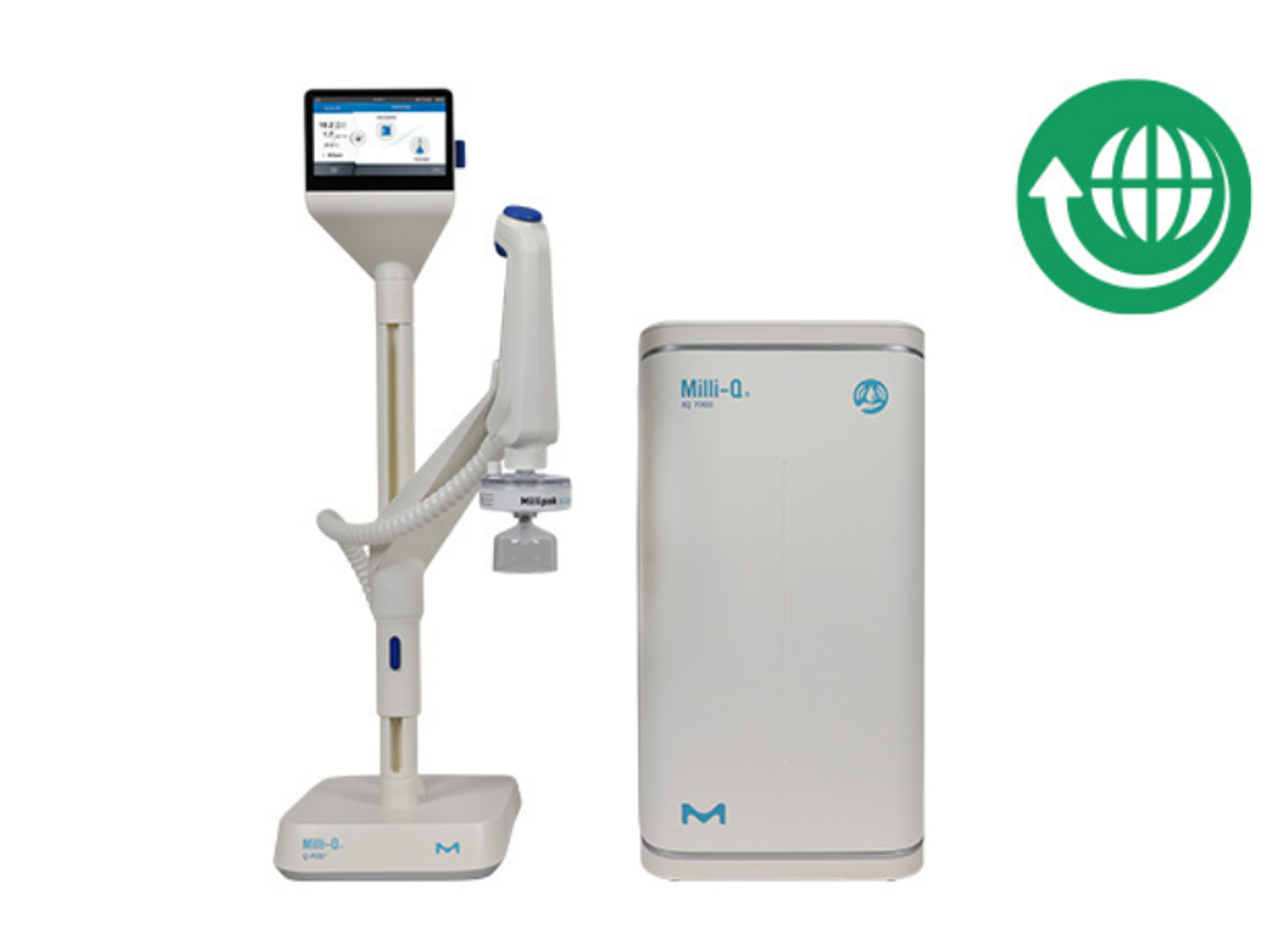
The title of Best New General Laboratory Product of 2017 went to the Milli-Q® IQ 7000 Ultrapure Lab Water System by MilliporeSigma, as nominated and voted for by scientists worldwide.

MilliporeSigma's Renaud Bardon, who accepted the award, said: “This is a great honour and I want to thank SelectScience for the strong partnership that we have. Having this award from the readers and the users is really important to us. This is the type of recognition that we value the most. We will try to win another one next year!”
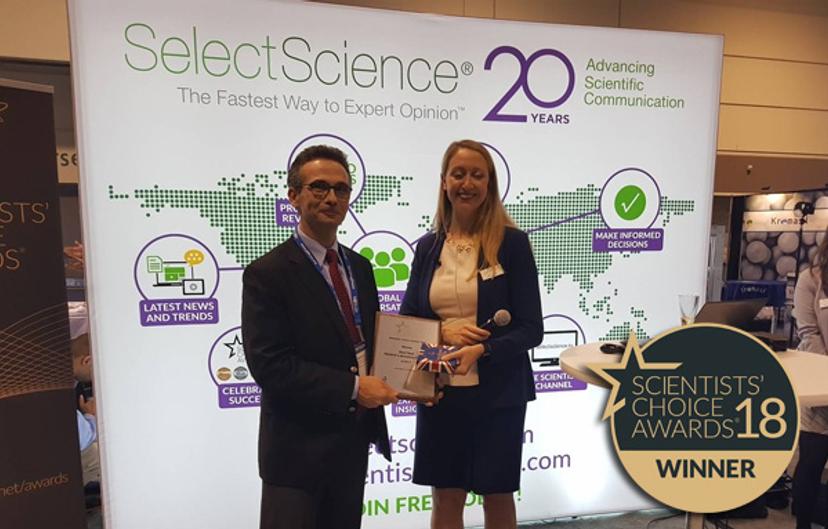
Renaud Bardon, of MilliporeSigma, receives this year's award for Best New General Lab Product

Runners up

Best New Separations Product 2017

SelectScience announced that the Best New Separations Product of 2017 had been awarded to the 1260 Infinity II Prime LC system by Agilent Technologies, as chosen by scientists across the globe.
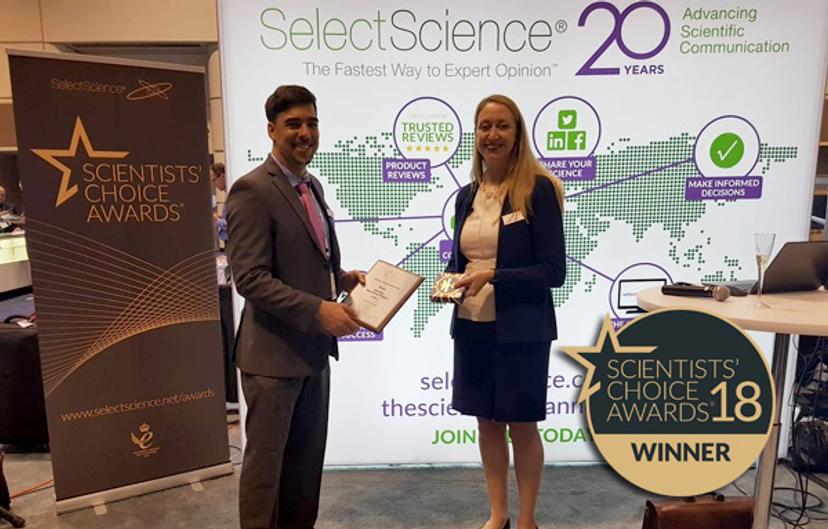
Goran Gerhard Rasched, of Agilent Technologies, receives the award for Best New Separations Product of 2017

Runners up

Best New Spectroscopy Product 2017

The Best New Spectroscopy Product of 2017, according to scientists around the world who have been nominating and voting for their favorites over the past few weeks and months, was the Ultivo Triple Quadruploe LCMS by Agilent Technologies.
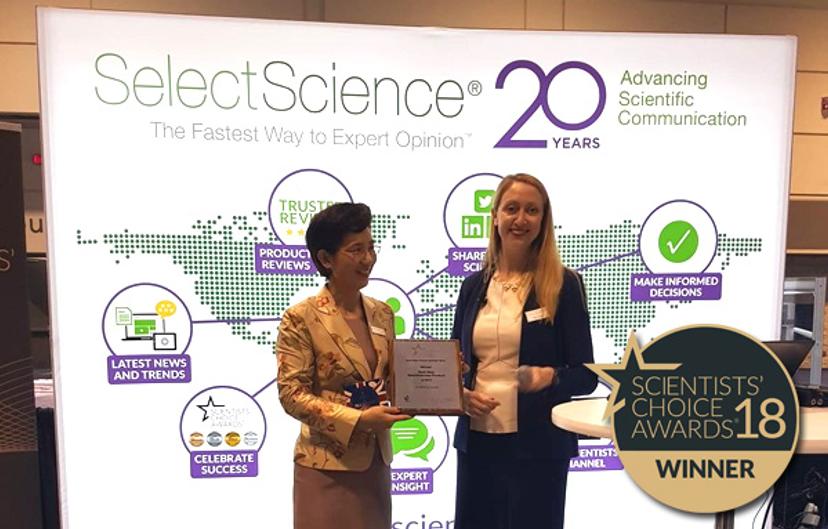
Cynthia Cai, of Agilent Technologies, is presented with this year's award for Best New Spectroscopy Product by SelectScience Editor-in-Chief, Kerry Parker

Runners up

Best Analytical Science Video of 2017

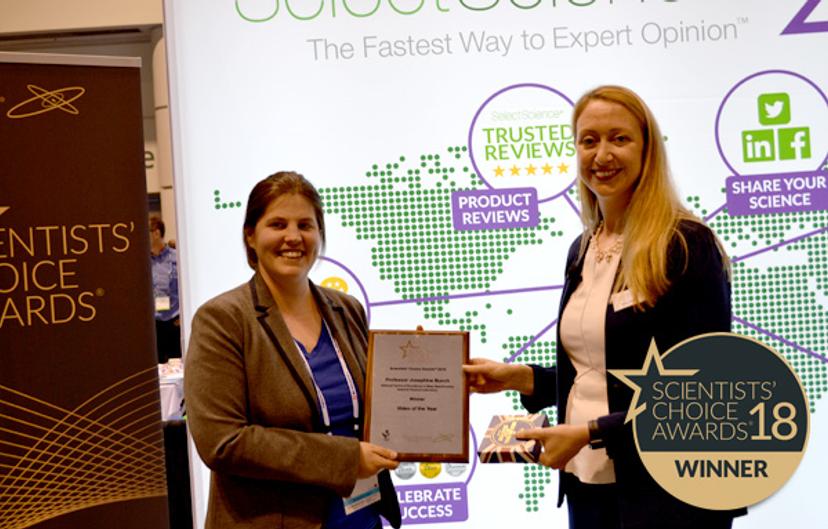
Prof. Josephine Bunch receives this year's award for Best Analytical Science Video of the Year

In the prestigous Analytical Science Video of the Year category, the winning production features Prof. Josephine Bunch, Co-Director of NiCE-MSI at the National Physical Laboratory, UK. The video explores how the latest mass spectrometry imaging from Waters is enabling Prof. Bunch to map tumors at a molecular and cellular level, helping to advance both the diagnosis of cancer and the development of new therapies. Watch the winning video >>

Best Analytical Science Article of 2017
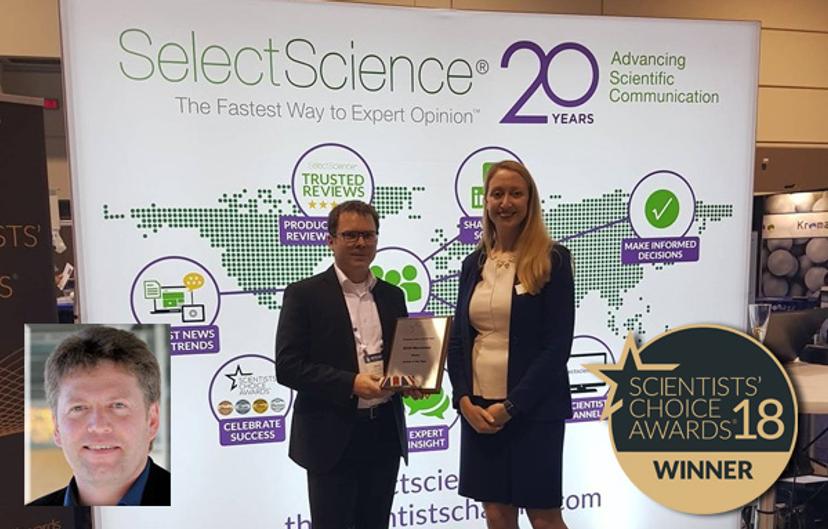
The award for Best Analytical Science Article went to Dr. Timo Bernthaler (inset) and was accepted at the ceremony by Pascal Anger, of ZEISS, which features in the article

The Scientists' Choice Award for Best Analytical Science Article went to 'Could Correlative Microscopy Solve the Energy Problems of the Future?', an in-depth article featuring Dr. Timo Bernthaler, materials scientist at IMFAA, Germany. In the interview Bernthaler discusses his characterization work on energy storage, magnetic and 3D printed materials and how correlative microscopy from ZEISS is accelerating his research.

Dr. Bernthaler told us: “It is with great pleasure that I accept this award and honor on behalf of our research team at the Materials Research Institute (IMFAA) at Aalen University, Germany. It was a pleasure to enhance research into materials for energy conversion, additive processing and energy storage by using correlative microscopic approaches and to explain the relevance of this important research.

"My thanks are also going to Sonia Nicolas and Sarah Thomas from SelectScience, for their professional assistance in producing the interview and the outstanding article. Of course, I would finally like to thank some important members of the IMFAA, Tim Schubert, Andreas Kopp, Andreas Jansche and Gerhard Schneider, for their support and vision to push microscopy into new materials and relevant technologies.”

Best Analytical Science Webinar of 2017
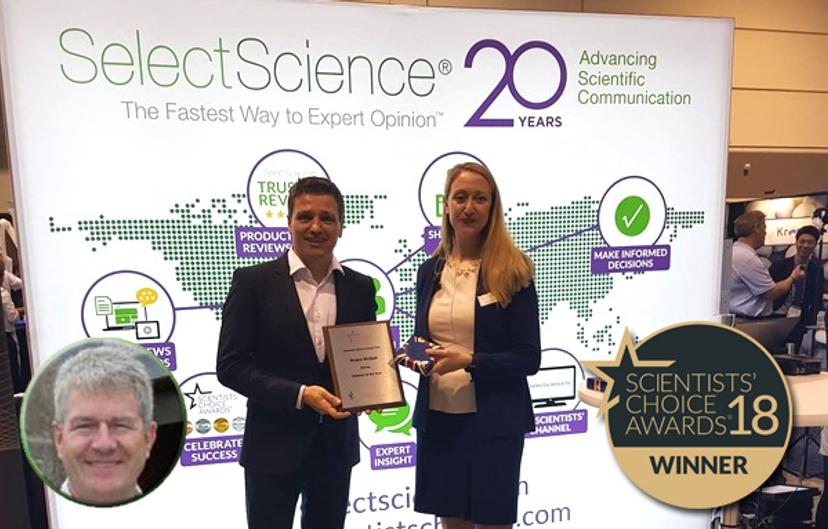
Best Analytical Science Webinar of 2017 was a presention by Dr Clemens Anklin (inset); the award was accepted at the ceremony by Thorsten Thiel, of Bruker.

SelectScience revealed 'Nuclear Magnetic Resonance (NMR) is a Quantitative Method' as webinar of the year, run by Bruker. In the webinar, presenter Dr. Clemens Anklin, explores how NMR can be used to quantify a material, discussing the key parameters and experimental conditions that need to be controlled for accurate results, as well as the advantages and pitfalls of quantitative NMR.

Best Analytical Science Email of 2017

It was the Phenomenex 'Optimize Your HPLC/UHPLC Analysis' email which was named Best Analytical Science Email of the Year. You can see the award-winning email here.
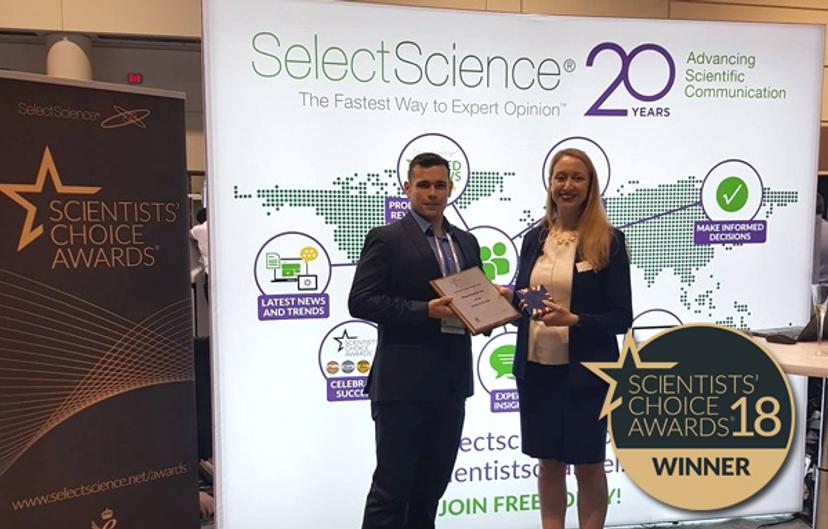
Ryan Splitstone, of Phenomenex, accepts this year's award for Best Analytical Science Email of the Year

Reviewers’ Choice Award™ – Analytical Science Product of 2017

The Reviewers' Choice Award for Analytical Science Product of the Year, which is based on reviews published on the SelectScience website, went to VanGuard Column Protection products, by Waters.
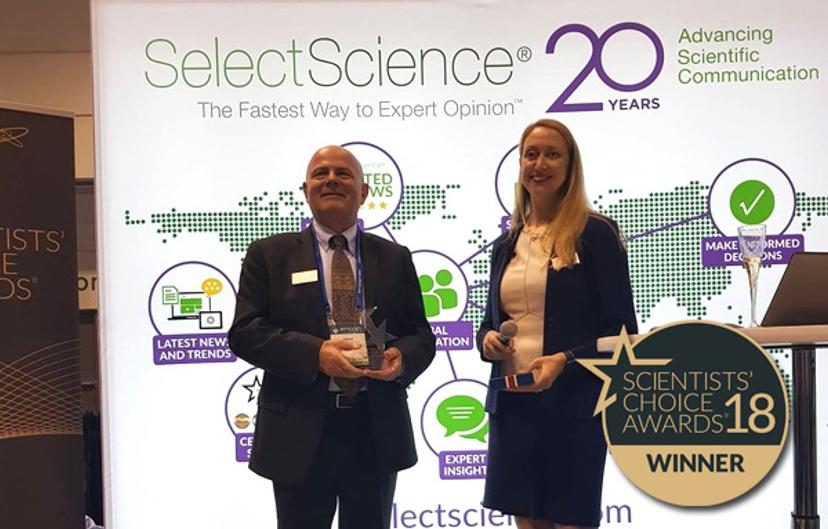
Waters Corporation's VanGuard Column Protection products were winners of the Reviewers' Choice Award for Analytical Science Product of the Year, accepted by Steve McDonough

Reviewers’ Choice Awards™ – Company of the Year & Customer Service of the Year

SelectScience announced that for a second year in a row, Thermo Fisher Scientific won the Company of the Year and Eppendorf won Customer Service of the Year.
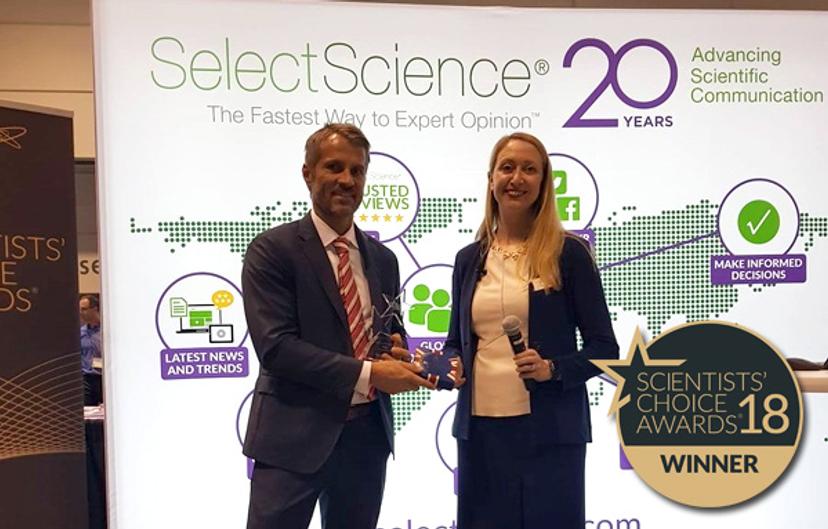
Jakob Gudbrand, of Thermo Fisher Scientific, receives this year's award for Company of the Year

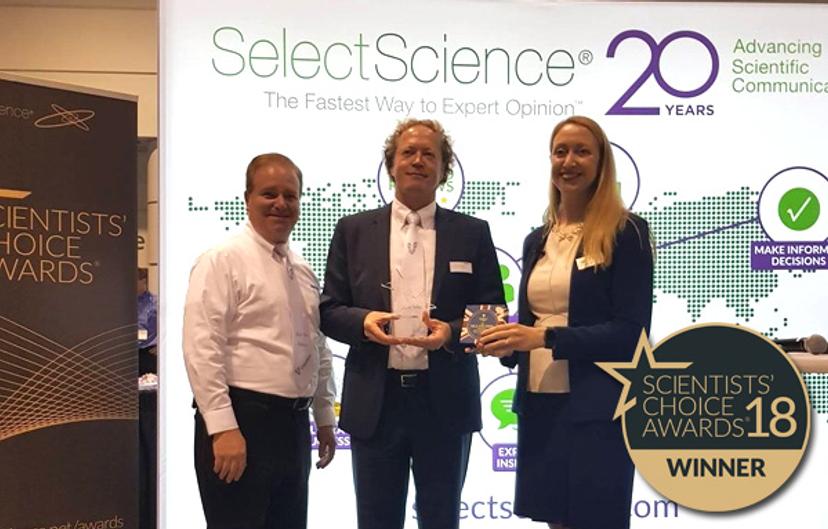
Christian Rohrer (center) and Charlie Villano (left), of Eppendorf, accept this year's award for Customer Service of the Year

Visit the Scientists' Choice Awards website for more information. For news, live updates and interviews from the expo, visit the Pittcon 2018 Special Feature.

Agilent 1260 Infinity II Prime LC System

Agilent Technologies

The 1260 Infinity II Prime LC is a versatile HPLC offering the highest functionality and operational convenience for analytical HPLC and entry-level quaternary UHPLC at pressures up to 800 bar and for flow rates up to 5 mL/min. This versatile HPLC system is a perfect front end for your MS system. 
(29)

Links

Tags

AutosamplersAutosamplers are automated sample loaders used with a number of separation and analytical techniques. HPLC autosamplers use automated partial or full-loop injection systems and place samples in vials or microplates for analysis. Autosamplers can also be used for elemental analysis. Features to consider include repeatability, syringe capacity, footprint and temperature controls.  Capillary ElectrophoresisCapillary electrophoresis (CE) is used to separate molecules based on charge, size and hydrophobicity. Pressure, voltage or a vacuum is used to introduce the sample to fused silica capillaries. Fluorescence, UV/Vis, UV or diode array detectors are used to visualize components. Types of CE systems include capillary electrochromatography (CEC), capillary zone electrophoresis and capillary gel electrophoresis. Find the best capillary electrophoresis equipment in our peer-reviewed product directory: compare products, check customer reviews and receive pricing direct from manufacturers.Flash ChromatographyFlash chromatography is a fast-preparative column chromatography technique used for separation and purification of liquid analytes. Flash chromatography systems use small silica gel particles for separation and a pressurized gas for driving the solvent through the column or pre-packed cartridge. Find the best flash chromatography equipment in our peer-reviewed product directory: compare products, check customer reviews and receive pricing direct from manufacturers.Gas ChromatographyGas chromatography (GC) is an analytical technique used to separate and quantitate mixtures of small and volatile compounds. Gas chromatographs or GC systems include components such as GC columns, detectors, pumps and autosamplers. Choose from packed or capillary GC columns, flame ionization (FID), photoionization (PID) electron capture detectors and selective or non-selective detectors. Find the best gas chromatographs in our peer-reviewed product directory: compare products, check customer reviews and receive pricing direct from manufacturers.UHPLC and HPLCHigh performance liquid chromatography (HPLC) and ultra high performance liquid chromatography (UHPLC), also known as UPLC, are analytical techniques used to separate, identify and quantitate components of complex mixtures including biological samples such as proteins and lipids as well as chemical mixtures of pesticides, drugs and oils. Both techniques are liquid chromatographic methods but differ by operating pressures (HPLC < 6000 psi < UHPLC ). Components of HPLC and UHPLC systems include columns, detectors, pumps, autosamplers and column heaters. Explore a range of UHPLC and HPLC columns for your specific sample needs including reverse phase, normal phase, ion exchange, HILIC, ion exclusion and size exclusion columns. For more specialized HPLC, explore FPLC, countercurrent LC and simulated moving bed systems. Find the best UHPLC and HPLC equipment in our peer reviewed product directory: compare products, check customer reviews and receive pricing direct from manufacturers.Ion ChromatographyIon chromatography, also known as ion exchange chromatography, is a high-performance liquid chromatographic technique used for the separation and identification of ions or polar molecules in a sample, including proteins, nucleotides and amino acids. Equipment includes ion exchange columns, ion exclusion columns, ion chromatography systems, pumps, and detectors. Find the best ion chromatography equipment in our peer-reviewed product directory: compare products, check customer reviews and receive pricing direct from manufacturers.Sample PreparationSample preparation can improve the quality and speed of separation techniques. Products to assist sample preparation include filtration equipment, evaporators, membranes and sieves.Size Exclusion ChromatographySize exclusion chromatography (SEC) is a liquid chromatographic technique used to separate and identify molecules based on their size, including polymers, proteins, nanoparticles & nucleic acid. SEC is further subdivided into gel filtration chromatography (GFC) and gel permeation chromatography (GPC) when an aqueous or organic mobile phase is used respectively. HPLC-based SEC systems and columns are available for analytical separation alongside SEC spin columns or filters to prep samples for many protocols. Find the best size exclusion chromatography equipment in our peer-reviewed product directory: compare products, check customer reviews and receive pricing direct from manufacturers.Atomic Absorption / Emission SpectroscopyAtomic absorption spectroscopy (AAS) and atomic emission spectroscopy (AES) — also called optical emission spectroscopy (OES) — are used to detect the elemental constituents in samples. Both techniques involve the atomization of a sample. Atomic absorption spectrometers may use a flame or furnace to create an atomic vapor of the sample before irradiation with spectral light. Optical emission spectrometers may use a flame, inductively coupled plasma (ICP), microwave plasma (MP) or spark arcs to atomize and excite the sample. At higher excitation energies, electrons can be emitted instead of photons, which can be useful for samples that can’t be atomized and for surface analysis. Explore electron spectroscopy equipment such as Auger spectrometers and photoelectron spectrometers for surface elemental analysis of samples. Find the best atomic absorption, photoelectron and optical emission spectrometers in our peer-reviewed product directory: compare products, check customer reviews and receive pricing direct from manufacturers.Fluorescence SpectroscopyFluorometers and spectrofluorometers (also called fluorescence spectrometers) are used to measure the intensity and wavelength of fluorescent light emitted from a sample after excitation by illumination. Spectrofluorometers utilize monochromators to select the desired wavelengths, whereas filter fluorometers employ a set of filters. Spectrofluorometers for measuring steady-state fluorescence and lifetime fluorescence (or time-resolved fluorescence) are available, as well as fluorescence microscopes and microplate readers. Find the best fluorescence spectroscopy products in our peer-reviewed product directory: compare products, check customer reviews and receive pricing direct from manufacturers.Infrared / IR SpectroscopyInfrared (IR) spectroscopy measures the interaction of infrared light with a sample, including transmission, reflectance & absorbance, facilitating the identification of analytes. Equipment used for quantitative analysis includes Fourier-transform infrared (FTIR) spectrometers, infrared cameras, FTIR gas analyzers, as well as attenuated total reflectance (ATR) accessories and pellet or film presses. Find the best IR spectroscopy products in our peer-reviewed product directory: compare products, check customer reviews and receive pricing direct from manufacturers.LC-MSLC-MS (liquid chromatography-mass spectrometry) systems and equipment are used for separation and quantitative analysis of complex mixtures, combining liquid chromatography and mass spectrometry. Quantify proteins, contaminants, pesticides or screen for drug metabolites with a high level of sensitivity. LC-MS systems and equipment include reverse phase, normal phase and specialized columns integrated with various MS detectors such as time-of-flight (TOF), quadrupole, orbitrap or ion trap mass analyzers. LC-MS/MS instruments equipped with a qTOF or triple quadrupole analyzer give greater sensitivity and resolving power to your analysis. Find the best LC-MS equipment in our peer-reviewed product directory: compare products, check customer reviews and receive pricing direct from manufacturers.Mass SpectrometryMass spectrometry (MS) is a powerful analytical technique used to identify and quantify molecules based on the mass-to-charge ratio of gas-phase ions. It provides detailed information about the structure, composition, and properties of compounds and is widely used across fields such as environmental monitoring, materials science, drug discovery and development, food and beverage testing, and wider chemical research. Key MS techniques include tandem mass spectrometry (MS/MS), liquid chromatography–mass spectrometry (LS-MS) and inductively coupled plasma (ICP-MS). Choosing from these wide range of techniques and technologies can be a daunting task, so keep up to date with scientific applications, performance expectations, and customer reviews here all in one place. Visit our product directory to receive quotes direct from the manufacturer. Near Infrared SpectroscopyNear-infrared (NIR) spectroscopy measures the interaction of near-infrared light with a sample, including transmission, reflectance and absorbance, facilitating the identification of analytes. Measurements can be conducted using a Fourier-transform near infrared (FT-NIR) spectrometer, while there are also UV-Vis- NIR spectrophotometers that measure a broader spectrum of wavelengths. Find the best NIR spectroscopy products in our peer-reviewed product directory: compare products, check customer reviews and receive pricing direct from manufacturers.NMR and EPR SpectroscopyNuclear magnetic resonance (NMR) spectroscopy is used to resolve the local chemical environment of atomic nuclei with spin, revealing information on molecular structure, dynamic processes and chemical reactions of organic molecules, from proteins to synthetics. Electron paramagnetic resonance (EPR) also known as electron spin resonance (ESR) spectroscopy is used to detect and quantify paramagnetic species in a sample, including free radicals as transition metal ions. By immersing the sample in a strong magnetic field, both NMR and EPR spectrometers probe the sample with either radio waves or microwaves respectively. A range of benchtop, solid-state and time domain NMR spectrometers & EPR spectrometers are available, as well as NMR tubes, NMR solvents, software, coils, and magnets. Find the best NMR & EPR equipment in our peer-reviewed product directory: compare products, check customer reviews and receive pricing direct from manufacturers.