
Smart columns and open science drive PFAS breakthroughs
New strategies pair high-performance chromatography with digital tools to tackle persistent pollutants
7 Apr 2026

Dr. Ricardo Cunha, Scientific Researcher, Institut für Umwelt & Energie, Technik & Analytik e.V. (IUTA)
Across the globe, scientists are racing to understand PFAS, persistent pollutants that resist degradation and infiltrate soil, water, and even food chains. These compounds, often present at trace levels and numbering in the thousands, pose a formidable challenge: how do you detect what you can barely see, and make sense of the massive datasets that modern screening generates?
At Germany’s Institut für Umwelt & Energie, Technik & Analytik e.V. (IUTA), Scientific Researcher Dr. Ricardo Cunha has taken this challenge personally. With a background spanning chemical engineering, environmental technology, and programming, he’s building solutions that go beyond traditional analysis. His approach combines robust chromatographic workflows with open-source software, creating tools that not only sharpen peaks but also unlock insights hidden in complex data. For Cunha, the mission is clear, make advanced PFAS analysis practical, transparent, and accessible for researchers everywhere.
Why column performance matters in PFAS analysis
For the most demanding PFAS applications, where trace-level detection and sharp peak resolution are critical, high-performance columns are essential. “PFAS compounds are fundamentally challenging to analyze,” explains Cunha. “With thousands of structurally similar molecules, often present at trace levels in complex environmental matrices, you need columns that deliver consistent performance and sharp resolution to distinguish closely related isomers.”
In a recent collaboration with Tübingen University, Cunha applied advanced chromatographic workflows to contaminated soil samples, validating performance against real-world conditions. Using the robust column platform YMC-Triart C18 , the team achieved improved separation and sharper peaks compared to alternatives. “We could check whether the approach would work, and it turns out it performed well in comparison to the alternatives at that time,” Cunha says. These gains were critical for uncovering transformation products and unexpected compounds, demonstrating how column technology underpins reliable PFAS screening.
Detecting unknowns in complex matrices
This work in collaboration with Tübingen University highlighted that the YMC columns could show not only the removal of target compounds, but also the formation of transformation products. "We saw that we could remove these main targets, but we also saw that there were a lot of other unknowns coming up that are visible in the separation," Cunha explains. "We could see the transformation of non-polar to more polar PFAS, for example.”
This ability to detect unexpected compounds highlights why column performance matters in non-targeted screening. When you do not know what you are looking for, sharper peaks reveal compounds that might otherwise stay hidden.
Sharing his application data with YMC, the published application note now provides other researchers with proven methods for both targeted quantification and non-targeted screening. The work demonstrated efficient separation of PFAS clusters and, importantly, improved isomer separation, enabling structural elucidation through distinct fragmentation patterns in complex soil matrices.
Bridging hardware excellence and data competence
During Cunha’s career he has made a connection between column performance and data processing. "I started to realize that as soon as we actually increase the data complexity or the workflows to process data, we are looking into very specific transformation processes," he explains. "You need to be either an expert in these processes, or it is completely inaccessible for you."
This realization led him to develop StreamFind, an open-source platform that translates published analytical methods into usable code. "We have developed a platform where you can easily use open-source software," Cunha explains. "We engage developers, translating their concept from the original scientific publication into a code."
"We use YMC hardware for non-target screening analysis, combined with advanced data processing in StreamFind," notes Cunha. The use of two high-quality systems, including robust chromatographic hardware, and an advanced data analysis system ensures all data is accurately analyzed.
With digitalization becoming a defining conversation in laboratories, Cunha is keen to emphasize the importance of FAIR (findability, accessibility, interoperability, and reusability) data. “Addressing this skill gap requires collaborative effort,” Cunha emphasizes. “By working with developers and researchers to simplify access to advanced data management, processing, analysis, and standardization tools, we can make sophisticated data practices accessible to all users. Better-quality data benefits everyone, particularly when reporting or sharing research outcomes.”
Testing bio-inert hardware for trace-level work
Looking to the future, Cunha is particularly interested in YMC's bio-inert Accura Triart C18 column. There are two applications he is excited to explore: protein digest analysis with ion mobility separation and non-targeted screening of trace-level environmental compounds.
"We have already showcased the difference between standard steel and PEEK-lined columns in a GIT article, in which we studied the coupling of size-exclusion chromatography with high-resolution mass spectrometry," Cunha notes. "We observed a significantly lower tailing factor with PEEK-lined columns compared to standard steel."
For trace-level compounds sitting at detection limits, these improvements can be the difference between a true signal and no signal at all. "We expect it to perform better, especially for trace-level compounds," he says.
Miniaturization meets AI-driven analysis
Looking ahead, Cunha sees miniaturization as a key solution beyond green chemistry. "Miniaturization provides solutions to several critical challenges that we are already facing today," he argues. "As AI becomes more prevalent and data processing capabilities become more powerful, miniaturized systems could become a vital component of future chromatographic strategies."
Crucially, these miniaturized, AI-enabled, workflows will rely on advanced column technology. "Advancements in column technology and hardware design are crucial as they provide the necessary efficiency, robustness and precision to enable reliable, small-scale, high-performance analysis," Cunha concludes.
Ultimately for Cunha, the future of analytical science is reliant on reliable analytical hardware and accessible data processing tools. From PFAS to pharmaceuticals, the principles remain the same: good separation science generates good data, but only if you have the tools to understand what you are seeing.
Related products
Request Quote for All Products
Versatile, pH Stable (U)HPLC Columns: YMC-Triart Portfolio
YMC EuropeYMC-Triart: Robust and reproducible (U)HPLC columns with a wide range of stability towards pH (1-12), temperature and 100% aqueous eluents.
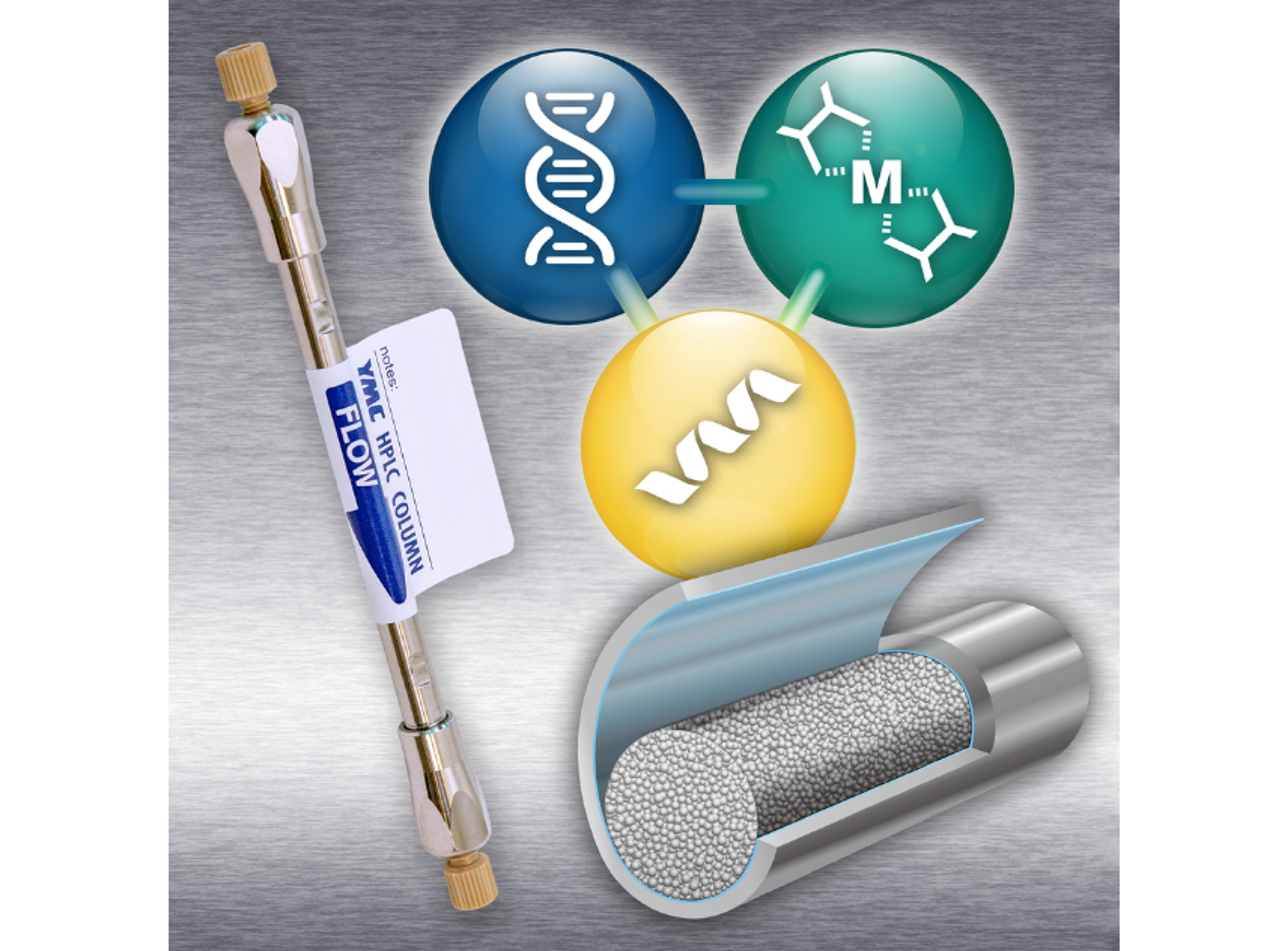
(Bio)inert RP/HILIC (U)HPLC Columns: YMC Accura Triart
YMC EuropeBioinert YMC Accura Triart RP and HILIC columns are available for the analysis of critical substances including selected proteins, (oligo)nucleotides and metal-coordinating compounds such as organophosphates.