
HILIC-inspired extraction solves oligonucleotide challenges
Innovative extraction approach overcomes polarity and charge challenges in oligonucleotide analysis
6 Mar 2026

Robert MacNeill, Scientific Director for Regulated Bioanalysis & Mass Spectrometry at Bristol Myers Squibb
For decades, Robert MacNeill had spent his career refining extraction methods for small molecules, but, during his recent years in contract bioanalytical research, a shift to an oligonucleotide focus demanded a new outlook. MacNeill, currently Scientific Director for Regulated Bioanalysis & Mass Spectrometry at Bristol Myers Squibb, had a clear objective to develop a quantitative LC-MS method for oligonucleotides in human plasma. But he also knew that the traditional playbook could be significantly improved and diversified, and therefore had to look outside the box.
When small molecule thinking does not apply
Oligonucleotides present a perfect storm of analytical challenges. Their extreme polarity, intense proclivity for negative charging, and huge tendency toward non-specific binding under certain very common conditions, make them fundamentally incompatible with extraction approaches designed for hydrophobic small molecules.
Hydrophilic-phase extraction (HPE), a technique that translates the principles of hydrophilic-interaction chromatography to the solid-phase extraction domain, emerged as a good alternative to standard approaches. Effectively delivering the clean extracts and reproducibly high recoveries essential for regulated bioanalysis.
"HPE is essentially a creative response to the challenges posed by oligonucleotide solid-phase extraction (SPE)," says MacNeill. "This is a modality unsurpassed in terms of extreme polarity and is intensely negatively charged along the phosphate backbone."
Translating HILIC to solid-phase extraction
The insight that drove HPE development came from recognizing what oligonucleotides actually need, a polar environment similar to what they encounter in hydrophilic-interaction liquid chromatography (HILIC). “Indeed HPE is the translation of HILIC to the SPE domain in bioanalysis, and oligonucleotides are the perfect candidates for it,” MacNeill notes.
The HPE protocol reflects this HILIC foundation at every step. MacNeill’s protocol involves conditioning the sorbent with 9:1 acetonitrile:aqueous solution, reflecting the need to create and maintain a water-enriched layer, then purposefully omitting the aqueous equilibration step that is standard in most SPE workflows. This departure from convention serves a critical purpose.
"Having only the organic conditioning greatly helps avoid oligonucleotide breakthrough in the load step," he explains. The acidified plasma sample is loaded and allowed to drip through under gravity over 3-4 minutes. The ‘oligo-phobic’ acetonitrile remaining in the sorbent bed prevents premature loss of analytes during this aqueous loading phase.
Two washes follow, the first maintaining 90% acetonitrile, the second shifting to a slightly alkaline solution with doubled aqueous content, but still insufficiently eluotropic to bring off the oligonucleotides. Finally, elution occurs with 70% aqueous solution, "reflecting a true HILIC elution profile with increasing aqueous, also with enough alkalinity to neutralize the weak anion exchange sorbent and allow full release of the analytes," he adds.
As alluded to, throughout the entire procedure, MacNeill maintains a minimum of 10% aqueous to preserve HILIC conditions, specifically the water-enriched layer necessary around the sorbent particles.
Beyond conventional mixed-mode approaches
HPE is distinguishable from traditional extraction techniques, not only in the HILIC mechanism but also in its flexibility and sensitivity. One particularly valuable feature is the ability to perform washes at both an acidic and alkaline pH.
"The ability to wash with both acidic and alkaline pH I feel is very valuable for cleanliness, where the most impressive SPE methods I have created embrace this facet," MacNeill says. "In typical mixed-mode SPE protocols, this seems to be never practiced."
This pH flexibility enables selective elimination of matrix interferences that would otherwise compromise method performance, while the HILIC mechanism itself provides essentially automatic and intrinsic phospholipid removal, a critical advantage for LC-MS applications.
Clean extracts, reliable performance
The reliability of HPE is clear, with the results delivered meeting the exacting demands of regulated bioanalysis; high recoveries, exceptional cleanliness, and performance suitable for GLP studies.
Furthermore, signal consistency across analytical batches remained uniform with no significant drift – a level of reliability not always seen in less selective extraction methods. This enabled subsequent LC-MS data to be of an incredibly high standard. As MacNeill explains, “we were essentially able to produce data as if it were an analysis in the solution domain, not the extract domain."
Finding the right chemistry partner
The success of HPE depended on finding the right sorbent chemistry. MacNeill needed a silica-based weak anion exchange option with sufficient packed sorbent weight approaching 100 mg. "The silica base would enable HILIC, right at the heart of the regime and selectivity intended," he says.
Flow characteristics mattered too. To achieve optimal uniformity in extraction and subsequent method performance, MacNeill wanted gravity-based flow with consistent, unhurried characteristics. "The slower, the better for the formation and release of high-energy electrostatic interactions," he notes.
UCT's NAX (aminopropyl-bonded silica) sorbent provided the combination of chemistry and physical characteristics the method required.
Getting the chemistry right
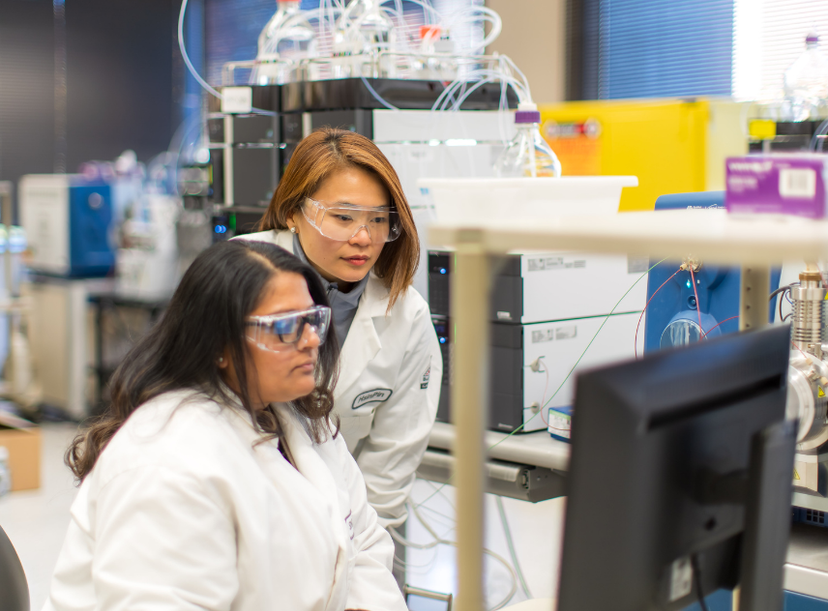
Inside the lab at Bristol Myers Squibb (Photo courtesy of Bristol Myers Squibb)
For scientists facing their own oligonucleotide extraction challenges, or any complex biologics application, MacNeill offers straightforward advice: embrace the challenge, think creatively, and do not be constrained by conventional approaches.
"I would encourage the immersion into the challenges in front of you, enjoy it, and don't be afraid to think outside the box," he says. "There is always a way, and as I often say, 'we just need to get the chemistry right' as a starting point!"
That chemistry-first philosophy, combined with thoughtful sorbent selection and willingness to adapt principles from one domain to another, is what turned an analytical challenge into an innovative solution. "It's all about new recipes, new angles and approaches," MacNeill concludes. "Innovation is a must so try to be creativity's best friend."
The views and opinions expressed in this article are those of Robert MacNeill, Scientific Director for Regulated Bioanalysis & Mass Spectrometry at Bristol Myers Squibb, and do not necessarily reflect the positions, strategies, or opinions of his employer.