
The A-TEEM: Combining Absorbance and Transmission with EEMs
HORIBA Scientific, a global leader in fluorescence solutions, has a new technique for molecular fingerprinting
14 Sept 2017A-TEEM (Absorbance and Transmission Excitation Emission Matrix) simultaneously measures absorbance and fluorescence transmission. A-TEEM fingerprints molecules with high specificity and ultrahigh-sensitivity enabling researches to identify, quantify and understand dynamics of fluorescing and absorbing molecular states, and mixtures.
A-TEEM is included on HORIBA’s Aqualog, a compact, benchtop spectrometer for CDOM. Aqualog is the only instrument to simultaneously measure both absorbance spectra and fluorescence excitation-emission matrices. These EEMs are acquired up to a 100 times faster than with other instruments.
See the latest in Spectroscopy here >>
“The A-TEEM acquisition and analysis timeframe takes place in seconds to minutes, thus effectively competing with other techniques and procedures that may take hours to weeks,” said Adam Gilmore, Fluorescence Product Manager for HORIBA Scientific. “In many cases, A-TEEM has already proven to be more effective in protein, vaccine, wine and water research, quality and process applications than HPLC and vibrational spectroscopy.”
Want more information about the A-TEEM? Contact Horiba here.
Do you use the Aqualog benchtop spectrometer? Review it here!
Related products
Request Quote for All Products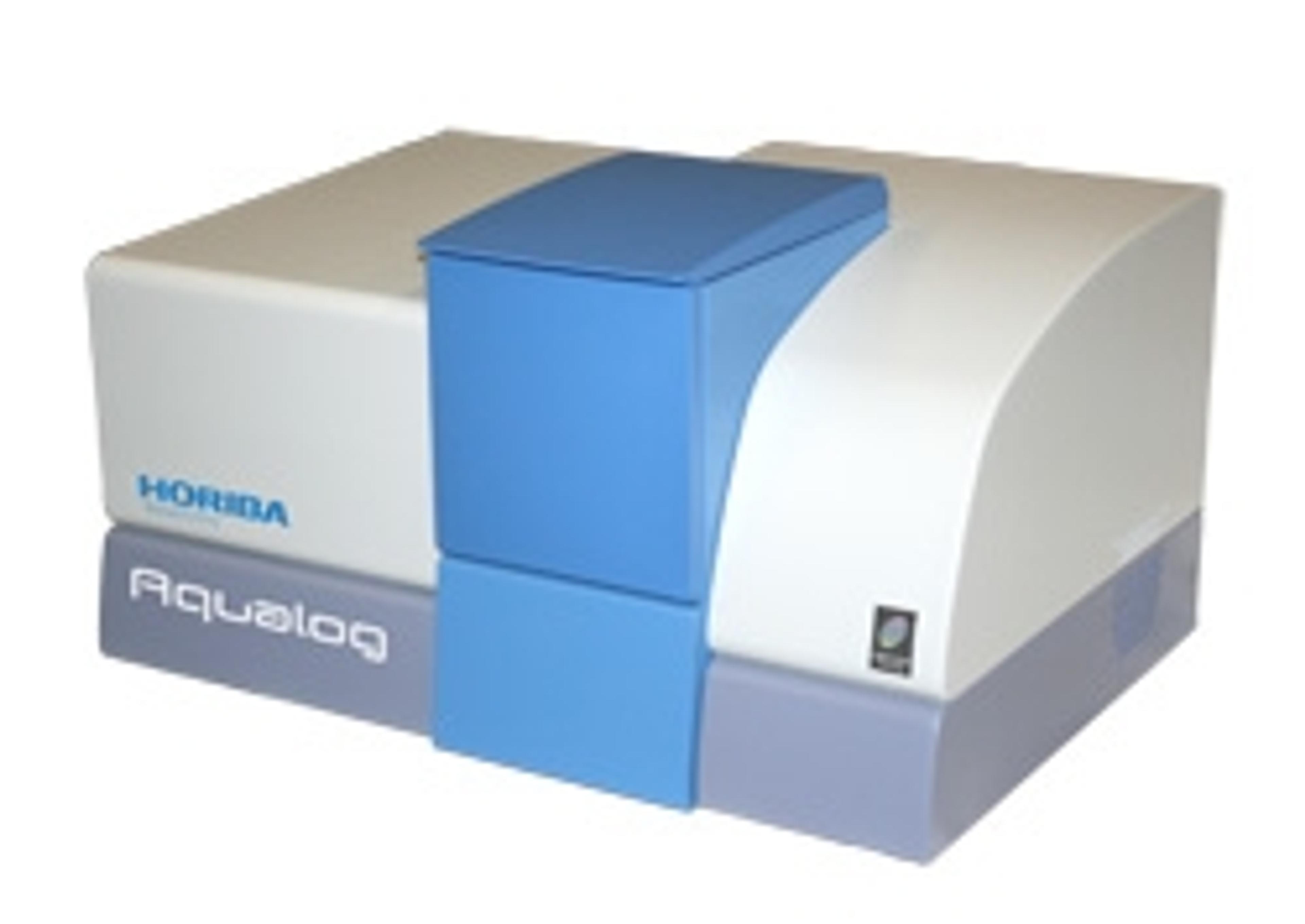
Aqualog® - The compact, Benchtop Fluorometer for CDOM
HORIBA ScientificThe Aqualog is a fluorescence instrument for rapidly measuring and identifying CDOM in water. The measurement is based on fluorescence excitation-emission matrices (EEMS) corrected for all instrumental factors. These corrections require an absorbance measurement to also be performed on the water sample. Key features:• The only instrument to measure both fluorescence and absorbance spectra in a single instrument for water quality analysis • Up to 100 fold faster data acquisition rates than any other benchtop fluorometer • Table-top instrument based on a CCD detector for fast simultaneous readout of the entire emission spectrum • Software routines automatically correct data for inner filter effects, Rayleigh line scattering, water Raman scattering, normalize the intensity scale, and export data for analysis in industry standard 3rd party packagesIts main benefits are: • Table-top instrument based on a TE cooled CCD detector for fast simultaneous readout of the entire emission spectrum, means less analysis time or more samples • Analysis of samples with orders of magnitude variation in concentration without the need for tedious dilutions • Eliminating sample aging, bleaching and dilution issues as experimental variables. AqualogTM measures fully corrected EEMs in seconds. Rapid acquisition reduces bleaching compared to ‘scanning’ instruments that require up to 100 times longer data collection, exposing the sample to damaging UV wavelengths the whole time • The instrument is fully automated• Software: The Aqualog software automatically: - masks the Rayleigh scatter lines - normalizes to traceable intensity standards (Quinine Sulfate or Raman Scattering) - offers 2-dimensional profiling of the ‘integrated’ excitation and emission spectra from EEMs - corrects and batch exports the data for multivariate analysis using the industry standard Parallel Factor Analysis (PARAFAC) method, reducing data analysis time by a factor of ten• Corrected UV-VIS absorbance detection path for stability and accuracy • Double grating excitation monochromator for superior stray light rejection • Matching bandpass for absorbance and fluorescence spectra • The optics: We only use aberration-corrected mirrors (no lenses) to increase the wavelength range, for you cannot get good anti-reflection coatings from 200 nm up through 850 nm or above. Lenses also suffer from chromatic aberrations, meaning different wavelengths focus at different depths in the samples, and consequently you lose sensitivity• Gratings: HORIBA, previously known as Jobin Yvon, has been designing and making ruled and holographic gratings for over 50 years. We use plane-ruled gratings in our instruments as opposed to cheaper holographic ones, because ruled gratings are much less dependent on polarization effects• The excitation source is a 150 W ozone-free xenon lamp. It is mounted vertically to prevent sagging and keep the illumination of the sample optimal• A photodiode reference detector monitors the intensity as a function of time and wavelength to correct for any change in output due age or wavelength, and ensure more repetitive measurements. This reference detector enables to correct both absorbance and fluorescence detector signals