
New optical platform reveals a material’s chemistry, structure, and mechanics at once
A single multimodal spectroscopy measurement captures what a material is made of, how it is structured, and how it mechanically behaves, with early impact on pharmaceutical analysis and potential across biomedical research and materials science
16 Jul 2026
Specto Photonics, together with researchers from leading universities in Italy, Denmark, and Australia, has developed a new optical spectroscopy platform that, in a single non-contact measurement, reveals what a material is made of, how it is structured, and how it mechanically behaves1.
This multimodal vibrational spectroscopy approach provides a powerful new tool for pharmaceutical analysis, biomedical research, and materials science.
A single multimodal measurement replaces multiple instruments
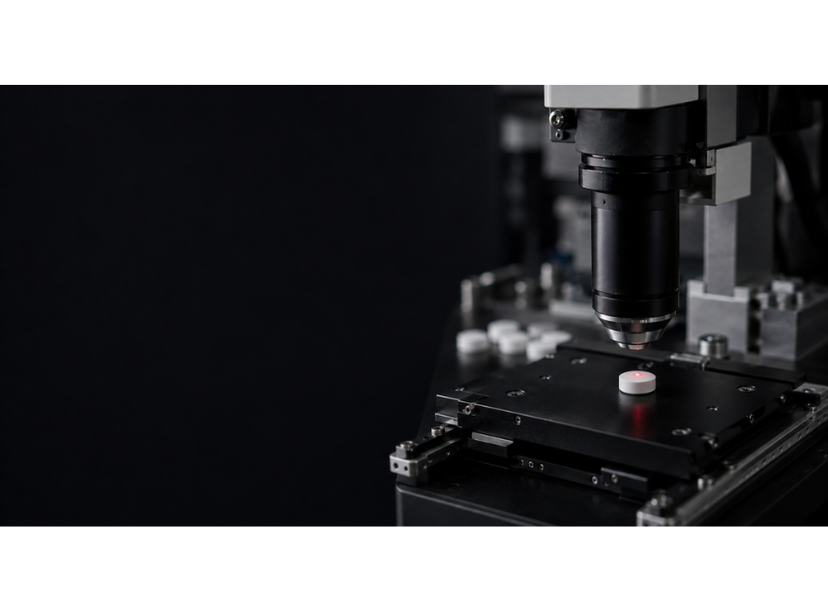
A new framework for multimodal vibrational spectroscopy and imaging
Conventional material characterization typically requires several instruments and multiple measurements to obtain chemical, structural, and mechanical information. The new platform developed by Specto Photonics and its collaborators captures all three types of data from a single voxel of laser light. This enables faster; more complete analysis of materials used in pharmaceutical development, biological systems, and advanced materials engineering.
Capturing three signals from the full vibrational spectrum
Within the full vibrational spectrum lie three complementary optical signals:
- Brillouin scattering, which reveals mechanical properties such as stiffness
- Ultra-low-frequency Raman scattering, which reports on molecular structure and organization
- Conventional Raman scattering, which identifies chemical composition
The low-frequency components that encode mechanical and structural information are usually obscured by intense, scattered laser light, making them difficult to detect alongside conventional Raman signals.
Specto Photonics’ proprietary Birefringence-Induced Phase Delay (BIPD) filter suppresses this background, enabling all three signals to be recorded simultaneously from the same point in the sample.
Unlocking hidden information in scattered light
By combining Brillouin, ultra-low-frequency Raman, and conventional Raman scattering in a single measurement, the platform delivers co-registered mechanical, structural, and chemical information without touching or labeling the sample. This all-optical, label-free approach allows researchers to probe the stiffness, molecular orientation, and chemical makeup of a material simply by shining laser light onto it.
Demonstrated on widely used pharmaceutical drugs
To demonstrate the capabilities of the platform, the team analyzed widely used active pharmaceutical ingredients, including indomethacin, ibuprofen, and paracetamol. The method distinguished between amorphous forms of the same drug produced by different manufacturing routes, a difference that conventional techniques often struggle to resolve.
The researchers also mapped the mechanical, structural, and chemical properties across an ibuprofen tablet, revealing how these characteristics vary within a single dosage form.
Impact on solid-state drug development and manufacturing
A drug’s solid-state form, whether crystalline or amorphous, and the way it is processed, directly influence its solubility, stability, shelf life, and bioavailability. Amorphous formulations are increasingly important in modern drug development but remain challenging to characterize.
A single, label-free measurement that simultaneously captures mechanical, structural, and chemical detail could support formulation design, stability assessment, and real-time quality control during pharmaceutical manufacturing, while minimizing sample consumption and waste.
Applications across biomedical research and materials science
Because the technique is fully optical, non-contact, and operates in three dimensions at diffraction-limited resolution, its applications extend beyond pharmaceuticals. In biomedical research, the platform could be used to study the mechanics and organization of structures inside living cells and tissues.
In materials science, it offers a way to read the mechanical, structural, and chemical state of a sample together, rather than measuring each property separately, enabling more comprehensive characterization of polymers, composites, and other advanced materials.
A new framework for multimodal vibrational spectroscopy
The authors describe the work as a new framework for multimodal vibrational spectroscopy and imaging. By co-registering three-dimensional mechanical, structural, and chemical maps of a sample at sub-micron resolution, the approach represents a step toward fully optical instruments that can deliver rich, multidimensional information from a single measurement.
References
1. Behrouzitabar, M., Bērziņš, K., Vanna, R. et al. Full vibrational spectroscopy for simultaneous mechanical, structural and chemical analysis. Nat Commun 17, 5632 (2026). https://doi.org/10.1038/s41467-026-74558-z
Want the latest science news straight to your inbox? Become a SelectScience member for free today>>
Tags
Frequently asked questions
Show frequently asked questions
How does Specto Photonics’ multimodal vibrational spectroscopy platform improve pharmaceutical material characterization?
The platform captures mechanical, structural, and chemical information from a single non-contact optical measurement using Brillouin, ultra-low-frequency Raman, and conventional Raman scattering. Enabled by the Birefringence-Induced Phase Delay (BIPD) filter, it replaces multiple instruments, distinguishes amorphous drug forms such as indomethacin, ibuprofen, and paracetamol, and supports formulation design, stability assessment, and real-time quality control in pharmaceutical manufacturing.
What role does full vibrational spectroscopy play in analyzing active pharmaceutical ingredients like ibuprofen and paracetamol?
Full vibrational spectroscopy measures the complete vibrational spectrum of scattered light, simultaneously capturing Brillouin, ultra-low-frequency Raman, and conventional Raman signals. This allows researchers to differentiate amorphous forms of active pharmaceutical ingredients, including ibuprofen and paracetamol, produced by different manufacturing routes and to map mechanical, structural, and chemical variations across dosage forms such as ibuprofen tablets.
What are the key applications of the new multimodal vibrational spectroscopy framework in biomedical research and materials science?
The fully optical, label-free, non-contact platform operates in three dimensions at diffraction-limited resolution, enabling co-registered mechanical, structural, and chemical mapping. In biomedical research, it can probe the mechanics and organization of structures inside living cells and tissues. In materials science, it provides comprehensive characterization of polymers, composites, and advanced materials by reading their mechanical, structural, and chemical states together.