
Isotopically labelled materials and SIMS depth profiling advance energy materials research
Exploring how secondary ion mass spectrometry enables high‑resolution analysis of diffusion, ion exchange, and contamination in solids
15 May 2026
Hiden Analytical, led by Principal Scientist Dr. Graham Cooke, is providing researchers worldwide with secondary ion mass spectrometry (SIMS) tools to study ion exchange, diffusion and material transport in solid materials, particularly for emerging energy technologies such as batteries, fuel cells, fusion reactors and corrosion-resistant components.
Using isotopically labelled materials and high-sensitivity SIMS depth profiling, scientists can precisely track atomic movement in solids, enabling fundamental materials research and quality control in semiconductor and thin-film production.
What is secondary ion mass spectrometry?
SIMS is a surface analysis technique used to investigate the composition of solid materials with high sensitivity and excellent depth resolution. In SIMS, a focused ion beam sputters the surface of a sample, and the ejected secondary ions are analyzed by mass spectrometry. This allows researchers to:
- Monitor impurities and dopants in semiconductors
- Detect contamination at interfaces in thin films
- Characterize layered structures in devices such as solar cells
Because SIMS is a mass spectrometry technique, it can distinguish between different isotopes of the same element, making it one of the few methods capable of directly studying atomic movement and diffusion in solids.
Using isotopes to track atomic movement in solids
Many elements have multiple stable isotopes that can be used as tracers in materials research. For example, lithium has two stable isotopes, lithium-6 and lithium-7. By introducing one isotope into a material containing the other during a battery charging experiment, SIMS depth profiling can reveal how lithium moves and reacts within electrodes and solid electrolytes.
Similarly, oxygen-18 and deuterium, a rare isotope of hydrogen, can be introduced into materials and devices to study key processes such as:
- Electrochemical reactions and ion transport in fuel cells
- Hydrogen transport and retention in fusion reactor materials
- The progression of corrosion in critical structural components
These isotopic tracers, combined with SIMS depth profiling, provide a powerful way to visualize and quantify diffusion pathways and reaction fronts at the nanoscale.
Investigating hydrogen transport and fusion reactor materials
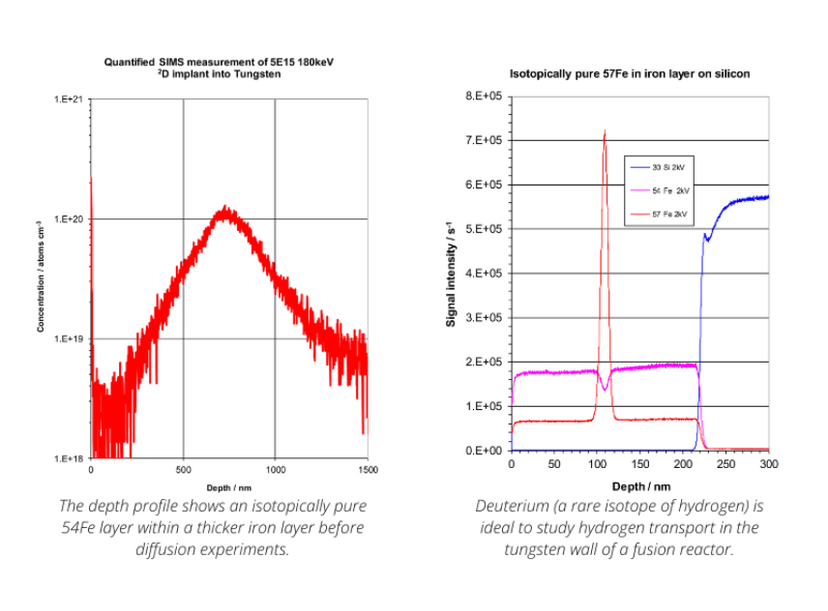
Deuterium is particularly valuable for studying hydrogen transport in materials used in fusion reactors. In tungsten, a common candidate for fusion reactor wall components, deuterium can be used to mimic hydrogen behavior while remaining distinguishable by SIMS.
By preparing isotopically labelled layers and performing diffusion experiments, researchers can generate depth profiles that show how deuterium penetrates and accumulates within tungsten and other critical materials. This information is essential for understanding fuel retention, material degradation and long-term performance in fusion energy systems.
Depth profiling with isotopically pure layers
SIMS depth profiling can also be applied to isotopically pure thin films to study diffusion and intermixing. For example, an isotopically pure 54Fe layer can be deposited within a thicker iron layer. Before diffusion experiments, SIMS depth profiling clearly resolves the 54Fe layer as a distinct region within the bulk iron.
After controlled heating or exposure to reactive environments, repeated SIMS measurements reveal how the 54Fe layer broadens and redistributes, providing quantitative data on diffusion coefficients and material transport mechanisms. This approach is widely applicable to metals, oxides, semiconductors and complex multilayer structures.
SIMS instruments from R&D to production
Hiden Analytical produces a range of SIMS tools designed to support both fundamental research and industrial production environments. These instruments are used in laboratories and manufacturing facilities working on semiconductors, thin films, energy storage and conversion devices, and corrosion-resistant materials.
Key SIMS solutions from Hiden include:
- SIMS Workstation Series: Highly flexible systems for advanced analysis, ideal for research and development laboratories requiring detailed depth profiling and isotopic analysis.
- AutoSIMS: A compact, automated SIMS instrument capable of unattended operation, suitable for routine analysis and use by non-expert operators in quality control and production settings.
By providing high-sensitivity, high-resolution depth profiling and isotopic analysis, Hiden’s SIMS platforms enable scientists and engineers to optimize materials, improve device performance and accelerate innovation in energy and electronic technologies.
Want the latest science news straight to your inbox? Become a SelectScience member for free today>>
Tags
Frequently asked questions
Show frequently asked questions
How does secondary ion mass spectrometry (SIMS) enable high-sensitivity analysis of batteries, fuel cells and fusion reactor materials?
SIMS is a surface analysis technique in which a focused ion beam sputters the surface of a solid sample and the ejected secondary ions are analyzed by mass spectrometry. This provides high sensitivity and excellent depth resolution, allowing researchers to monitor impurities and dopants in semiconductors, detect contamination at interfaces in thin films, and characterize layered structures in devices such as solar cells.
Because SIMS can distinguish between different isotopes of the same element, it is particularly valuable for studying ion exchange, diffusion and material transport in batteries, fuel cells, fusion reactor materials and corrosion-resistant components.
How are isotopically labelled materials used with SIMS to study lithium, oxygen and hydrogen transport in emerging energy technologies?
Many elements used in energy technologies have multiple stable isotopes that can act as tracers in SIMS experiments. In lithium-ion batteries, lithium-6 and lithium-7 can be selectively introduced so that SIMS depth profiling reveals how lithium moves and reacts within electrodes and solid electrolytes during charging.
In fuel cells, oxygen-18 can be used to study electrochemical reactions and ion transport, while deuterium, a rare isotope of hydrogen, can be introduced to investigate hydrogen transport and retention in fusion reactor materials and to track the progression of corrosion in critical structural components. These isotopic tracers, combined with high-sensitivity SIMS depth profiling, make it possible to visualize and quantify diffusion pathways and reaction fronts at the nanoscale.
What SIMS instruments does Hiden Analytical offer for semiconductor, thin-film and energy materials research and quality control?
Hiden Analytical, led by Principal Scientist Dr. Graham Cooke, provides a range of SIMS tools that support both research and industrial production. The SIMS Workstation Series offers highly flexible systems for advanced analysis, ideal for research and development laboratories that require detailed depth profiling and isotopic analysis of materials such as metals, oxides, semiconductors and complex multilayer structures.
AutoSIMS is a compact, automated SIMS instrument designed for unattended operation, making it suitable for routine analysis and use by non-expert operators in quality control and production environments.
These platforms enable scientists and engineers working on semiconductors, thin films, energy storage and conversion devices, and corrosion-resistant materials to optimize materials, improve device performance and accelerate innovation.