
Signals Synergy breaks down sponsor-CRO data silos
As sponsor–CRO collaborations become even more central to drug discovery, fragmented data and manual processes continue to slow progress – but more structured, connected workflows are beginning to reshape how teams share and act on information
20 Aug 2026
The pharmaceutical industry has always been an intensely competitive one. As of January 2026, there were over 7000 companies with active pipelines all vying for research funding and market share, according to Citeline. To keep up with the competition, drug discovery and development needs to be efficient and cost effective, as well as being focused on patient safety and unmet needs. Achieving this without help can be a challenge for many small and medium-sized enterprises (SMEs), and inefficient for even the largest multinational pharma or biotech.
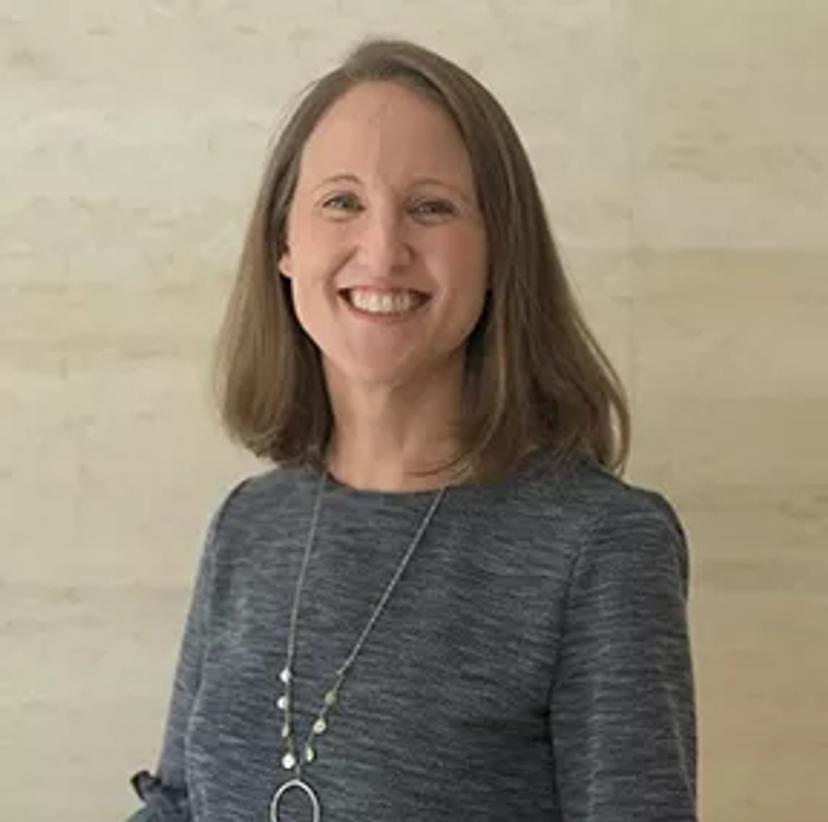
Heather Hayes, Signals Synergy Product Leader at Revvity Signals
Collaboration between sponsors, contract research organizations (CROs), and academic partners is essential to modern drug discovery, yet many partnerships remain hindered by fragmented data and disconnected workflows. Critical research activities are still frequently managed through spreadsheets and email, creating inefficiencies, limiting visibility, and making data harmonization more challenging. The question is no longer whether organizations should modernize sponsor–CRO collaboration, but whether they can afford not to. Connected digital workflows are helping teams overcome data silos, improve visibility, and unlock greater value from their research data.
In an interview with SelectScience®, Heather Hayes, Signals Synergy Product Leader at Revvity Signals, shares how Signals Synergy™ from Revvity Signals, a SaaS (Software as a Service)-based product, can address these challenges and improve the outcomes of collaborations between sponsors and CROs, CDMOs (contract development and manufacturing organizations), academic labs, and other external collaborators.
What drew you from hands-on research into software product management, and how does your scientific background shape the way you approach building tools for scientists?
As an engineer, I’ve always loved solving problems and innovating solutions that truly impact human health. What I love about working at Revvity Signals, and software product management in general, is the multiplier effect – when you make better tools for pharmaceutical and biotech companies, it impacts many areas of human health – not just the one disease or area you are researching. It helps companies across the globe bring better drugs or therapies to market faster for a wide array of diseases and make better, safer, and more effective decisions with harmonized, cleaner data. That’s what really excites me.
I also love being the translator – I look forward to getting on the phone with scientists, hearing what slows them down and then taking the language of the scientist and turning it into real, implementable engineering solutions. This is my day-to-day job.
From my time in the lab and at a smaller startup company, I also understand the challenges of the lab ecosystem, the pain of change management, need for clean data, and the frustration with software that isn’t intuitive for the scientist. Because I empathize with the need, I’m motivated to deliver the solution.
For people who are not familiar with Signals Synergy, can you describe it to us?
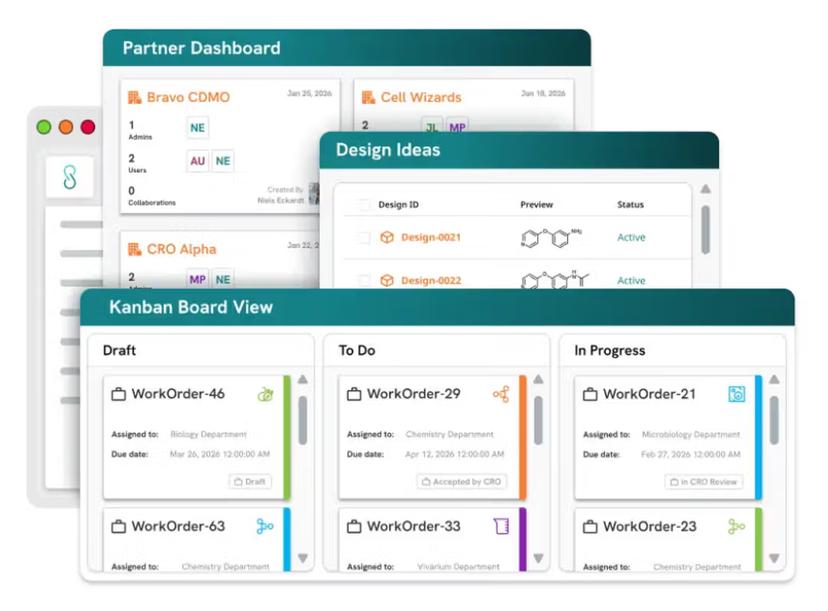
Signals Synergy™ by Revvity Signals empowers users to access differentiated expertise and cutting-edge technologies from external partners such as CROs, CDMOs, and academic labs
Signals Synergy is a SaaS-based product that uniquely addresses the challenges of sponsor-CRO collaboration. Believe it or not, most communication and data sharing between sponsors and CROs is still managed in spreadsheets and emails, from synthesis or assay requests to weekly updates and study results. It’s highly manual and error-prone and costs time and money. Not to mention the challenges with CRO administration, security, and data harmonization.
Signals Synergy harnesses the power of the Signals platform to change that. Synergy delivers fit-for-purpose tools for simplified CRO and project administration, IP protection, integrated drug design and ideation, scientifically minded project management, and importantly rationalized data exchange. Synergy allows the CRO to work literally on the same page as the sponsor, while hiding key proprietary metadata and selectively sharing key information. As the results role into Signals, Synergy allows the sponsor to harmonize internal and external data, all in one place, without placing undue burden on the CRO.
We all know that clean, harmonized data is the key to improving the efficiency and accuracy of downstream decisioning, especially as AI comes on the scene. The goal really is to accelerate drugs to market in an environment where CROs play such an integral part in the R&D ecosystem.
What are the key benefits?
First, simplified CRO administration. We provide automatic CRO ring-fencing, dynamic licensure, and transparent on and off boarding. This is a key time saver in a dynamic CRO ecosystem.
Second, IP protection. It’s important to work with CROs as partners, but there are pieces of IP that can leave the boundaries of the sponsor. Synergy allows for selective sharing, hidden from CRO fields, material masking – it’s easy – it’s built-in.
Design ideation and synthesis tracking. The first step in virtuous cycle of drug discovery is Designs. With Synergy, Design ideation and synthesis tracking is fully integrated with your internal ELN.
Project management. You don’t have to manage projects with your CROs outside of Signals. Rather Synergy provides scientifically minded project management tools, including Kanban boards and live updating from Designs to work orders. You can see and track the progress in real time right where you are filling in your own experiments.
Finally, rationalized data exchange for data harmonization. With Synergy, CRO data is quickly consumed and accessible rather than lingering in reports on sharefile or email that are human readable but not computer consumable. We handle the transformation for you.
It all adds up to saving time and money, and yields better decisions.
Synergy has been available for 2+ years. What have you seen in terms of adoption in outsourcing? What are some challenges? What about successes?
Synergy really did hit the market at the right time, a time when sponsors were relying more and more on outsourced expertise and efficiencies at CROs, but were also very sensitive to security and IP protection. Of course, some companies had their own custom solutions that worked when there was 1-2 CROs, 1-2 spreadsheets, and 1 engineer managing the system. But when the ecosystem is growing and dynamic, the data is exploding, and you want to apply the latest analytics (such as AI or advanced cheminformatics), it becomes more challenging. This is what Synergy addresses.
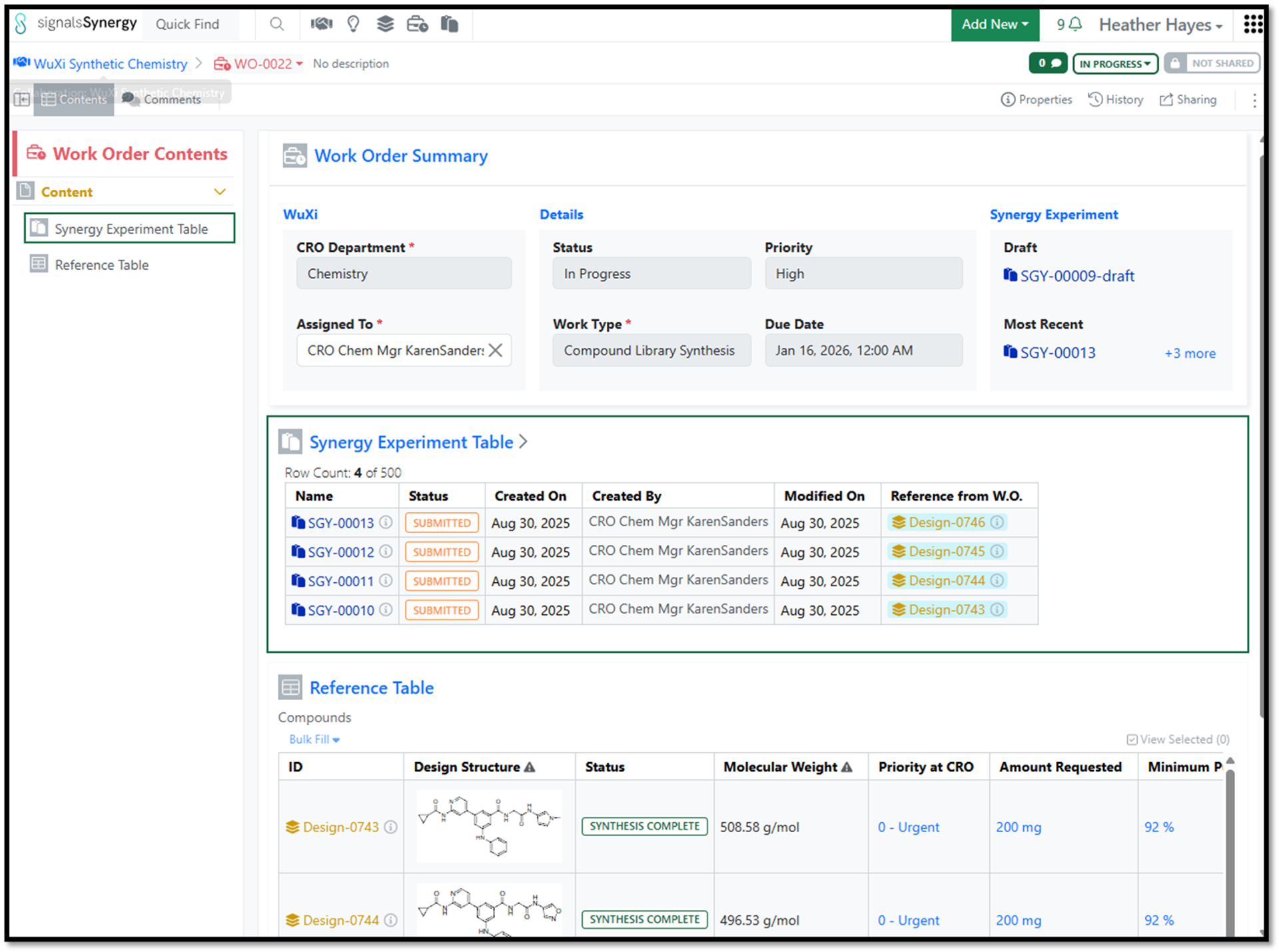
Signals Synergy™ is scalable to thousands of CRO users, with support for up to 100,000 experiments created each month
We had the privilege to work hand-in-hand with a customer consortium and several early adopters to prioritize the biggest, common roadblocks in sponsor-CRO collaborations. They really helped us deliver value from the very beginning. They showed us where there might be too many clicks or where it needed to be easier to move from spreadsheets to SaaS. As results, we’ve seen Synergy be adopted by 4 of the top 20 pharmaceutical companies all the way down to virtual companies with 1-5 employees, and many in between.
We have customers using Synergy for:
- Designs management and Synthesis outsourcing
- Assays
- DMPK
- Digital pathology
In 2025, we focused a lot on chemical synthesis (or design synthesis) outsourcing, a major focus of many of our sponsors. We have greatly expanded the functionality of Designs to empower users to better manage and track the progress of Designs, whether sent internally to an assigned user/group or externally via Work Orders to an assigned CRO. We worked to make it so CROs could accurately and efficiently report back synthesis results. We also focused on making it easier for the CRO to easily and properly report synthesis for both high and low throughput.
We also focused on performance with scalability. Scalable to 1000s of CRO users and 100,000 experiments created each month. Creating a performance experience that is pleasing to both the sponsor and CRO.
Finally, we developed on some key in-context workflows, where the sponsor can easily request assays or such from the CRO, without ever leaving their internal experiments.
Do you have any advice for other scientists within organizations who may be having trouble with outsourcing data harmonization?
Look, we all love spreadsheets. Spreadsheets are easy, but they won’t evolve with your organization. You need faster, cleaner, trackable, and searchable data, and spreadsheets don’t give you that. Change is hard, but bad or scattered data is worse.
CROs are more amenable than you think to delivering data directly into your system, especially when tools like the Synergy Data Exchange work with their existing reports and reduce the need to copy and paste or reformat!
Importantly, I also would tell them that we want to be partners. We are here to help. Reach out!
What does the future look like for Synergy? Where do you see this moving to next?
Assay management is a big focus for next year. Synergy already provides several tools for assay management, but we are expanding these capabilities. We are asking, how do we make it easier, faster, duplicate-proof to request assays? We are also very excited about integrating with the assay repository, where a sponsor can easily register assays and request the right assay variant from the CRO.
We are also expanding our Samples management workflows. The goal is to make sponsor receipt and review of synthesis more efficient. As a sponsor, I may have 1000s of Designs outsourced for synthesis. Some are easy to synthesize and are ready very quickly, while others are complex or require starting materials to be ordered. Thus, we are adding new features for the sponsor to:
- Easily identify when my requested Designs/Samples are ready for review
- Efficiently review and register Designs/Samples without going into every Synergy Experiment
- Effectively utilize AI, super charge search and CRO management
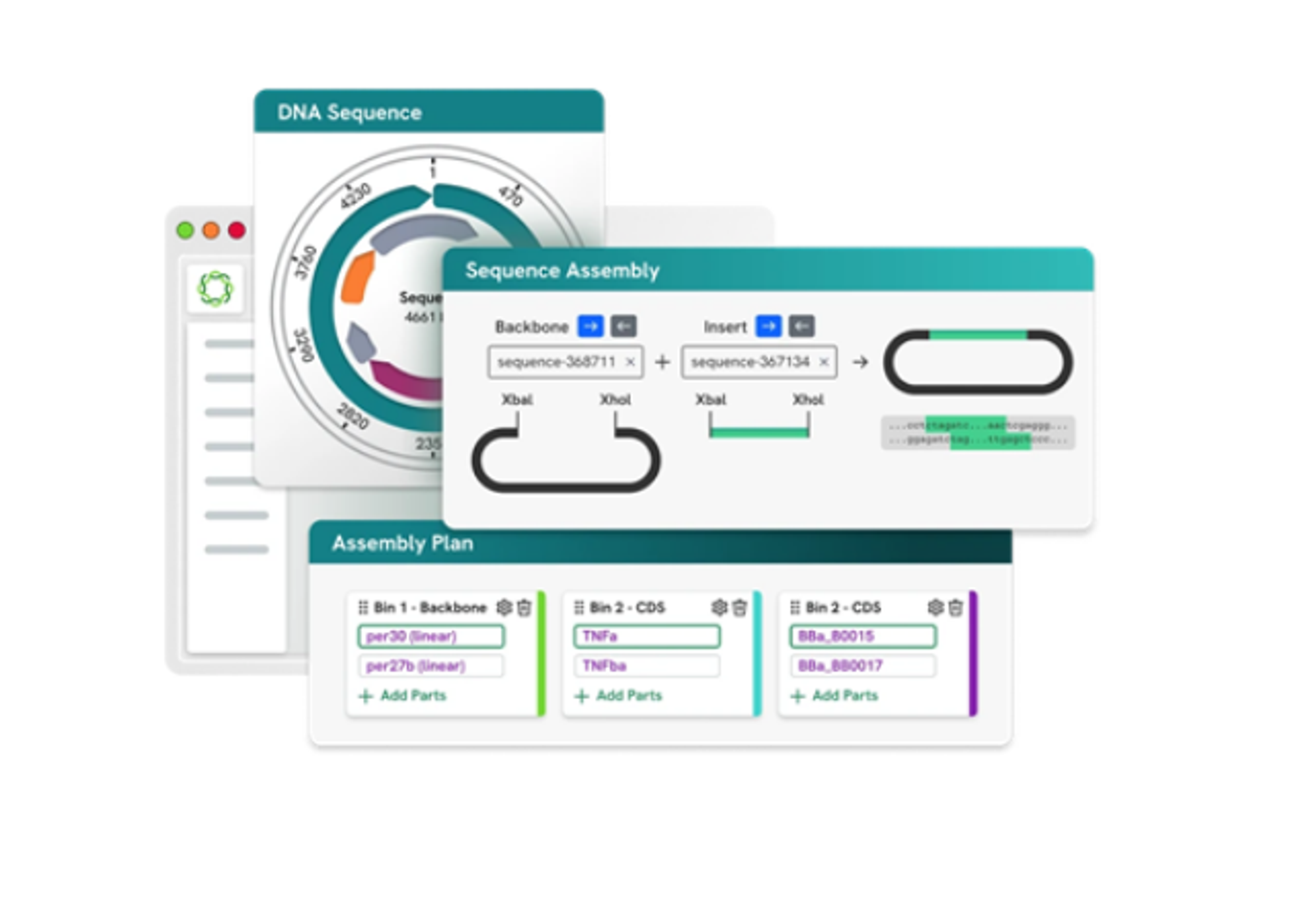
- Extending biologics capabilities through the launch of BioDesign this year for plasmids, proteins, and other large molecules. We are also expanding our Antibody registration capabilities.
- Deliver best in class, accessible, and easy to implement systems for startups
The next chapter in sponsor–CRO collaboration
Throughout the interview, Hayes returns to a simple but important point: successful collaboration depends on accessible, harmonized data. As drug discovery becomes more distributed and data volumes continue to grow, organizations that can connect external partners, research activities, and scientific data within a unified workflow will be better positioned to turn insights into action, and in turn, bring promising therapies to patients faster.
Related products
Request Quote for All Products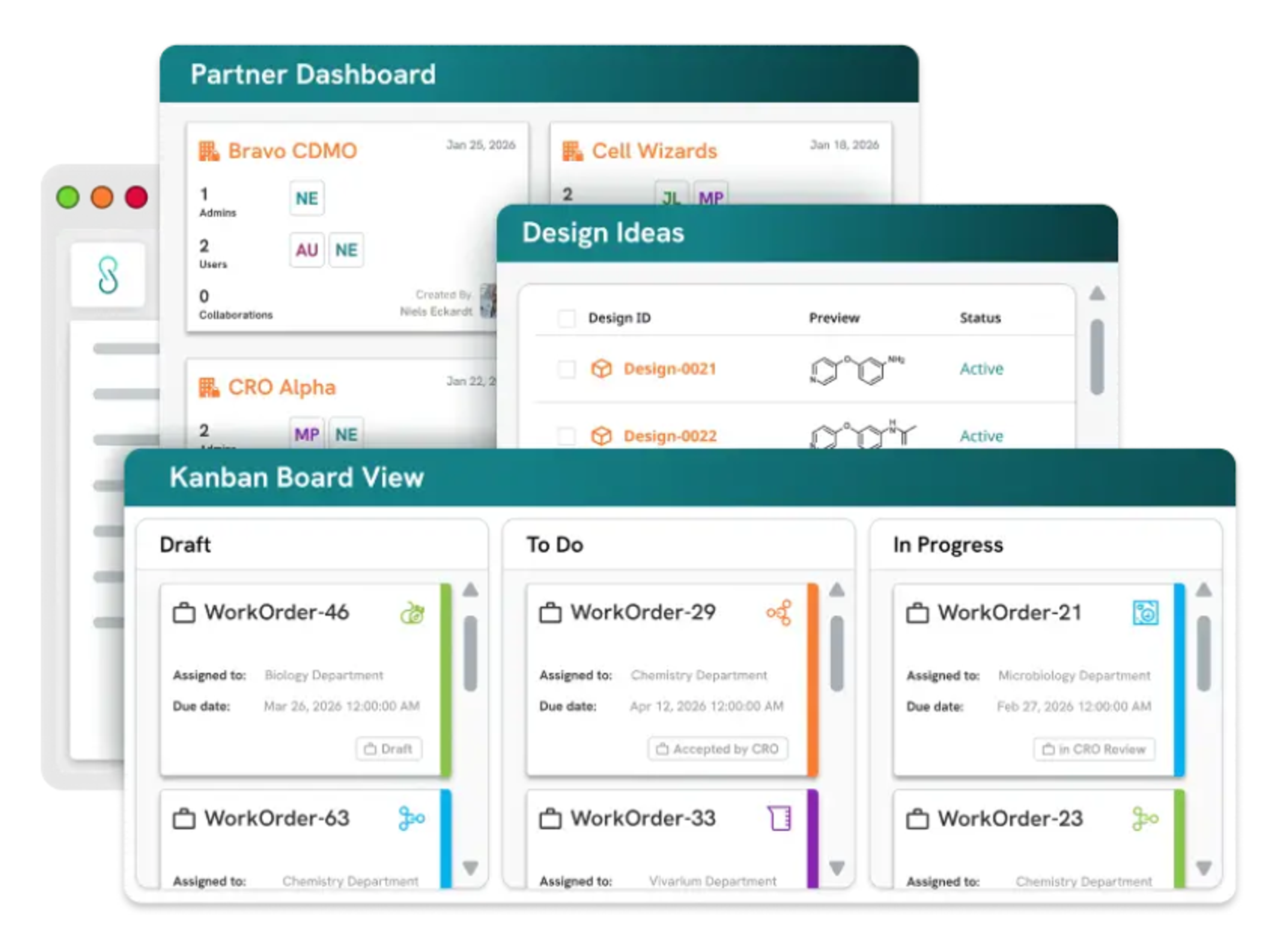
Signals BioDesign™
Revvity SignalsRevvity Signals BioDesign is a streamlined, enterprise-ready SaaS molecular biology product that improves large molecule design. Focusing on core cloning features, it avoids unnecessary complexity while supporting high-throughput workflows capable of modelling thousands of plasmids. Designed for any organization - from small and medium biotech to global pharma - Signals BioDesign integrates with other Revvity Signals solutions to enhance collaboration.
Links
Tags
Frequently asked questions
Show frequently asked questions
What is sponsor-CRO collaboration?
Sponsor-CRO collaboration refers to the partnership between a pharmaceutical or biotechnology company (the sponsor) and a contract research organization (CRO). CROs provide expertise, technologies, and research services that help sponsors advance drug discovery and development programs more efficiently.
What is data harmonization?
Data harmonization is the process of bringing together scientific data from multiple sources into a consistent, structured format. Harmonized data is easier to search, analyze, share, and use for decision-making, helping organizations gain greater value from both internal and external research activities.
What are data silos in pharmaceutical R&D?
Data silos occur when information is stored in separate systems, spreadsheets, emails, or databases that are difficult to access or integrate. In outsourced research environments, data silos can reduce visibility, slow decision-making, and create inefficiencies across sponsor and CRO teams.
What is a digital workflow?
A digital workflow is a connected process that allows research activities, data, project management, and collaboration tasks to be managed within a structured platform rather than through manual methods such as spreadsheets and email. Digital workflows can improve efficiency, transparency, and data accessibility.
Why is clean scientific data important for AI?
Artificial intelligence tools rely on high-quality, well-organized data to generate meaningful insights. Clean, harmonized scientific data can improve the accuracy of analytics and support the adoption of AI-driven approaches in drug discovery and development.