
Rethinking solid support chemistry for scalable siRNA manufacturing
Dr. Catherine McKeen of LGC Diagnostics & Genomics - Biosearch Technologies Oligo Synthesis explains how solid support chemistry influences oligonucleotide yield and purity, and how customer collaboration shaped the development of PrimeMax™ CPG
18 Sept 2026

Dr. Catherine McKeen, Senior Director of Research and Development, Nucleic Acid Chemistries and Oligonucleotides at LGC Diagnostics & Genomics - Biosearch Technologies Oligo Synthesis
Optimizing solid support chemistry may appear to be a simple matter of increasing loading to produce more oligonucleotide. In practice, excessive loading can restrict access to the growing chain and create impurities that are difficult to remove. For manufacturers scaling small interfering RNA production, the real objective is to increase usable, full-length yield without compromising purity or reproducibility.
Dr. Catherine McKeen, Senior Director of Research and Development, Nucleic Acid Chemistries and Oligonucleotides at LGC Diagnostics & Genomics – Biosearch Technologies Oligo Synthesis, has worked across oligonucleotide synthesis and reagent development for more than 30 years. Her experience spans new product development, operations, facility management, and business development.
Today, McKeen works closely with customers on projects extending beyond routine production, from developing new synthesis reagents to preparing promising oligonucleotide programs for commercial scale.
“Sometimes we help design the molecule or oligo, and then we make it,” McKeen explains. “In other cases, customers have completed the proof of concept and need support commercializing the raw materials.”
Here, McKeen discusses why solid support chemistry should be considered early in process development and explains how LGC Biosearch Technologies addressed a customer’s synthesis challenge through PrimeMax™ CPG.
Supporting oligonucleotide development from concept to scale
LGC Biosearch Technologies supports customers across therapeutics, diagnostics, research, and next-generation sequencing (NGS). The requirements of each program depend on its application and stage of development, but McKeen is seeing a greater need for detailed impurity characterization and manufacturing processes that can scale reliably.
“Customers increasingly need to understand their impurities and have a good quality management system that can grow with them,” she says.
This is particularly relevant as investment increases in small interfering RNA (siRNA), antisense oligonucleotides (ASOs), and antibody-oligonucleotide conjugates (AOCs). These emerging modalities bring different sequences, modifications, and structural properties, placing greater pressure on the raw materials used during synthesis.
Early programs may initially require only gram-scale quantities. If a therapeutic candidate progresses, however, its manufacturing process must be capable of supporting substantially greater demand without introducing unacceptable variation.
LGC Biosearch Technologies therefore works to understand the intended application, anticipated scale, purity requirements, and development pathway before designing or optimizing synthesis reagents.
“We work with customers and try to stay ahead of their needs,” says McKeen. “As those relationships develop, we gain a fuller understanding of what they are trying to achieve and can partner to design the chemistry accordingly.”
Why solid support chemistry matters
During solid-phase oligonucleotide synthesis, a nucleotide chain is assembled while attached to an insoluble support, making solid support chemistry an important influence on synthesis performance. Controlled pore glass (CPG) is widely used for this purpose, but its pore size, surface area, and loading density can influence synthesis performance.
“The oligo you need to make dictates the support you should use,” McKeen explains. “If you’re making something very long or complex, you would typically want a wider pore.”
As the oligonucleotide grows, it becomes bulkier and occupies more space within the pores. If there is insufficient room, steric hindrance can restrict reagent access to the growing chain and reduce coupling efficiency.
Wider pores can accommodate longer or more complex molecules, but they typically provide less internal surface area for initiating synthesis. Smaller pores may offer greater loading capacity, particularly for shorter oligonucleotides, but loading must still be carefully controlled.
A support carrying more initiation sites may produce a greater quantity of crude material. If molecular crowding also increases incomplete sequences or unwanted reaction products however, the amount of usable material may not improve. Downstream purification can then become more demanding and potentially reduce the final yield further.
It’s not about achieving the highest possible loading. You need to understand the impact that loading has on oligonucleotide synthesis.
Dr. Catherine McKeen LGC Diagnostics & Genomics - Biosearch Technologies Oligo Synthesis
A customer challenge reveals the limits of conventional loading
PrimeMax™ CPG originated from a customer collaboration involving low-level, early-eluting impurities associated with the support-bound 3′ end of an siRNA strand.
Although the impurities were present in relatively small amounts, they were difficult to remove during purification. This prompted LGC Biosearch Technologies to investigate whether the support’s loading density and surface chemistry were contributing to their formation.
“Customers have traditionally asked for the highest possible loading on their CPG because they want maximum yield,” says McKeen. “What we found was that this could be detrimental.”
Rather than considering only the amount of nucleoside loaded per gram of CPG, the team examined how densely initiation sites were distributed across the available surface.
This led to the use of surface area normalized loading (SANL), which aims to balance available surface area with loading density. The objective is to make efficient use of the synthesis column without creating excessive molecular crowding.
“With PrimeMax™, we looked not just at the amount of nucleoside on the CPG, but also at the surface area of the CPG itself,” McKeen explains. “Getting that balance right enabled us to optimize the loading and the yield.”
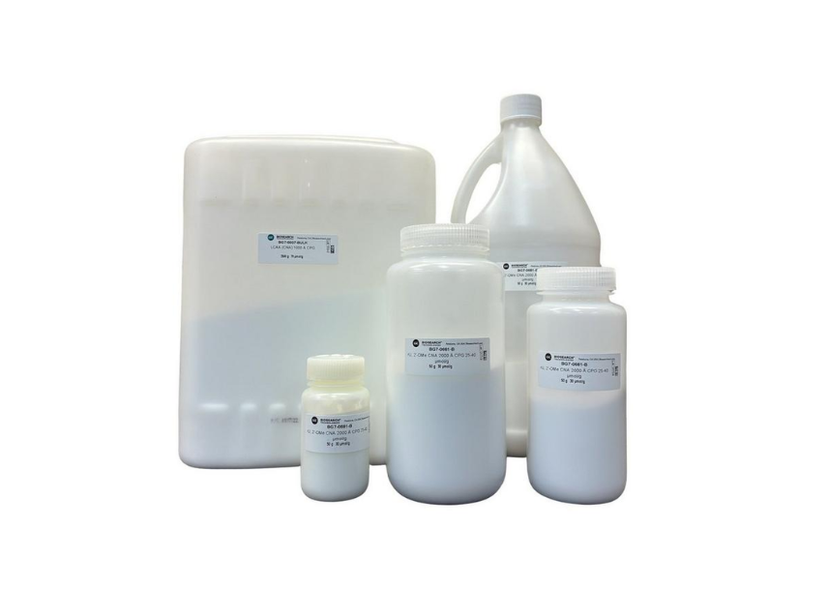
PrimeMax™ CPG is a solid support designed to maximize productivity and synthesis efficiency in oligonucleotide manufacturing.
Fine-tuning CPG for siRNA synthesis
PrimeMax™ CPG combines SANL with a pore architecture optimized for siRNA synthesis. The aim is to provide enough space for the growing strand while retaining sufficient accessible surface area to support productive output.
“We haven’t changed the nucleoside or fundamentally changed how it is loaded,” says McKeen. “What we have changed is the CPG itself. We have fine-tuned the pore size for siRNA to provide optimum performance.”
The solid support chemistry also incorporates an additional surface-blocking step. Once the linker has been introduced, residual reactive groups on the glass are blocked to reduce their potential to interfere with subsequent synthesis chemistry.
This modification emerged directly from the investigation into the customer’s impurities, which indicated that reactive sites on the glass surface could contribute to unwanted products.
“We block those reactive species before continuing with the chemistry to add the linker and make the oligo,” McKeen explains.
According to McKeen, PrimeMax™ has delivered approximately 20% more scale while maintaining, and in many cases improving, oligonucleotide purity. This, combined with an increased efficiency of 15%, lead to the outcomes of 50% increase in Net Full-Length Product (FLP) Yield compared to incumbent products.
Matching the support to the molecule
CPG is not the only support available for oligonucleotide synthesis. Polystyrene can provide high loading, but it may swell and contract during processing.
“Polystyrene is very highly loaded, but it also swells and shrinks,” says McKeen. “This can lead to higher backpressure than CPG and affect how much support can be placed into the column.”
Support selection therefore depends on the target molecule and the practical requirements of the synthesis workflow. Length, structural complexity, chemical modifications, column capacity, and downstream purification should all influence the decision.
Importantly, performance should be evaluated using purified full-length yield rather than loading or crude output alone. A support that produces more total material may offer little practical benefit if unwanted products create additional purification losses.
Advancing application-specific solid support chemistry
LGC Biosearch Technologies is now applying the principles behind PrimeMax™ CPG to additional pore sizes and oligonucleotide applications.
“PrimeMax™ initially concentrated on siRNA because that is where we were working closely with customers,” says McKeen. “We’re now developing other pore sizes, with the aim of creating PrimeMax™ CPGs fine-tuned for different applications.”
For manufacturers, this reinforces the value of considering solid support chemistry early. Matching pore architecture, surface chemistry, and productive loading to the target molecule can create a more predictable route from initial synthesis to commercial manufacturing.
Find out more about PrimeMax™ CPG and watch this webinar to discover how controlled pore glass selection improves siRNA yield and manufacturing performance.
Related products
Request Quote for All Products
PrimeMax™ CPG
LGC Diagnostics & Genomics - Biosearch Technologies Oligo SynthesisA CPG solid support designed to maximise productivity and synthesis efficiency for oligonucleotide manufacturing.
Links
Related content

Tags
Frequently asked questions
Show frequently asked questions
How does controlled pore glass chemistry affect siRNA synthesis yield and purity?
Controlled pore glass (CPG) pore size, surface area, and loading density influence reagent access and coupling efficiency. Excessive loading can cause molecular crowding, incomplete sequences, and difficult-to-remove impurities. Matching CPG architecture and productive loading to the siRNA molecule can increase purified, full-length yield while maintaining purity and reproducibility.
What is surface area normalized loading in PrimeMax CPG?
Surface area normalized loading (SANL) balances nucleoside loading density with the available CPG surface area. In PrimeMax™ CPG, this approach aims to use the synthesis column efficiently without excessive molecular crowding. LGC Biosearch Technologies combined SANL with pore architecture optimized for siRNA synthesis to improve synthesis efficiency and usable output.
How does PrimeMax CPG improve oligonucleotide manufacturing performance?
PrimeMax™ CPG uses siRNA-optimized pore architecture, balanced loading, and an additional surface-blocking step. Blocking residual reactive groups on the glass helps reduce unwanted products associated with the support-bound 3′ end. According to McKeen, PrimeMax™ has delivered approximately 20% more scale while maintaining, and in many cases improving, oligonucleotide purity. This, combined with an increased efficiency of 15%, lead to the outcomes of 50% increase in Net Full-Length Product (FLP) Yield compared to incumbent products.