
Researchers gain deeper spatial insights with multiplexed 2D image analysis tool

The latest release of Aivia AI Image Analysis Software offers accurate multiplex cell detection and automatic clustering with up to 30 markers

18 Mar 2024

Jemima Arnold
Editorial Assistant

Product news

Leica Microsystems, a provider of microscopy and scientific instrumentation, has released version 13 of Aivia, its AI image analysis software, which now provides a toolkit for transforming multiplexed 2D data into spatial insights. With Aivia 13, researchers can unveil spatial insights in tissues, allowing a deeper understanding of the microenvironment surrounding their phenotypes.

In addition to handling large multiplexed 2D images, the new version enables researchers to obtain a comprehensive view of large image datasets, with millions of detected objects and unsupervised automatic clustering with up to 30 markers. Aivia 13 also provides a vast array of charts and spatial measurements, allowing for the collection of critical insights.
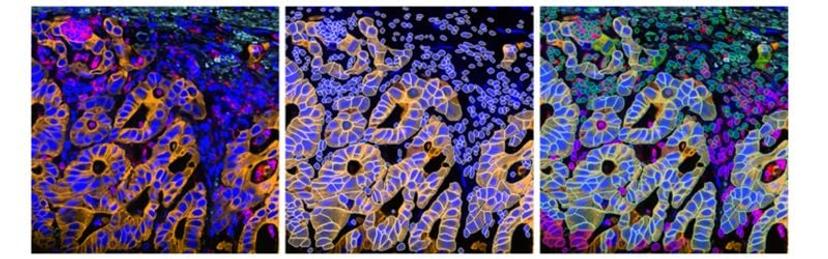
2D slice of colon cancer tissue stained with 30 markers and imaged using the Cell DIVE system. Analysis performed using Aivia 13’s new multiplex cell detection recipe and automatic clustering tool. Original image (left), detected cell membrane shown in white (middle), each phenotype denoted in a different color (right).

“Spatial biology methods with multiplexing and microscopy aid our understanding of normal and abnormal tissue development, such as what happens during cancer progression. Aivia is designed to help researchers reveal the invisible with profound insights into cellular and tissue structures through the power of AI,” said Luciano Lucas, Director Data & Analysis at Leica Microsystems.

Aivia now offers scientists an end-to-end solution for visual analysis, classification, and insight creation in a single application. Moreover, researchers can perform quantitative analyses, both individually and across phenotypes or clusters.

Aivia 13 is available through a flexible subscription model, allowing users to choose a plan that aligns with their specific lab requirements. Existing Aivia subscribers can access Aivia 13 as part of their subscription, ensuring a seamless transition to this cutting-edge platform. Learn more about Aivia and request a free trial.

Want the latest science news straight to your inbox? Become a SelectScience member for free today>>

Links

Tags

Gel Doc / Image AnalysisGel documentation (gel doc) or gel imaging systems are used for the analysis of proteins, antibodies and nucleic acid immobilized in polyacrylamide or agarose gels, membranes or microarrays. Explore a range of a gel imaging systems, densitometers, scanners, transilluminators or UV lamp + CCD cameras for your image analysis solutions. Colorimetric, fluorescent and/or radioisotopic samples can be visualized and documented for further analysis. See gel doc / Image analysis software for quantitative 1D and 2D analysis of your samples. Find the best gel doc / image analysis products in our peer-reviewed product directory: compare products, check customer reviews and receive pricing direct from manufacturers.Gene Expression and Molecular CloningMolecular cloning is a set of techniques that utilizes vectors to transfer recombinant DNA into host cells and is an essential tool for investigating the expression of genes and proteins in bacterial or mammalian cells. A variety of vectors optimized for gene cloning and expression in a range of host organisms are available, alongside competent cells for genetic replication. Here, you can explore a range of molecular tools, high-quality genomic and cDNA libraries, premade clones, transformation and transfection reagents and mutagenesis or gene expression detection assays and expression arrays. Find the best gene expression and molecular cloning products in our peer-reviewed product directory: compare products, check customer reviews and receive pricing direct from manufacturers.BiomarkersBiomarkers are biological markers which can be measured and evaluated to indicate a biological state. The use of biomarkers in research and diagnosis can indicate a normal or disease state or drug response of cells / tissues. Biomarkers include genetic markers, cell surface markers such as antigens, antibodies or receptors and secreted molecules such as cytokines. An assay system is required for identification of biomarkers. :Artificial Intelligence / Machine LearningArtificial intelligence (AI) and machine learning (ML) are transformative technologies used to analyze complex data, identify patterns, and make data-driven predictions across diverse scientific fields. Automate the analysis of large or complex data sets using AI algorithms and leverage machine learning models to improve diagnostics, accelerate drug discovery, and refine experimental design. Discover the best AI/ML software, platforms, and analytical tools in our peer-reviewed product directory: compare features, read customer reviews, and request pricing directly from manufacturers.MultiplexImagingImaging techniques are essential for obtaining visual representations of samples to understand structures, processes, and function in biological, chemical, and physical research. These tools range from traditional light microscopy to advanced imaging modalities like MRI and electron microscopy, providing researchers with valuable data for diagnostics, drug discovery, and material analysis. Explore imaging solutions in our peer-reviewed product directory to compare products, check reviews, and get pricing directly from manufacturers.Biomarker DiscoveryClinical biomarkers refer to substances related to known medical conditions that can be accurately measured <i>in vitro</i>. Biomarkers can be used to diagnose presence of a disease and indicate disease severity. The discovery of new biomarkers is incredibly valuable in the field of diagnostics.