
Renishaw inVia Raman Microscope Used in Breakthrough Graphene Research
4 Mar 2013
A Renishaw inVia Raman microscope has been used in new research that addresses one of the major hindrances to the wider exploitation of graphene: the difficulty in growing large defect-free films.
An international team - led by Oxford University scientists Professor Nicole Grobert and Adrian Murdock - in collaboration with Renishaw plc and researchers from the Forschungszentrum Juelich (Germany) and University of Ioannina (Greece), used a Renishaw inVia Raman microscope to examine film thickness, strain and defects in graphene films.
Graphene is a single layer of carbon atoms and was the first two dimensional material to be discovered. It has very interesting electronic and mechanical properties; it is one of the most conductive materials known to science and has a breaking strength 100 times greater than steel.
Typically, when graphene is grown using chemical vapour deposition (CVD), the individual graphene flakes merge with a variety of different orientations, creating defects. In this work, titled ‘Controlling the Orientation, Edge Geometry and Thickness of Chemical Vapour Deposition Graphene’, and published in the journal ACS Nano, it was found that the orientation of the underlying copper substrate could be used to guide the graphene flakes so they are aligned, and these defects are prevented.
Team member Dr Tim Batten, Raman applications specialist at Renishaw, said, “The inVia Raman spectrometer is a very powerful tool for investigating the properties of graphene. This work gives a much better understanding of CVD graphene growth, which will be important for manufacturing graphene on an industrial scale.”
In 2006 Professor Andrea Ferrari (University of Cambridge), used a Renishaw Raman spectrometer to conduct the first Raman characterisation of graphene. He used samples from its discoverers, Nobel Prize winners Professor Andre Geim and Professor Kostya Novoselov (University of Manchester). Since then, researchers worldwide have used data from Renishaw Raman systems in hundreds of scientific papers on graphene, greatly assisting in the understanding and development of this amazing material.
Related products
Request Quote for All Products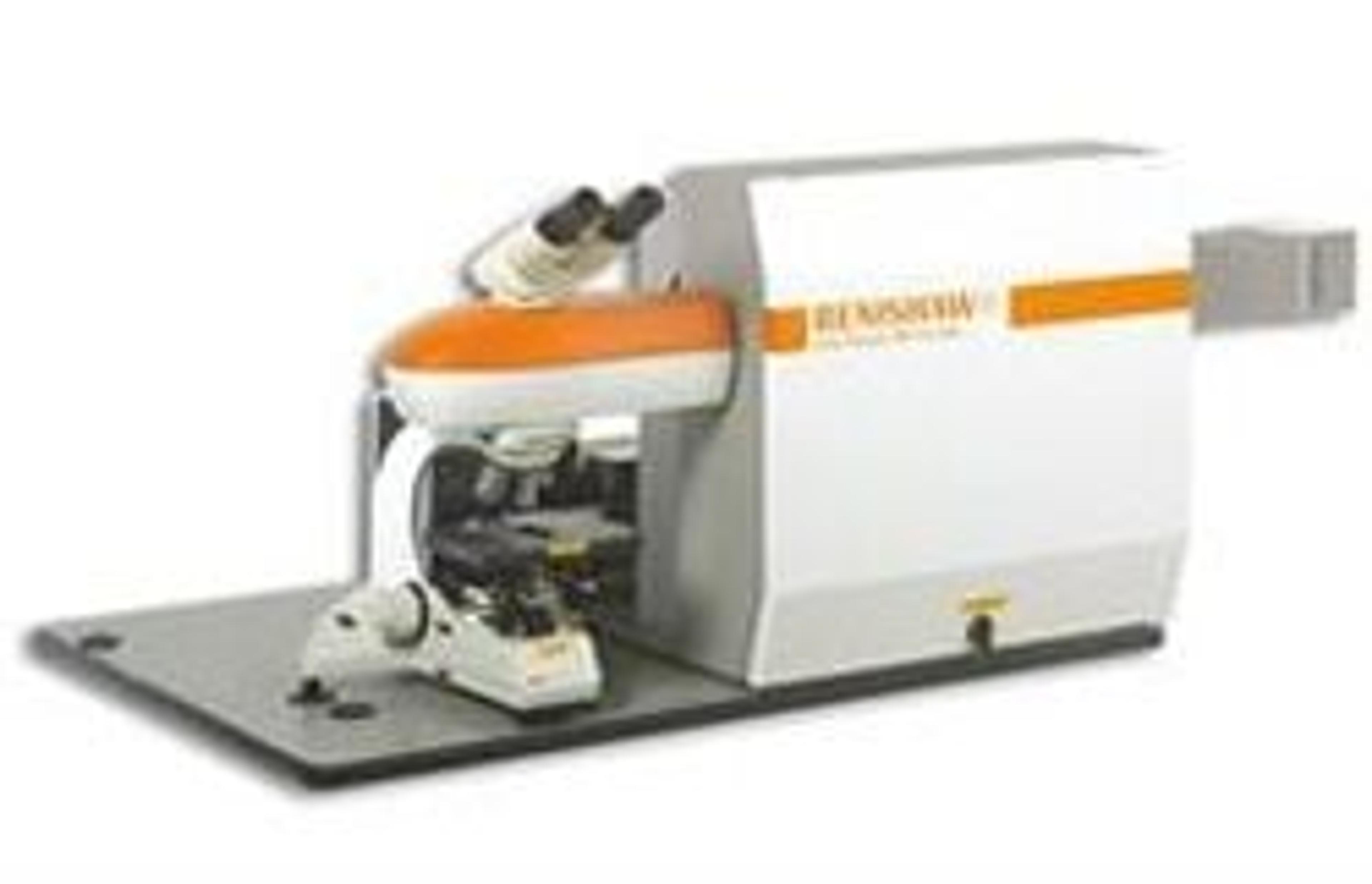
inVia Raman microscope
Renishaw plc.Since being launched, the Renishaw inVia Raman microscope has become the world's best selling research Raman system. The inVia Raman microscope combines simplicity of operation with the high performance and unparalleled flexibility for which Renishaw Raman systems are renowned. inVia Raman microscopes are high-sensitivity systems with integrated research grade microscopes, enabling high resolution confocal measurements. inVia Raman microscopes support multiple lasers, with automatic software switching of excitation wavelength.