
Real-time gas analysis supports carbon capture research and process optimization
Hiden Analytical highlights how mass spectrometry enables insight into CO₂ capture performance and process behavior
25 Jun 2026
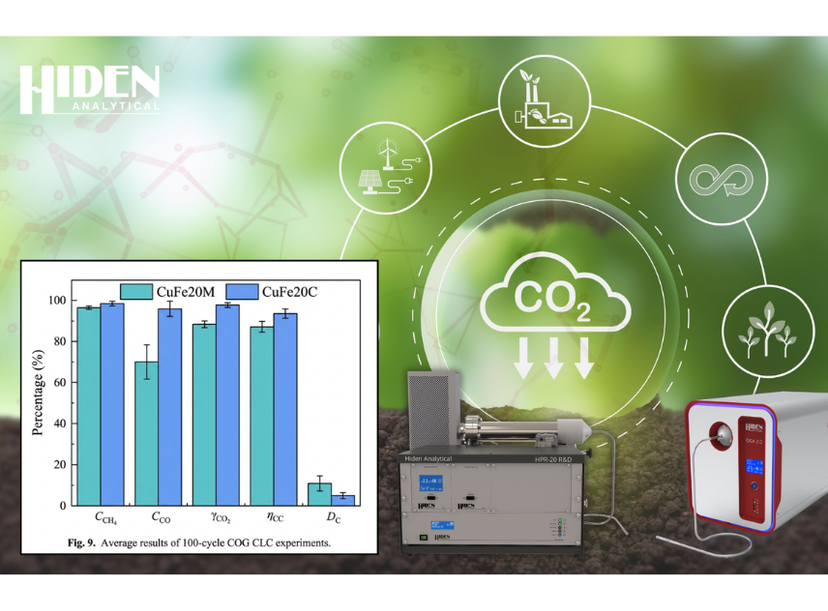
Real‑time gas analysis supports evaluation of carbon capture processes, enabling monitoring of CO₂ performance across repeated cycles
Hiden Analytical is highlighting how real-time gas analysis supports CO₂ capture monitoring, sorbent studies and low-carbon process optimization for researchers and engineers worldwide. As carbon capture technologies move from laboratory research towards pilot-scale and industrial deployment, reliable, real-time analytical data is becoming essential to understand process chemistry, validate performance and support decarbonization strategies.
Carbon capture technologies are designed to prevent carbon dioxide (CO₂) emissions from entering the atmosphere by capturing CO₂ at source for storage, utilization or further processing. However, successful carbon capture depends on more than capturing CO₂ alone. Researchers and engineers must also understand what is happening inside the process, including gas composition, material performance, regeneration behaviour, process stability and potential by-products.
Real-time gas analysis provides this insight by tracking how gas compositions change during adsorption, desorption, regeneration, reaction testing and long-term cycling. This capability helps research teams and process developers evaluate capture efficiency, identify degradation mechanisms and optimize operating conditions for low-carbon industrial processes.
Key applications in CO₂ capture research and development
Real-time gas analysis is used across a wide range of carbon capture and low-carbon process applications, including:
- CO₂ adsorption and desorption studies
- Sorbent regeneration analysis
- Breakthrough curve monitoring
- Evolved gas analysis (EGA)
- TGA-MS carbon capture studies
- Chemical looping research
- Simulated flue gas experiments
By monitoring how gas species evolve under different conditions, researchers can assess sorbent performance, understand thermal behavior, evaluate gas release profiles and investigate long-term cycling stability.
Monitoring critical gas species in complex streams
Hiden Analytical’s gas analysis systems support sensitive, fast and precise measurement of gases and vapors across carbon capture research and process development. By helping users monitor key species such as CO₂, O₂, H₂O, NH₃, CO, CH₄ and other process gases, Hiden instruments provide the data needed to evaluate material performance, refine experimental conditions and support more informed decision-making.
Real-time gas analysis in chemical looping combustion research
The importance of detailed gas-phase insight is reflected in recent low-carbon process research. In a 2025 study evaluating chemical looping combustion of coke oven gas1, researchers used an online Hiden Analytical HPR-20 mass spectrometer for real-time gas analysis during fixed-bed reactor testing.
The study reported that the hydroforming-derived CuFe20C oxygen carrier achieved an average CO₂ yield of 97.77% and carbon capture efficiency of 93.64% across 100 cycles. This work demonstrates how real-time gas monitoring can support the evaluation of carbon capture-related process performance under demanding test conditions, helping to validate oxygen carrier stability, capture efficiency and long-term operational behaviour.
Gas analysis systems for carbon capture applications
Hiden Analytical offers a range of systems relevant to carbon capture applications, including:
- QGA 2.0: Supports real-time, multi-species gas and vapor monitoring for CO₂ capture research, process development and low-carbon technology evaluation.
- HPR-20 R&D: Suited to high-sensitivity research gas analysis, enabling detailed investigation of gas-phase reactions, sorbent performance and process dynamics.
- HPR-20 EGA: Supports evolved gas analysis and TGA-MS workflows involving sorbents, thermal behaviour and gas release, providing insight into material stability and regeneration characteristics.
These systems help researchers and engineers see beyond headline capture figures to gain a clearer understanding of the chemistry, stability and performance underpinning CO₂ capture technologies.
Supporting the transition from concept to industrial deployment
As carbon capture projects continue to develop, robust analytical data will play an important role in turning promising concepts into measurable, optimised processes. Real-time gas analysis enables research teams to validate capture efficiency, optimise regeneration strategies, assess long-term cycling and understand the impact of complex gas mixtures.
Hiden Analytical’s gas analysis technologies support this transition by providing the detailed gas-phase information needed to design, refine and scale up CO₂ capture processes for industrial decarbonization.
“Carbon capture is moving into a phase where process understanding is just as important as capture capacity,” said David Lundie, Technical Director at Hiden Analytical. “Real gas streams are complex, and researchers need to know how CO₂ and other species behave throughout the full capture, conversion or regeneration cycle. Real-time mass spectrometry gives teams the visibility needed to improve materials, optimise processes and build confidence in technologies designed to support lower-carbon industry.”
References
1. Liu X, Lai X, Li Y, Kuang C et al. Performance evaluation of inexpensive composite copper/iron ore oxygen carriers produced by industrial granulation in chemical looping combustion of coke oven gas. Fuel Processing Technology; 15 October 2025; Article: 108293; Volume 276.
Want the latest science news straight to your inbox? Become a SelectScience member for free today>>
Tags
Frequently asked questions
Show frequently asked questions
How does real-time gas analysis enhance CO₂ capture performance and low-carbon process optimization?
Real-time gas analysis tracks changing gas compositions during adsorption, desorption, regeneration, reaction testing and long-term cycling. This helps researchers and engineers evaluate CO₂ capture efficiency, identify degradation mechanisms, understand sorbent and material performance, and optimise operating conditions. The detailed process insight supports development and optimization of low-carbon industrial processes and decarbonization strategies.
What CO₂ capture applications and gas species can Hiden Analytical’s mass spectrometry systems monitor?
Hiden Analytical’s gas analysis and mass spectrometry systems support CO₂ adsorption and desorption studies, sorbent regeneration analysis, breakthrough curve monitoring, evolved gas analysis, TGA-MS carbon capture studies, chemical looping research and simulated flue gas experiments. They enable sensitive, fast measurement of key gases including CO₂, O₂, H₂O, NH₃, CO, CH₄ and other process gases in complex streams.
Which Hiden Analytical instruments support CO₂ capture and chemical looping combustion research?
Hiden Analytical offers QGA 2.0 for real-time multi-species gas and vapor monitoring, HPR-20 R&D for high-sensitivity research gas analysis, and HPR-20 EGA for evolved gas analysis and TGA-MS workflows. In a 2025 chemical looping combustion study of coke oven gas, an HPR-20 online mass spectrometer helped show a CuFe20C oxygen carrier achieving 97.77% CO₂ yield and 93.64% carbon capture efficiency over 100 cycles.