
Promega Introduces Bioluminescent ROS-Glo H<sub>2</sub>O<sub>2</sub> Assay for Enzymatic Screening Programs and Cell-based Assays
30 Sept 2013
Promega Corporation announced today the launch of the ROS-Glo™ H²O² Assay. A non-horseradish peroxidase (HRP)-dependent, plate-based bioluminescent assay for detecting reactive oxygen species (ROS), ROS-Glo H²O² Assay is designed to specifically detect hydrogen peroxide (H²O²) in both enzyme and cell-based applications.
The ROS-Glo H²O² Assay measures the activity of enzymes that generate or eliminate H²O², and possesses many benefits over other commercially available assays for small molecule screening, including low false hit rate, signal stability, and compatibility with liquid handling. Importantly for screening applications, the assay does not rely on a reaction catalyzed by HRP, which is known to cause a high number of false hits. The assay can also be used to measure changes in the level of ROS by directly detecting H²O² in cultured mammalian cells after two reagent additions, with no cell sample preparation required, reducing variability and the number of cells required.
The new assays enable researchers to more effectively study the biology of ROS, and to screen large compound libraries for their capacity to alter H²O² levels in cultured cells or in enzymatic reactions. Although ROS can be beneficial to human cells as they are common byproducts of metabolism, they can also lead to cellular damage, such as oxidative stress, through environmental factors or aberrant metabolism.
The homogeneous ROS-Glo H²O² Assay uses a modified luciferin substrate that reacts directly with H2O2 to generate a luciferin precursor. Upon addition of detection reagent, precursor is converted to luciferin and Ultra-Glo™ Recombinant Luciferase included in the detection reagent produces a light signal proportional to the level of H²O² in the sample.
Due to the bioluminescent format and high sensitivity, ROS-Glo H²O² Assay can be multiplexed with a variety of other cell-based assays to gain additional data from a sample. For example, CellTox™ Green Cytotoxicity Assay reagent can be added to the same well at cell plating or treatment to kinetically monitor cytotoxicity by measuring changes in fluorescence, followed by implementation of the ROS-Glo H²O² Assay to measure changes in ROS levels by luminescence detection.
Related products
Request Quote for All Products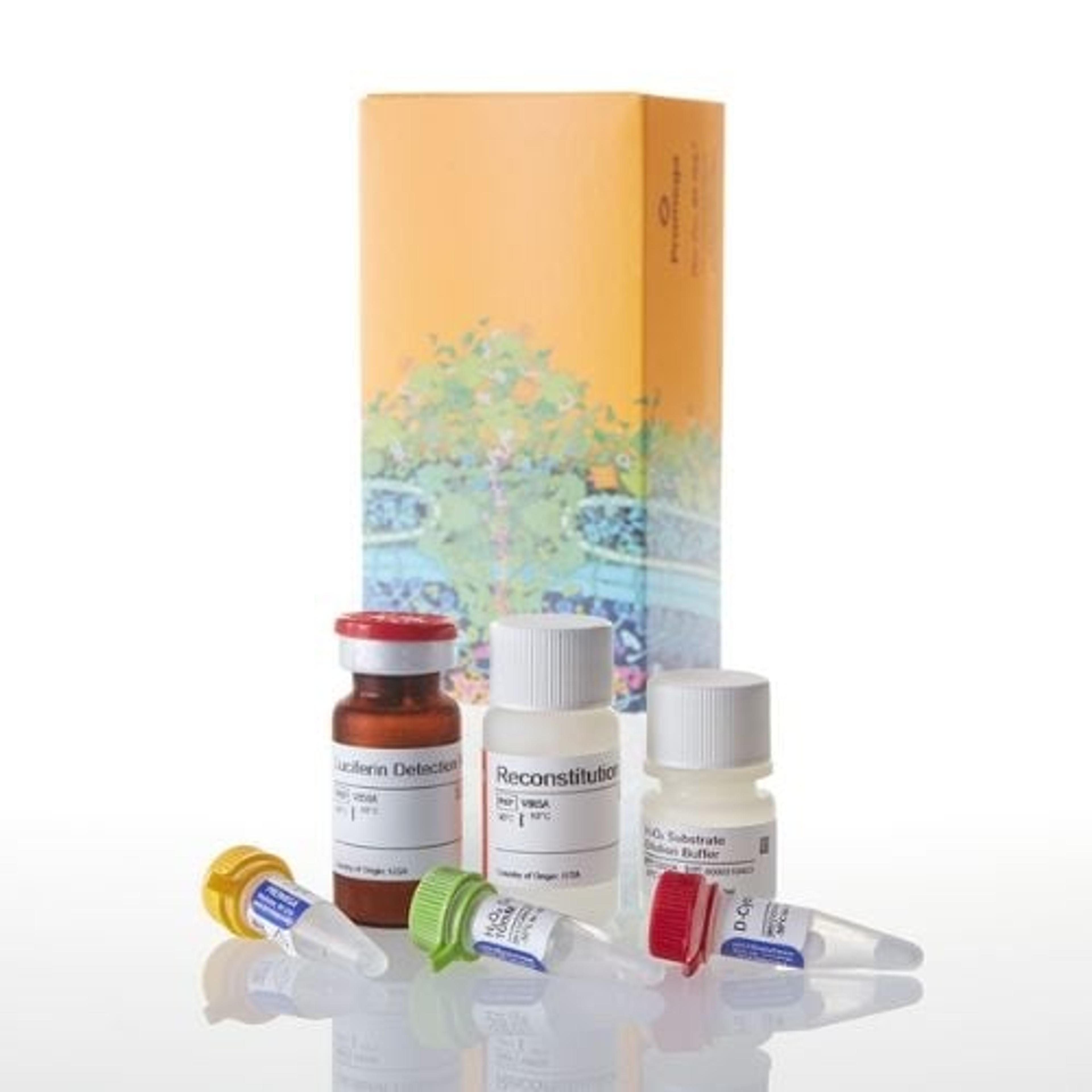
ROS-Glo™ H2O2 Assay
Promega Corp.The ROS-Glo™ H2O2 Assay is a homogeneous, fast and sensitive bioluminescent assay that measures the level of hydrogen peroxide (H2O2), a reactive oxygen species (ROS), directly in cell culture or in defined enzyme reactions. This assay allows identification of conditions or test compounds, such as small molecule inhibitors or inducers, that alter ROS levels. The scalable multiwell format couples a stable luminescent signal to the level of H2O2 in a sample. An H2O2 Substrate is employed that reacts directly with H2O2 to generate a luciferin precursor. Upon addition of ROS-Glo™ Detection Reagent containing Ultra-Glo™ Recombinant Luciferase and D-Cysteine, the precursor is converted to luciferin by the D-Cysteine, and the produced luciferin reacts with Ultra-Glo™ Recombinant Luciferase to generate a luminescent signal that is proportional to H2O2 concentration. ROS-Glo™ H2O2 Assay Benefits: Direct Cell-Based Detection - The assay can be performed in various cell culture media with or without serum, eliminating the need to remove media from cultured cells before performing the assay. Simple and Fast Protocol - The homogeneous assay is performed following a simple two-reagentaddition protocol that does not require sample manipulation. The assay can be completed in less than 2 hours. Automation Compatible - The assay is compatible with liquid handling robotics and can be scaled for use in multiwell formats. Non-HRP Based - The ROS-Glo™ H2O2 Substrate reacts directly with H2O2, obviating the need for horseradish peroxidase (HRP) as a coupling enzyme and thus eliminating false hits associated with HRP inhibition. Flexible - The assay can be used to screen compounds in both cell-based and enzyme-based formats. Multiplex-Compatible System - Get more informative data per well and reduce cell culture expenses by multiplexing with a real-time cytotoxicity assay (CellTox™ Green Cytotoxicity Assay) in the same well or with a viability assay.