
University of Nottingham unlocks rapid viral genotyping with Genome Detective
University of Nottingham uses Genome Detective to replace slower Sanger-based workflows and complex bioinformatics pipelines
11 Aug 2026
Researchers at the University of Nottingham are using the Genome Detective platform to accelerate viral genotyping and next-generation sequencing (NGS) data analysis in virology research.
Working across hospital-based clinical environments and veterinary collaborations, the team applies this web-based tool to rapidly analyze complex multiplex PCR and metagenomic datasets, helping to track respiratory, enteric, and emerging viral infections and to bridge the gap between raw sequencing data and actionable clinical insights.
Shifting focus to emerging viral threats
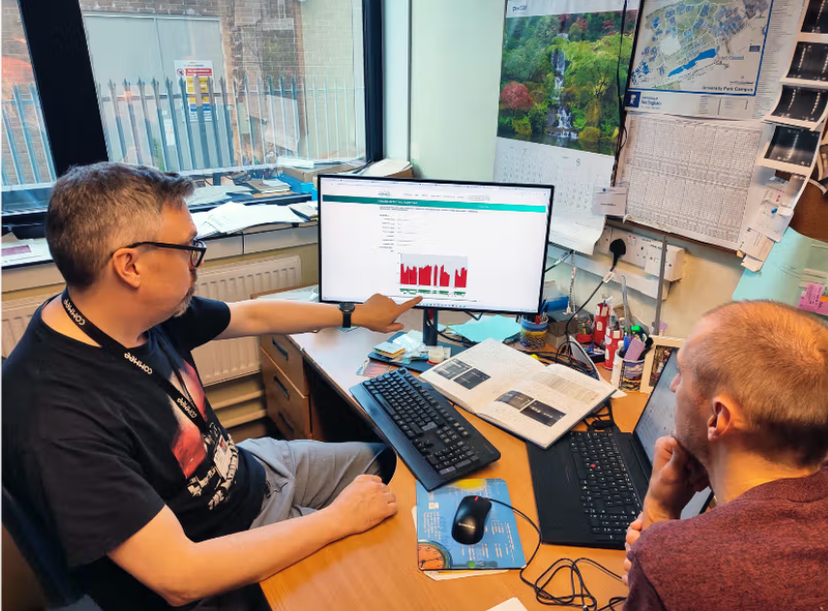
Patrick McClure, Assistant Professor at the Faculty of Medicine & Health Sciences (left), discussing results generated by Genome Detective (image by University of Nottingham)
At the University of Nottingham Faculty of Medicine & Health Sciences, Assistant Professor Patrick McClure has expanded his virology research beyond blood-borne viruses to focus on respiratory, enteric and emerging infections. Operating at the interface of human and animal health, he manages diverse portfolios that detect and characterize viruses in wildlife, animals and human patients.
Historically, McClure’s group relied on an orthodox Sanger sequencing approach. However, the exponential growth of large metagenomic datasets and complex multiplex PCR projects created a bioinformatics bottleneck that demanded specialist expertise and high-performance computing.
In collaboration with wet-lab deep-sequencing service providers, Genome Detective now helps remove many of the expense, risks and complications associated with traditional bioinformatics pipelines.
Overcoming bioinformatics bottlenecks in the lab
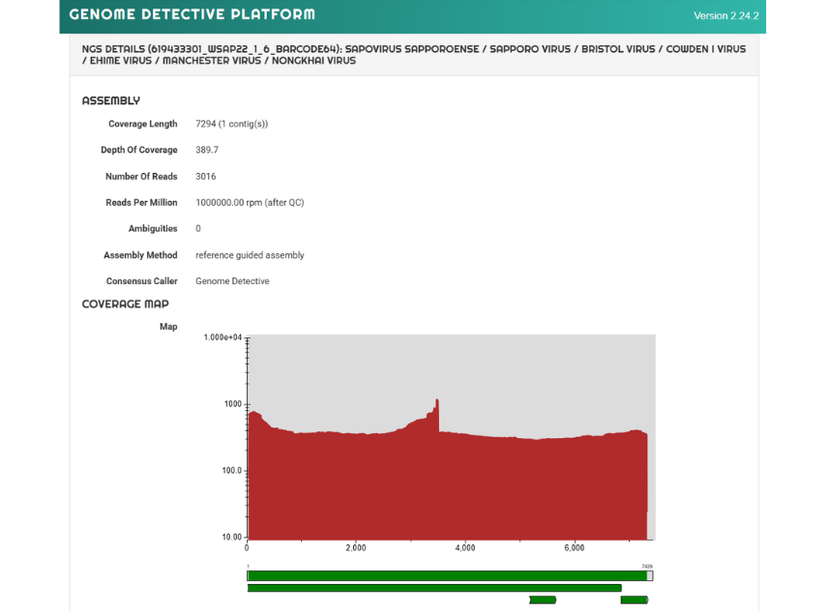
Genome Detective display showing Sapovirus-related coverage map (image by University of Nottingham)
The web-based Genome Detective platform has become an integral part of McClure’s laboratory workflow, reducing the duration of certain individual pipeline processes to just minutes.
When evaluating new amplicon sequencing schemes, including recent work on sapovirus, astrovirus and adenovirus, the drag-and-drop web interface enables his team and master’s students to quickly process raw sequencing data and obtain comprehensive, reliable typing reports.
By simply dragging and dropping raw data from commercial sequencing providers, users receive detailed reports that support rapid decision-making. The platform’s speed and reliability are particularly important for projects with tight turnaround times.
Genome Detective efficiently trims primers and processes multiplex amplicons, ensuring that even when budgets are limited or overnight sequencing services yield relatively few reads, the team can still access the detailed genomic insight required within clinically relevant timeframes.
Advancing global enterovirus surveillance
McClure highlights a specific study1 in which procedures for collecting clinical and epidemiological data, and integrating these with NGS-generated datasets, are designed to enhance data sharing and collaborative analysis.
Improved accessibility to NGS-based enterovirus data will support early outbreak detection, clinical diagnostics and research into enterovirus evolution, epidemiology, and disease burden at both regional and global scales. This approach underpins more effective enterovirus surveillance and strengthens international public health responses.
The insightful visual outputs and graphical reports provided by Genome Detective, including analysis summaries, alignment charts and enterovirus genotyping tools, are proving valuable for both academic research and emerging clinical applications.
As an active user and advocate, McClure has contributed to position papers on the use of NGS in clinical environments, noting that the platform’s precise range of outputs – from data plots and visualizations to copiable sequences – is helping to build the worldwide reputation of Genome Detective.
Encouraging the use of web-based genotyping tools
While much of McClure’s current work focuses on viral surveillance, the speed of the Genome Detective platform opens the door to rapid, single-day turnaround services that will be essential for future clinical management of infectious disease. He recommends the software to both non-clinical and clinical laboratories, emphasizing that these web-based genotyping tools clearly identify which viruses are present and generate complete, easy-to-interpret reports that support research, diagnostics and public health decision-making.
References
1. Benschop KSM, Zwagemaker F, Andersson-Li L, Andrés C et al. Next generation sequencing approaches for the detection and characterization of enteroviruses in clinical, public health, and research settings: Expert view of the European non-polio enterovirus network (ENPEN). Journal of Clinical Virology, Volume 184, June 2026, 105940.
Want the latest science news straight to your inbox? Become a SelectScience member for free today>>
Links
Tags
Frequently asked questions
Show frequently asked questions
How is the University of Nottingham using the Genome Detective platform in virology research?
Researchers at the University of Nottingham use the web-based Genome Detective platform to accelerate viral genotyping and NGS data analysis across clinical and veterinary settings. By rapidly processing complex multiplex PCR and metagenomic datasets, the tool helps track respiratory, enteric and emerging viral infections and transforms raw sequencing data into actionable clinical insights for research and diagnostics.
How does Genome Detective help Patrick McClure’s lab overcome bioinformatics bottlenecks in viral sequencing?
Patrick McClure’s lab at the University of Nottingham uses Genome Detective to replace slower Sanger-based workflows and complex bioinformatics pipelines. The drag-and-drop interface quickly trims primers, processes multiplex amplicons and generates reliable typing reports for viruses such as Sapovirus, Astrovirus and Adenovirus, even from limited reads, supporting rapid decision-making within tight, clinically relevant turnaround times.
How is Genome Detective advancing global enterovirus surveillance and public health responses?
Genome Detective supports global enterovirus surveillance by integrating clinical and epidemiological data with NGS datasets to improve data sharing and collaborative analysis. Enhanced accessibility to NGS-based enterovirus data enables early outbreak detection, better clinical diagnostics and research into enterovirus evolution, epidemiology and disease burden, strengthening regional and international public health responses and informing position papers on NGS use in clinical environments.