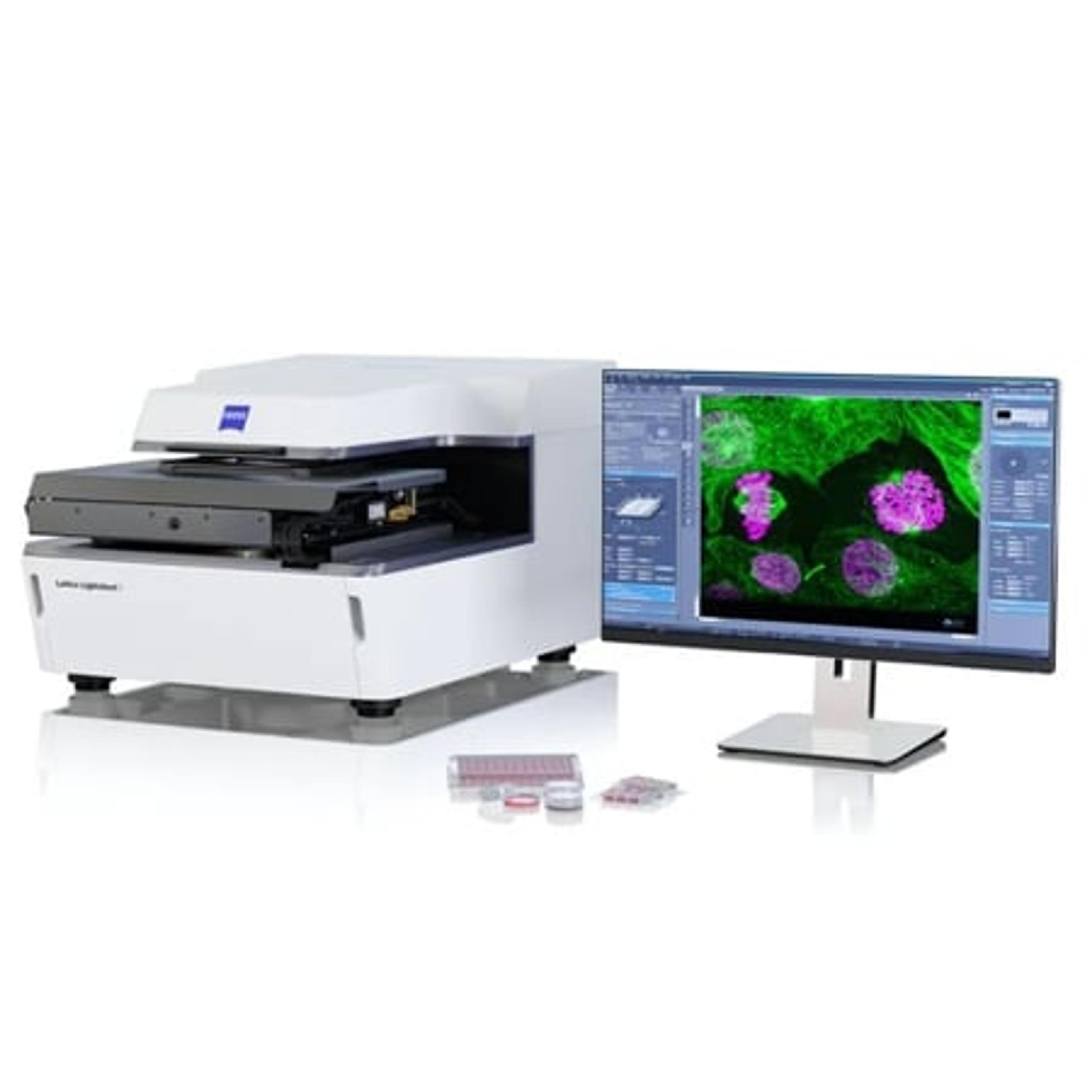
New advanced imaging center powered by two MuVi and LCS SPIM microscopes

25 Mar 2021

Edward Carter
Publishing / Media

Industry news

Bruker has announced that two Luxendo MuVi™and LCS SPIM™ light-sheet microscopes have been installed by Memorial Sloan Kettering Cancer Center (MSK). The funding for the two light-sheet fluorescence microscopes was supported by Cycle for Survival. The new SPIM microscopes will help researchers visualize the cellular and tissue hallmarks of cancer and translate those findings into better cancer treatment methods.

“By understanding how cells mobilize to build organs, researchers can glean insights into why some cells become cancerous and lead to organ destruction,” said Dr. Anna-Katerina Hadjantonakis, MSK Chair of the Developmental Biology Program. “Instruments such as these are useful for imaging across differing length scales — from subcellular to single cells to tissue-level processes — allowing researchers to study cellular dynamics and cellular motion, processes that enable cells to metastasize.”

“Light-sheet fluorescence microscopy has emerged as a uniquely powerful method for high-resolution, cleared-sample and dynamic biological imaging,” added Dr. Lars Hufnagel, Vice President and General Manager of Bruker’s Luxendo light-sheet microscopy business. “We couldn’t be more pleased that our technology will be assisting the great MSK researchers and programs in such important work.”

Want the latest science news straight to your inbox? Become a SelectScience member for free today>>

Tags

Cell Lines Stem Cells and Primary CellsPrimary cell cultures, established cell lines and stem cells are vital for <i>in vitro</i> and <i>ex vivo</i> experimentation. High-quality cells, optimized for your applications, alongside optimized cell substrates, growth medium and supplements, are critical for experimental success. Explore a range of cells suitable for your applications, including isogenic cell lines, competent cells, induced pluripotent stem cell (iPSC)-derived cell lines, fungal/bacterial/mammalian cell lines, stem cells and cancer cell lines. Find the best cells for your research in our peer-reviewed product directory: compare products, check customer reviews and receive pricing direct from manufacturers.Light MicroscopyLight microscopes or optical microscopes are used to visualize microscale objects under magnification, including cells, clinical specimens and materials. Lab equipment for light microscopy includes confocal microscopes, fluorescence microscopes, zoom and stereo microscopes. Microscope slides and imaging reagents are available for visualizing samples, as well as various microscope stages and incubators for large or temperature-sensitive samples. Find the best light microscopes in our peer-reviewed product directory: compare products, check customer reviews and receive pricing direct from manufacturers.Electron MicroscopyElectron microscopes (EM) are used to create high-resolution images of samples at the nanoscale by means of an accelerated beam of electrons as a source of illumination. Types of electron microscope include scanning electron microscopes (SEM), transmission electron microscopes (TEM), scanning transmission electron microscopes (STEM) and cryo-electron microscopes. Focused ion beam (FIB) microscopes are useful for modifying or milling a sample surface with nanometer precision, as well as imaging. Find the best electron microscopes in our peer-reviewed product directory: compare products, check customer reviews and receive pricing direct from manufacturers.Cancer DiagnosticsThere are a wide variety of diagnostic tests for cancer available, and this range continues to expand as our knowledge of cancer improves. Current diagnostic methods include biopsy, imaging and blood tests for known biomarkers. New methods in research development include liquid biopsies and cancer breathalyzers.MicroscopyMicroscopy is a technique used to observe small objects in detail, from cells to materials, using light or electron microscopes. It enables researchers to examine structures with high resolution, aiding in fields such as biology, medicine, and materials science. With advanced microscopy techniques, scientists can gain insights into cellular processes, tissue structures, and material properties. Explore the best microscopy solutions in our peer-reviewed product directory, compare products, read customer reviews, and get pricing directly from manufacturers.Cancer ResearchAlthough cancer is often referred to as a single condition, it actually consists of more than 100 different diseases. Microscopy, mass spectrometry, high throughput sequencing and flow cytometry are some of the most common techniques employed in cancer research labs.
New advanced imaging center powered by two MuVi and LCS SPIM microscopes