
iBox® Scientia™ In Vivo Imaging System for Fluorescent and Bioluminescent Applications

23 Oct 2016

Lynsey Forsyth
Post Doc / Research Fellow

Product news

The iBox Scientia features high sensitivity imaging and accurate quantification of bioluminescent and fluorescent sources. The new BioCam 900 camera provides superior imaging capabilities for bioluminescence. It has a deeply cooled CCD (-100ºC from ambient), superior quantum efficiency (>90%) and a selection of low f-stop (f/0.95) lenses for ultra-fast capture.

Applications for pre-clinical research include tumor studies, cancer research, inflammation, heart disease, immunology, bacterial/viral infections, metastasis and gene expression.The system is versatile and can support imaging of any probe in the visible to near infrared (NIR) range. NIR enables less skin autofluorescence (~650nm) and deep penetration with use of RFP for (3X) 2 penetration depth and GFP, NIR for near (8X) 2 penetration depth. The wide spectrum also allows more options for multiplex labelling. This capability displays tissue/tissue interaction, enhanced signal to background ratio and detection of multiple fluorescent proteins or labels.

For full Application Notes on these topics, please
Visit www.uvp.com

UVP’s Breakthrough Advances in Small Animal and In Vivo Imaging
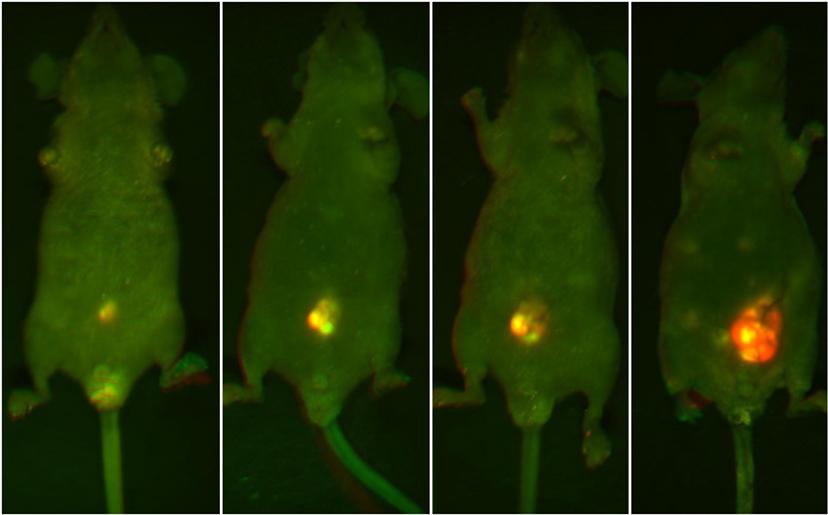
Tumor imaged using GFP and RFP

The iBox Explorer2 Imaging Microscope detects fluorescent markers from whole mouse to individual cell level for in vivo imaging in immunology, stem cell biology,neuroscience and cancer biology research applications. Applications include tumor shedding, tumor growth and tracking, biodistribution, metastases Hematogenous and Intralymphatic trafficking and extravasation.

The integrated optics are designed to transition from the macroscopic to the microscopic scale, with deeper interrogation of a fluorescent signal in real time. Magnification range is from 0.17x to 16.5x. Scientists imaging whole animals for tumor tracking or biodistribution will be able to "dive deeper" into the animal in order to investigate biological phenomena at the cellular level.

The iBox Explorer utilizes a BioLite™ Xe MultiSpectral Light Source which provides bright illumination for multispectral fluorescent, visible and NIR excitation. The BioLite Xe houses a 150-watt xenon lamp that supplies brilliant excitation of fluorescent probes for a variety of applications. The BioLite Xe includes an eight-position emission filter wheel for placement of filters and convenient switching between experiments and multiplexing applications.

The system captures detailed images of tissues and cells with the leading-edge cooled scientific grade CCD camera. VisionWorks® software automates research with total system control and allows easy creation of templates for reproducible and consistent results. The system a computer/monitor loaded with the software.
Additional features include a built-in warming plate maintains a uniform temperature of the mouse. The plate slides out for easy access. A port in the darkroom allows access for an optional anesthesia system.

Links

Tags

BiomarkersBiomarkers are biological markers which can be measured and evaluated to indicate a biological state. The use of biomarkers in research and diagnosis can indicate a normal or disease state or drug response of cells / tissues. Biomarkers include genetic markers, cell surface markers such as antigens, antibodies or receptors and secreted molecules such as cytokines. An assay system is required for identification of biomarkers. :In Vivo Imaging Systems<i>In vivo</i> imaging systems, including pre-clinical imaging systems and medical imaging systems are used to non-invasively visualize and capture images of live animals and plants. Monitor the natural processes or diseases of your subjects using small-animal pre-clinical imaging systems, including single photon positron emission tomography (SPECT), positron emission tomography (PET), computed tomography (micro-CT), magnetic resonance imaging (MRI), X-ray radiography, ultrasound, fluorescence and bioluminescence imagers. Multimodal systems and software solutions are also available for correlative analysis of organ, tissue, cell, or molecular-level processes. Find the best in vivo imaging products in our peer-reviewed product directory: compare products, check customer reviews and receive pricing direct from manufacturers.Animal ModelsThe use of non-human animals in experiments or behavorial observations. The research is conducted inside universities, medical schools, pharmaceutical companies, farms, defence establishments, and commercial facilities that provide animal-testing services to industry. It includes pure research such as genetics, developmental biology, behavioral studies, as well as applied research such as pharmaceutical testing in pre-clinical, before human, studies. NeuroscienceNeuroscience research investigates the neurological mechanisms underlying behavior, neurodegenerative diseases, and other brain conditions. Learn about the innovative technologies for bioimaging, electrophysiology, cell culture, chromatography and other techniques used in this field.ImmunologyImmunology is the branch of medical science that covers the study of all aspects of the immune system of multicellular organisms.FluorescenceThe emission of fluorescence occurs when a photon of energy is supplied to a fluorescent chemical compound by an external source, causing it to become excited. Fluorescence can be detected and measured for different purposes using microplate readers, fluorescence microscopes, fluorescence scanners, and flow cytometers.ImagingImaging techniques are essential for obtaining visual representations of samples to understand structures, processes, and function in biological, chemical, and physical research. These tools range from traditional light microscopy to advanced imaging modalities like MRI and electron microscopy, providing researchers with valuable data for diagnostics, drug discovery, and material analysis. Explore imaging solutions in our peer-reviewed product directory to compare products, check reviews, and get pricing directly from manufacturers.Small Animal ImagingSmall animal imaging is the visualization of living animals, most commonly mice and rats, for research purposes. This non-invasive technique is vital for long-term studies into drugs effects, as well as small animal anatomy and physiology.Gene ExpressionStem Cell ResearchStem cells have the ability to produce identical daughter cells as well as progeny, which commit and differentiate. Stem cell research has exciting prospects of biomedical applications in cellular disease modeling, pharmaceutical screening, and regenerative medicine. Cancer ResearchCancer research aims to understand the mechanisms of cancer development and progression to improve prevention, diagnosis, and treatment. From molecular biology to clinical trials, research spans a wide range of disciplines, including immunotherapy, targeted therapies, and drug discovery. Explore the best cancer research products in our peer-reviewed product directory; compare products, check reviews, and get pricing directly from manufacturers.Cardiovascular DiseaseCardiovascular disease refers to a group of disorders of the heart and blood vessels, including heart attacks, strokes, and high blood pressure. Early diagnosis and effective treatment are essential for improving patient outcomes. Explore cardiovascular disease research and diagnostic tools in our peer-reviewed product directory; compare products, check reviews, and get pricing directly from manufacturers.TumorsTumor research focuses on understanding abnormal cell growth that leads to cancer. Identifying biomarkers, studying tumor microenvironments, and developing targeted therapies are critical for advancing cancer treatment. Early detection and personalized treatment options are key to improving outcomes for patients. Browse our peer-reviewed product directory to explore tools for tumor research, diagnostics, and cancer therapies; compare products, read customer reviews, and get pricing directly from manufacturers.Protein BiologyThe analysis of protein expression, identity and function is vital for many areas of life science research and drug discovery. Some of the most commonly used techniques in protein analysis include Western blotting, electrophoresis and mass spectrometry.