
Engineering the future of patient care through cGMP tissue banking with Paul Behrends
Discover how Amnion Laboratory Director Paul Behrends is bridging the gap between facility infrastructure and clinical innovation to celebrate Medical Laboratory Professionals Week 2026
20 Apr 2026
Medical Laboratory Professional Week shines a spotlight on the often-invisible experts powering healthcare. This year, we sit down with Paul Behrends, Laboratory Director for Amnion, whose non-linear career path has taken him from the foundational world of food safety to the cutting edge of gene therapy and cGMP tissue engineering.
From managing $15 million laboratory renovations to developing life-changing wound care products from repurposed placental tissue, Paul shares a unique perspective on the intersection of engineering and biology. He discusses the vital human impact that remains at the forefront of his work, especially when those products are used by his own colleagues, and why the ability to make connections across scientific specialties is the secret to a successful career at the bench.
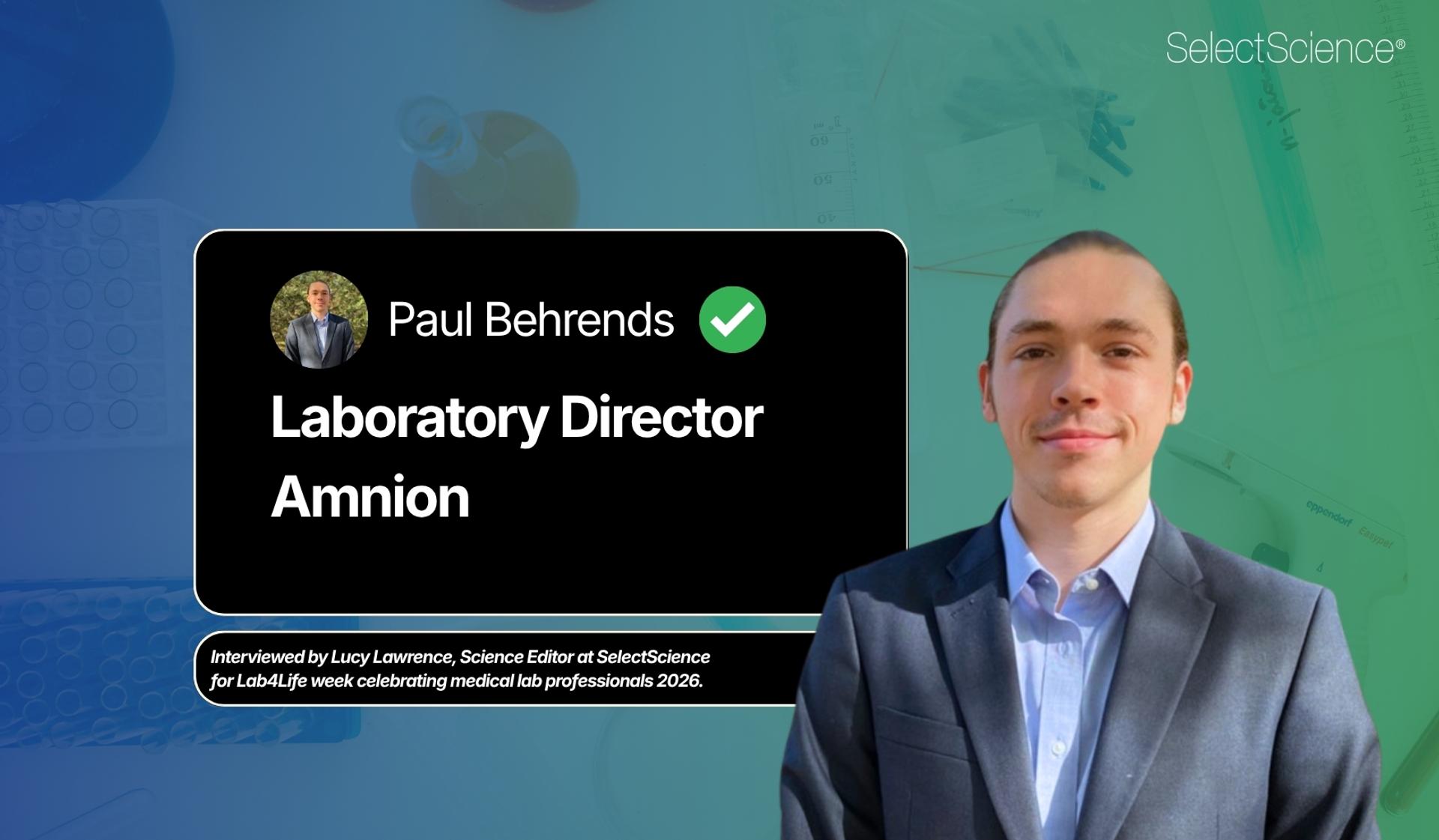
Paul Behrends, Laboratory Director, Amnion.
Lucy Lawrence (LL): Could you tell us about your background and current role?
Paul Behrends (PB): I attended VCU, where I earned a Bachelor of Science in Chemistry, and am currently pursuing a master's in biomedical engineering with a focus on tissue engineering. I seek not only to understand science but to apply it. The pathway from idea to discovery to process development to a product that can genuinely improve patient outcomes is complex and difficult, and I find that challenge deeply interesting.
My first position was at a food safety testing company, which gave me a grounding in lab practice. I then moved to a CDMO start-up in the gene therapy space, working in manufacturing before transitioning into process development. When the company was acquired and a $15 million, 75,000 sq ft laboratory renovation was funded, I joined the facility team.
Having worked in those spaces myself, I could speak to what scientists actually need — the right amount of bench space, the right number of outlets, and the right equipment footprint. That ground-level perspective turned out to be as valuable as any engineering specification. After completing that project, I joined my current company, Amnion, as Laboratory Director, where I've been building a new laboratory for a tissue banking and tissue engineering operation from the ground up.
LL: What first drew you to the lab, and what makes you proud to put on your lab coat every day?
PB: What drew me to the lab was honestly a professor's recommendation in my last semester. Testing food samples may sound mundane, but I was immediately fascinated by how lab tools let me see into a microscopic world invisible to everyone else.
What keeps me putting on the lab coat is the awareness of how much the work actually matters. Biotech and laboratory science underpin an enormous amount of what keeps the modern world functioning, including the safety of our food, the reliability of our medicines, and even the materials in everyday products. It's an often unseen, essential infrastructure. Being part of that, while also working on something as immediate as a wound care product that could be on a patient next week, is a combination of scale and specificity I don't think I could find anywhere else.
LL: What is a project or area you are currently working on that you’re particularly excited about?
PB: I currently work in tissue engineering to develop new methods for the cultivation and use of human tissues for medical applications. Currently, our focus is on repurposing the placenta as wound care products. Because the organ has historically been treated as medical waste, finding uses for this tissue is a multi-win scenario.
LL: Every sample is a person waiting for an answer. What specific moment reminds you of the human impact behind the data?
PB: What grounds me most is something unique to our team. Several of my colleagues have had our own products implanted for eye and dental procedures. When I'm reviewing a batch record or a quality document, I'm thinking about the fact that the standard I hold that product to is the same standard I'd want applied if it were going into someone I care about. Every graft we release represents someone recovering from an injury, and that weight is something I carry constructively as pride in the work.
LL: What soft skill is actually the secret to being a truly great scientist?
PB: The ability to make connections. Connections between ideas, concepts, data, people, and outcomes. Specializations have walls, but nature doesn't. The most interesting discoveries tend to happen when someone realizes that a principle from one field answers a question in another.
Finding that thread requires intellectual curiosity that extends well beyond your own specialty and a willingness to communicate with people who don't speak your technical language. You have to be as comfortable in a conversation with a clinician or an engineer as you are reading a journal article. Science is hard, but connecting is what makes it move forward.
LL: How can the industry better support the next generation, and what is your advice for students considering a career at the bench?
PB: Don't be afraid of a non-linear path. I went from testing food-safety samples to manufacturing gene therapies to designing laboratory infrastructure to building a tissue-engineering operation. None of those steps was planned in a straight line; they followed curiosity, opportunity, and a self-honest reckoning with what actually held my attention.
My advice is to find the thing that refuses to let you sleep—not because of stress, but because you're too excited to stop thinking about it. When you find it, you stop asking whether you're good enough and start asking how to get better, because the thing itself demands it of you. Follow that thread, wherever it leads.
Paul Behrends was speaking with Lucy Lawrence, Science Editor for SelectScience.
Explore the full feature.