How to improve pipetting accuracy for challenging liquids
Discover how BRANDTECH’s latest pipette allows temporary fine-tuning for different liquids, temperatures, and tip styles
2 Jun 2026
Air displacement pipetting is one of the first skills scientists learn at the bench. Yet even in experienced hands, some liquids refuse to play ball. Traditional air displacement pipettes commonly struggle with highly viscous, dense, or volatile samples, and their performance is also affected by temperature and pressure.
While various techniques can improve the performance of air displacement pipettes with challenging liquids, these approaches increase reliance on operator skill and can exacerbate user-to-user variability. Positive displacement pipettes remain the gold standard for many of these samples, but they are not always necessary for liquids that sit at the boundary between air and positive displacement—and switching instruments can be costly and inconvenient.
What scientists often need is a way to more precisely tune air displacement pipetting for these borderline liquid types, improving accuracy and reproducibility before stepping up to positive displacement when it’s truly required.
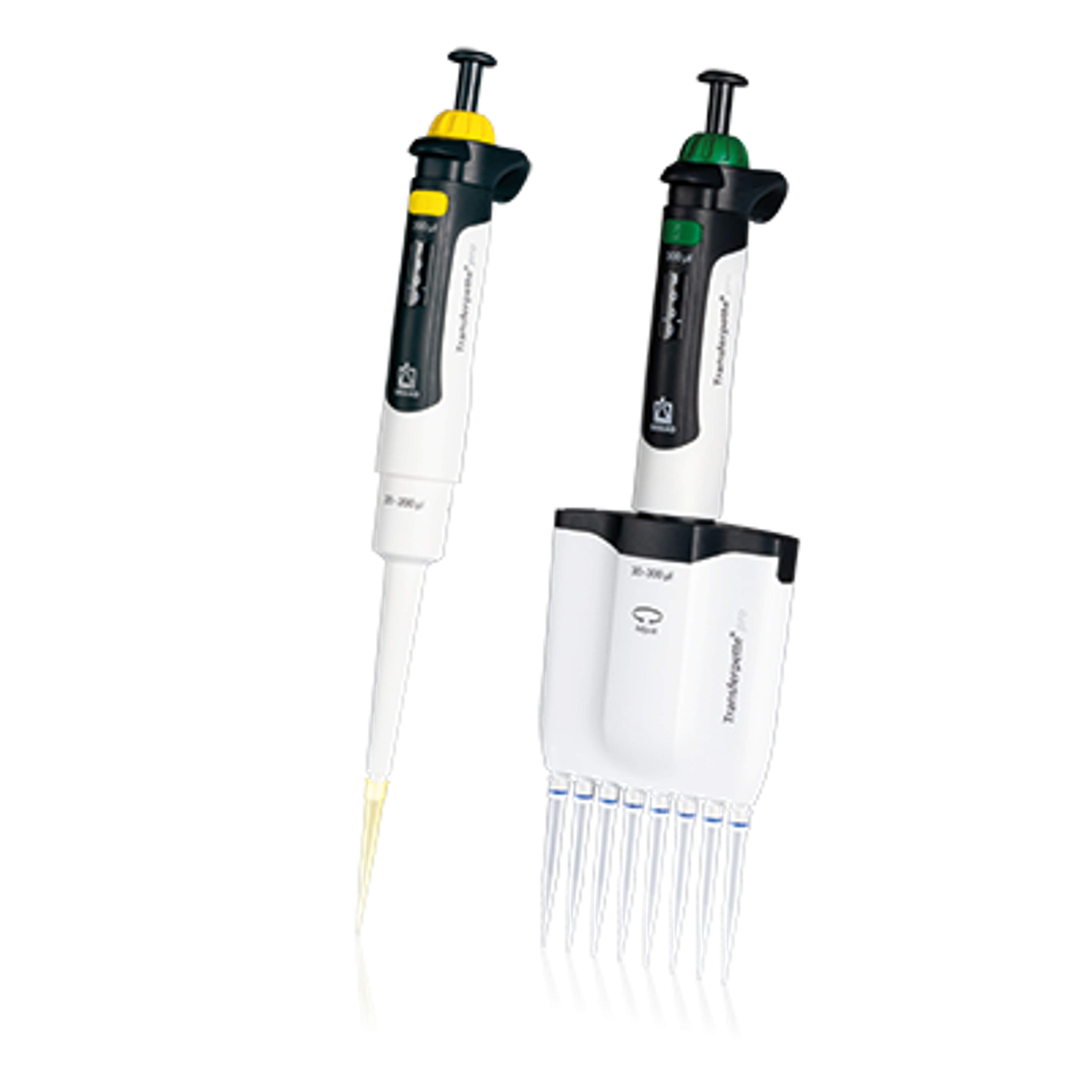
This is the rationale behind BRANDTECH Scientific’s new BRAND® Transferpette® pro. It is an advanced air displacement pipette designed to extend reliable performance with difficult liquids, allowing users to fine-tune settings and standardize workflows. While it does not replace positive displacement pipettes, the Transferpette® pro helps scientists work more accurately and confidently with challenging samples—clarifying when air displacement is sufficient and when a positive displacement solution is warranted.
Fine-tuning pipetting accuracy for difficult liquids

Rebecca Lampert, Product Manager of Liquid Handling, BRANDTECH Scientific
Several properties of liquids can make accurate pipetting challenging. “Factory-set air displacement pipettes are typically calibrated to water under defined environmental conditions,” explains Rebecca Lampert, who manages BRANDTECH’s liquid handling portfolio. This means that when a sample deviates from these properties, the delivered volume can be affected.
For example, if a sample’s density differs significantly from that of water, it alters the expansion of the air cushion – the pocket of air between the piston and the liquid – which in turn impacts the volume aspirated. Similarly, volatile liquids can evaporate into the air cushion, causing it to expand and leading to the formation of droplets at the pipette tip.
The volume delivered by air displacement pipettes also varies with temperature, due to the expansion and contraction of the air cushion, as well as changes in the density and viscosity of the liquid itself. Cold liquids tend to contract, often resulting in under-pipetting, whereas warmer liquids expand, which can lead to over-pipetting. At the same time, viscosity decreases as temperature rises, making liquids easier to aspirate but more prone to evaporation. Conversely, cooler liquids are more viscous and resistant to flow, requiring a slower aspiration speed to achieve accurate volumes.
“When pipetting challenging liquid types, scientists will typically rely on techniques such as reverse pipetting, adjusting pipetting speed, and pre-wetting the tip to improve accuracy, before considering a positive displacement pipette over an air displacement pipette,” says Lampert. However, these workarounds shift the burden of accuracy onto the individual rather than the instrument, and they are not always practical to implement.
For instance, although it is preferable to allow both samples and equipment to equilibrate to ambient temperature before pipetting, this is not always feasible in certain workflows, such as those involving cold reagents like PCR mastermix.
To address these limitations, the new Transferpette® pro incorporates a User Adjustment feature that allows users to temporarily fine-tune the pipette for different liquid properties and conditions, including density, viscosity, vapor pressure, temperature differences between the liquid and the environment, and the use of different-shaped pipette tips.
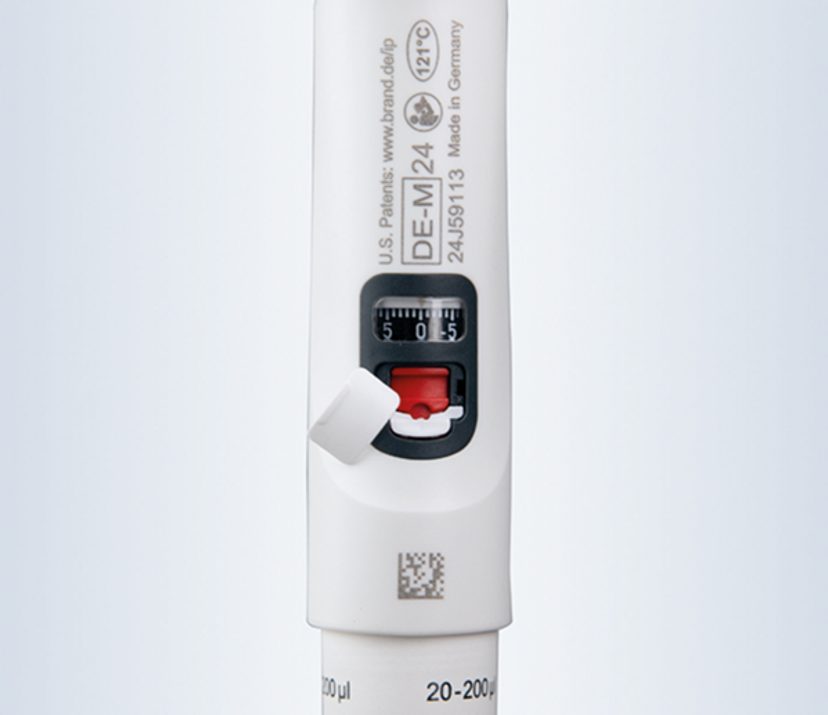
The Transferpette® pro ensures precise performance, even with changing liquid types, temperatures, or style of tips
Users can determine the required offset and direction of adjustment using an online calculator by entering the liquid’s density at ambient temperature and the average mass of the sample at the set volume, obtained through a gravimetric test. A volume adjustable table is also provided for those who wish to perform calculations manually after gravimetric testing.
“Then, you just pull down the red slider and adjust the setting using the volume wheel,” says Lampert. “Once you are done and want to return the pipette to factory settings, just you pull the red slider again and change the value back to zero.”
Having a simple, reversible adjustment feature built into the pipette enables users to quickly accommodate challenging liquids or varying conditions and create optimized settings for specific workflows. “Users can dedicate the Transferpette® pro pipette with User Adjustment settings to a specific workstation or workflow, or revert the settings within seconds for use in another task,” adds Lampert.
Unique pipetting features, universal benefits
Beyond situational calibration, the Transferpette® pro builds on the trusted features of the Transferpette® S, with added improvements in ergonomics and comfort. Among the most exciting updates, according to Lampert, is a rotating finger rest.
“The finger rest rotates through nine click positions, allowing users to adjust the grip angle to suit their preference,” she explains. “This not only improves comfort for both right- and left-handed users, but also enables them to customize their grip for maximum comfort during long pipetting sessions.”
This is something early adopters have already noticed. “We really like the new features; it felt like a more user-friendly pipette,” reported a molecular biologist working in a bioscience lab, feedback that Lampert says has been consistently echoed since launch.
Other features of the Transferpette® pro are simply designed to keep the pipette working better for longer. These include a smoother plunger action that reduces operating force, and integrated counter protection to prevent the volume dial from being turned beyond the pipette’s nominal range. This simple safeguard helps eliminate a common source of both instrument damage and silent miscalibration. It is complemented by a volume lock mechanism, ensuring that the set value remains fixed – so what the display shows is exactly what the pipette delivers.
Try the Transferpette pro for free
For scientists working with challenging liquids, seeking greater flexibility, or looking to reduce repetitive strain, the Transferpette® pro could offer a practical upgrade. And to help labs discover the difference firsthand, BRANDTECH is currently offering a demo program. One Transferpette® pro per lab can be requested free of charge, with no need to trade in an old pipette (for US and CA customers only).
“If you are looking to procure a new pipette or haven't considered another option in a long time, I strongly encourage you to take advantage of our Transferpette pro demo program,” says Lampert. “Once you feel the difference in your hands, you'll feel the value that the Transferpette line of pipettes brings.”