
Bruker introduces analytical and automation innovations at analytica 2026
Selected analytical systems and workflows based on mass spectrometry, NMR, SPR, X-ray analysis, nanoparticle tracking, and laboratory automation and software showcased in Hall A2, Booth 314
25 Mar 2026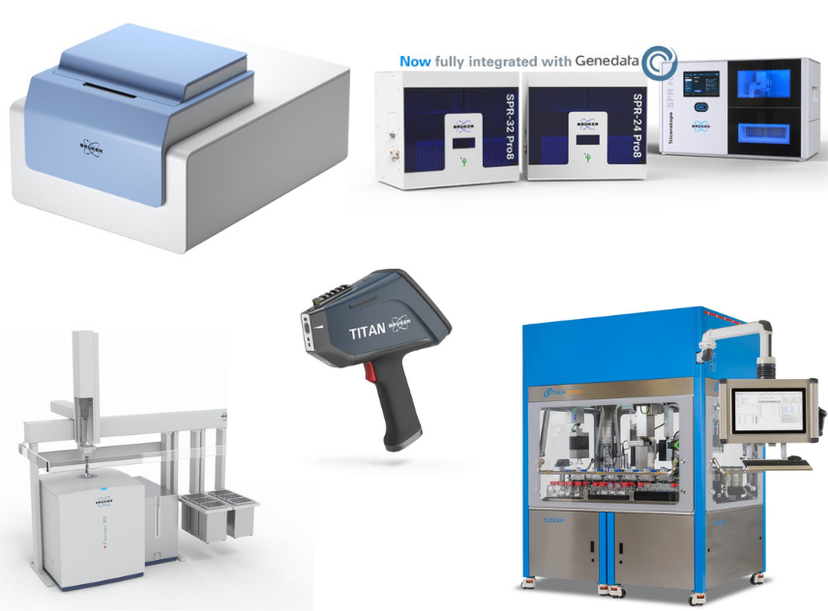
iNTApharma™, SPR Pro8 Series, Fourier 80 Automation Suite, TITAN XRF analyzer, and Chemspeed Flex EP
At analytica 2026, Munich, Germany, Bruker will highlight novel analytical systems and workflows for chemistry and life science research, applied, biopharma and industrial research and QC, including Chemspeed lab automation and SciY lab scientific and data management software.
A key biopharma highlight is the iNTApharma™ system for cell & gene therapy applications. The new iNTApharma is a label-free platform for quantitative characterization of nanoscale bioparticles in native aqueous media.
The system provides size and concentration measurements within minutes with single-particle sensitivity, without labeling or chemical modification.
Optimized for particles in the 50 to 300 nanometer range, iNTApharma is suitable for extracellular vesicle research, adenoviral and lentiviral vector analysis, as well as for the analysis of lipid nanoparticles used in nucleic-acid delivery. A built-in well-plate reader supports standard laboratory workflows, and iNTApharma can also resolve subpopulations in heterogeneous biological samples.
For chemistry laboratories, the expanded benchtop FT-NMR Fourier 80 Automation Suite supports labs processing more than 50 samples per day. The system supports 108 room-temperature positions, with options to 252 positions, plus optional cooling or heating, with barcode reading and user-defined waste handling. These permanent-magnet NMR capabilities improve throughput, repeatability, and method standardization while reducing errors and reruns in unattended batch workflows.
Bruker is also launching the affordable Fourier 80 Duo to offer 80 MHz resolution and sensitivity as an accessible new standard for benchtop proton-carbon FT-NMR in chemistry labs that so far have used 60 MHz systems.
The Fourier 80 Duo includes inverse g-¹H/¹³C capabilities with TopSpin software and gradient spectroscopy for research flexibility and analytical performance.
In applied and industrial settings, Bruker introduces TITAN, the next-generation handheld XRF analyzer for elemental analysis from magnesium to uranium. Designed for field use and production-floor environments, TITAN combines high-performance XRF with an operator-focused interface that includes smart workflows, reporting and connectivity features.
The TITAN system is used in industrial QC, materials ID, and regulatory screening, where reliable, traceable elemental results are required in demanding operating conditions.
The SPR Pro8 Series of surface plasmon resonance systems for biomolecular interaction analysis is available with 24 or 32 measurement spots, and up to 8 buffer conditions per run to streamline assay development and multi-condition screening. Integration with Genedata supports data management as well as consistent QC and analysis across instruments.
The Chemspeed Flex EP is an automated eluent-preparation workstation that prepares up to 16 different eluents in standard 0.5, 1 or 2 liter glass bottles with throughput of 60 to 120 liters per day.
The Flex EP handles organic and aqueous solvents as well as acid/base and solid components, and integrates pH measurement and adjustment, QR-code material verification, digital documentation, and LIMS connectivity to support consistent, compliant, and traceable operation.
The SciY Digitalization Suite advances lab workflow integration, automated data management, and AI-ready data use across R&D, QC, and manufacturing through a vendor-agnostic software environment. Within SciY, the ZONTAL platform automates the capture and centralization of data across the organization, helping make lab data Findable, Accessible, Interoperable, and Reusable (FAIR).
By applying a common metadata standard for instrument and analysis data and supporting enterprise ontologies, the ZONTAL platform helps to use lab R&D and QC data more effectively across AI and analytics workflows.