
Beyond creatinine: Why labs and clinicians should incorporate cystatin C for kidney assessment
28 May 2026
In this article, Gentian details why labs and clinicians should incorporate cystatin C for kidney assessment
Recent clinical guidelines for kidney management, e.g. KIDIGO 2024, and a growing body of evidence are driving broader adoption of cystatin C alongside creatinine testing in chronic kidney disease (CKD) care and medication dosing.
For decades, serum creatinine has been the standard biomarker used to estimate glomerular filtration rate (GFR), a key indicator of kidney function. However, it is known to be influenced by factors such as age, diet, sex, and muscle mass, which can limit accuracy in certain patient populations.
The growing role of cystatin C in international guidelines
Today, increasing clinical evidence and updated international guidelines support the use of cystatin C, either alone or in combination with creatinine, as a valuable biomarker for more accurate kidney function assessment.
Organizations including KDIGO, the National Kidney Foundation (NKF) and the American Society of Nephrology (ASN), the U.S. Department of Veterans Affairs, and the European Kidney Function Consortium, increasingly recommend the use of cystatin C to improve the accuracy and reliability of GFR assessment in selected patient populations1,2,3:
- Older adults
- Patients with low or high muscle mass
- Individuals with chronic illness or malnutrition
- Patients with obesity
- Cancer patients
- Transplant recipients
- Frail or hospitalized patients
Moving beyond creatinine with cystatin C – Expert webinar
With growing interest in cystatin C and expanded kidney function assessment, Dr. Alison Potok from the University of California discussed the topic in the webinar Beyond Creatinine: Integrating Cystatin C into Clinical Practice.
The webinar explores the biological basis of cystatin C, practical approaches to interpreting discordant eGFRcr and eGFRcys results, and how combined equations can support more informed clinical decision-making in kidney function assessment and medication dosing.
Understanding when to use cystatin C, and use it, can help clinicians identify kidney dysfunction earlier and more accurately.
Dr. Alison Potok University of California
When cystatin C adds value: Clinical scenarios from KDIGO
The recent KDIGO recommendations provide practical guidance on clinical scenarios where cystatin C may complement creatinine-based eGFR assessment.
The guideline update reflects a major shift in nephrology practice, highlighting how combined creatinine-cystatin C evaluation can improve confidence in kidney function assessment and support more individualized clinical decision-making across different patient groups and clinical scenarios.
Explore the KDIGO clinical scenarios table highlighting where cystatin C may improve kidney function assessment and support more informed clinical decision-making.
Overcoming barriers to broader adoption of cystatin C
While clinical evidence and guideline support for cystatin C continue to expand, adoption in routine practice remains variable due to factors such as awareness, workflow integration, and cost considerations.
Historically, limited testing volumes have contributed to disproportionately high calibration and control costs. As adoption increases and cystatin C testing becomes more integrated into routine clinical workflows, scalability is expected to improve, helping support wider access and more standardized use alongside creatinine in kidney function assessment and medication dosing.
Bringing cystatin C into routine clinical chemistry
As clinical interest in cystatin C grows, implementation on existing clinical chemistry platforms can support faster turnaround times, broader routine use, and improved accessibility for clinicians and patients. Increased adoption and higher testing volumes may also contribute to improved scalability and lower overall testing costs over time.
Since launching its cystatin C assay in 2006, Gentian Diagnostics has supported the clinical adoption and standardization of cystatin C testing. The Gentian Cystatin C Immunoassay received FDA 510(k) clearance in 2007 and contributed to the evaluation of the IFCC reference material ERM-DA471/IFCC in 2010.
Gentian’s cystatin C immunoassay is designed for turbidimetry-based clinical chemistry platforms and can be implemented as an open-channel assay on major clinical chemistry analyzers already used in routine laboratories.
- Avian antibody technology designed to reduce interference
- Compatible with major clinical chemistry platforms
- FDA 510(k) cleared since 2007
- CE-marked in compliance with IVDR 2017/746 (CE 0123)
- Global shipping, including distribution within the US
References:
1. Delgado, C., Baweja, M., Crews, D. C., Eneanya, N. D., et al. (2022). A Unifying Approach for GFR Estimation: Recommendations of the NKF-ASN Task Force on Reassessing the Inclusion of Race in Diagnosing Kidney Disease. American journal of kidney diseases : the official journal of the National Kidney Foundation, 79(2), 268–288.e1. https://doi.org/10.1053/j.ajkd.2021.08.003
2. Schwartz, A. R., Sosnov, J., Brown, J., Delgado, C., Fried, L., et al. (2026). 2025 U.S. Department of Veterans Affairs and U.S. Department of Defense Clinical Practice Guideline for the Primary Care Management of Chronic Kidney Disease. Annals of internal medicine, 179(3), 411–424. https://doi.org/10.7326/ANNALS-25-03499
3. Pottel, H., Björk, J., Rule, A. D., Ebert, N., Eriksen, B. O., et al. (2023). Cystatin C-Based Equation to Estimate GFR without the Inclusion of Race and Sex. The New England journal of medicine, 388(4), 333–343. https://doi.org/10.1056/NEJMoa2203769
Related products
Request Quote for All Products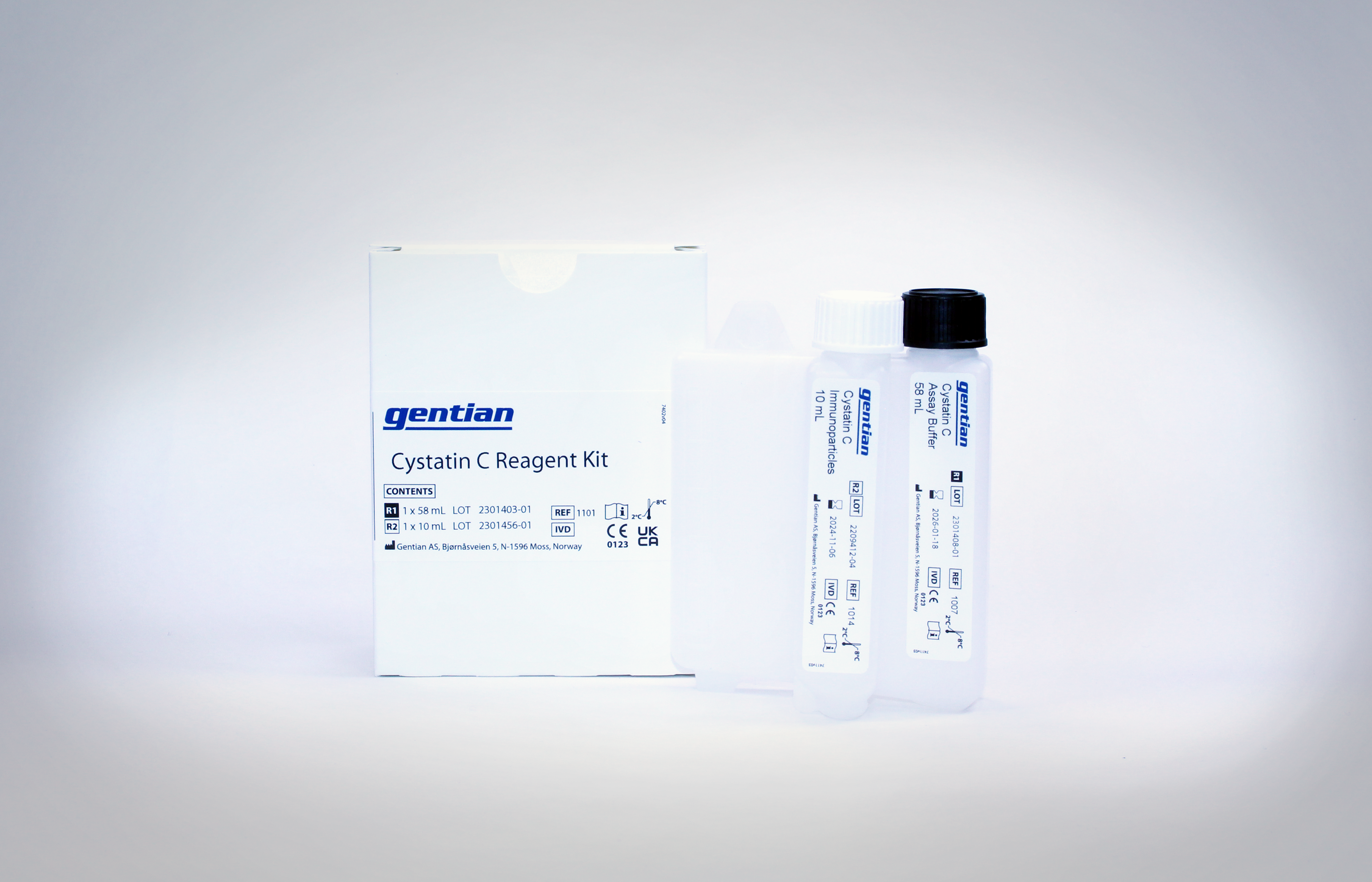
Gentian Cystatin C Immunoassay
Gentian DiagnosticsGFR marker for the diagnosis and therapeutic control of renal function and Chronic Kidney Disease (CKD)
Links
Tags
Frequently asked questions
Show frequently asked questions
How are KDIGO 2024 and other international guidelines influencing the use of cystatin C alongside creatinine in chronic kidney disease (CKD) management?
Recent clinical guidelines for kidney management, including KDIGO 2024, are driving broader adoption of cystatin C alongside creatinine testing in CKD care and medication dosing. While serum creatinine has long been the standard biomarker to estimate glomerular filtration rate (GFR), its accuracy can be limited by factors such as age, diet, sex, and muscle mass.
Updated international guidelines and a growing body of evidence now support using cystatin C, either alone or combined with creatinine, to improve the accuracy and reliability of GFR assessment. Organizations such as KDIGO, the National Kidney Foundation (NKF), the American Society of Nephrology (ASN), the U.S. Department of Veterans Affairs, and the European Kidney Function Consortium increasingly recommend cystatin C for selected patient populations, including older adults, patients with low or high muscle mass, individuals with chronic illness or malnutrition, patients with obesity, cancer patients, transplant recipients, and frail or hospitalized patients.
In which clinical scenarios does KDIGO recommend cystatin C to improve kidney function assessment and medication dosing?
The recent KDIGO recommendations provide practical guidance on when cystatin C may complement creatinine-based eGFR assessment to improve kidney function evaluation and support more individualized clinical decision-making. KDIGO highlights that combined creatinine–cystatin C evaluation can increase confidence in GFR assessment across different patient groups and clinical scenarios.
Cystatin C is particularly valuable in selected populations where creatinine may be less reliable, including older adults, patients with low or high muscle mass, individuals with chronic illness or malnutrition, patients with obesity, cancer patients, transplant recipients, and frail or hospitalized patients.
Understanding when to use cystatin C, and using it in these scenarios, can help clinicians identify kidney dysfunction earlier and more accurately and optimize medication dosing.
What role does Gentian’s cystatin C immunoassay play in supporting routine kidney function assessment and CKD care?
Gentian Diagnostics has supported the clinical adoption and standardization of cystatin C testing since launching its cystatin C assay in 2006. The Gentian Cystatin C Immunoassay, designed for turbidimetry-based clinical chemistry platforms, can be implemented as an open-channel assay on major clinical chemistry analyzers already used in routine laboratories.
It received FDA 510(k) clearance in 2007 and contributed to the evaluation of the IFCC reference material ERM-DA471/IFCC in 2010. The assay uses avian antibody technology designed to reduce interference, is compatible with major clinical chemistry platforms, is CE-marked in compliance with IVDR 2017/746 (CE 0123), and is available with global shipping, including distribution within the US.
As cystatin C testing becomes more integrated into routine clinical workflows, increased adoption and higher testing volumes are expected to improve scalability, support faster turnaround times, broaden routine use, and potentially lower overall testing costs in kidney function assessment and medication dosing.