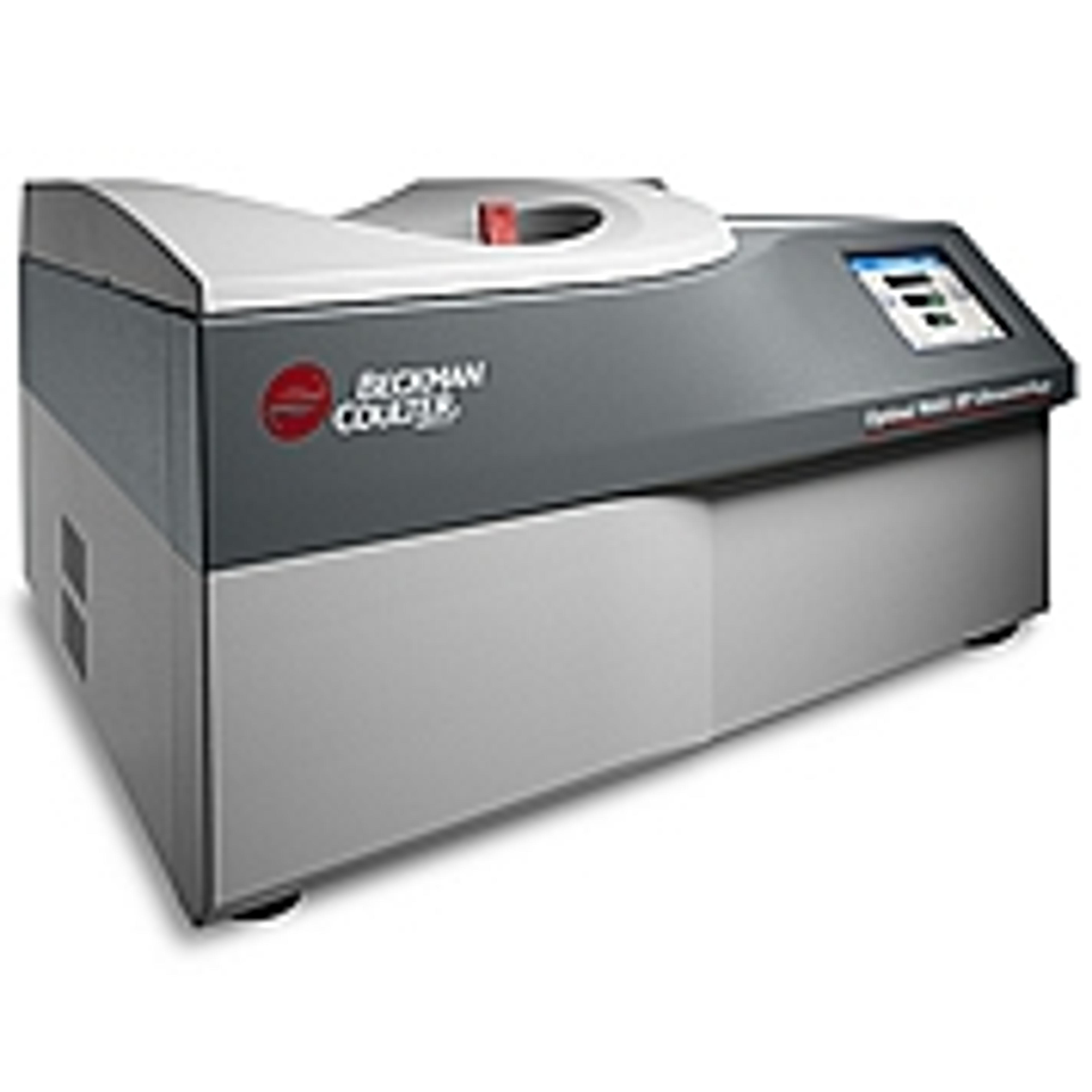
Beckman Coulter to Unveil Next Generation Analytical Ultracentrifuge at Analytica 2016
Optima AUC delivers enhanced optics and improved software to open new applications
12 Apr 2016
Beckman Coulter Life Sciences is to launch the new Optima AUC at this year’s Analytica: 25th International Trade Fair for Laboratory Technology, Analysis, Biotechnology and analytica conference, being held in Munich, Germany, from May 10-13, 2016. This next generation analytical ultracentrifuge has been developed with many enhanced capabilities.
The new Optima AUC is a fast, sophisticated and easy-to use analytical research tool. A 38.1 cm (15 inch diagonal), touch-screen display eases operation and boosts efficiency. In addition, modern, intuitive software enables simple run-monitoring and data exports performed either locally or remotely. The optics are contained outside the rotor chamber, making it easier to clean, and reducing the impact of the g-force on the optics.
As Chad Schwartz, Ph.D., the Product Manager explained: “The new Optima AUC returns analytical ultracentrifugation to the forefront of solution-state protein and particle analysis for accurate molecular weight determination, thermodynamics of associating systems, viral and nanoparticle payload characterization, and many additional emerging applications.”
Although analytical ultracentrifugation is a recognized technique for protein characterization, researchers have realized the technology’s value for characterizing a wide array of particles including peptides, polymers, metallic nanoparticles, liposomes and other non-biological materials. The Optima AUC allows molecules to float free and unbound so that researchers are able to characterize them in their native state.
Dr. Schwartz added: “Researchers are constantly pushing the boundaries of scientific advancements and require ever more precision and reproducibility from their instruments. The new analytical ultracentrifuge is the result of a successful collaboration with our customers. This latest offering continues Beckman Coulter’s commitment to innovation and provides users with the capabilities they seek to continue their research.”
This powerful technology determines molecular weight, size, shape, and polydispersity, and is capable of interactions between particles in a native, matrix-free environment. The new Optima AUC now allows multi-wavelength analysis.
“Rapid data acquisition coupled with reproducible and precise wavelength selections enable applications never before possible with AUC,” said Dr. Schwartz. Wavelength-specific monitoring now allows researchers to study complex systems easily and in a single experiment.”
Dr. Borries Demeler, University Texas Health Science Center, USA, singled out the following key technical innovations:
- New Rayleigh interference system for higher resolution for more precise measurements, higher data density and higher confidence in the results
- State of the art UV-visible absorption optics to provide reproducible wavelength selections, fast radial scanning for reduced temporal distortion, and sensitive detection in the far UV.
Commenting on their importance, he stressed: “For the first time, these advanced features enable revolutionary new multi-wavelength experiments, an entirely new class of experimental designs that can exploit the presence of multiple chromophores in complex mixtures through spectral decomposition.
“Coupled with the advanced high-performance UltraScan software, large multi-wavelength datasets can now be rapidly analyzed to separate particles in three dimensions, based on size, shape and unique spectral contributions. This will further enhance the unsurpassed power of this analytical technique to help investigators analyze solution properties of complex mixtures without the need for standards.”
The Optima AUC improves temperature control and increases data storage, wavelength precision, and wavelength repeatability, providing researchers the confidence needed for clean, reproducible data. Additionally, the instrument’s modular design allows for the development of new detection systems, opening up the possibility for unique detection capabilities.
Beckman Coulter has always been at the leading edge of centrifuge innovation and commercialized the first analytical ultracentrifuge in 1954. For more information on the Optima AUC visit info.beckmancoulter.com/OptimaAUC.
About Beckman Coulter Life Sciences
Beckman Coulter Life Sciences develops, manufactures and markets products that simplify, automate and innovate complex biomedical testing. For more than 75 years, our products have been making a difference in peoples' lives by improving the productivity of medical professionals and scientists, supplying critical information for improving patient health and delivering trusted solutions for research and discovery. Scientists use our life science research instruments to study complex biological problems including causes of disease and potential new therapies or drugs. For more information on Beckman Coulter Life Sciences, visit beckman.com.